


Article by
Jacob Nieuwenhuijze
Jacobus Nieuwenhuijze (CEO, and Founder of LR Consultants) is a senior energy executive with over 40 years of international experience across five continents and more than US$23 billion in successfully executed projects. He specialises in project initiation, concept development, front-end loading (FEL), CAPEX optimisation and project financing, transforming complex concepts into bankable business cases and high performing assets. His experience spans major greenfield and brownfield developments, with a proven track record in technical, commercial and strategic leadership across complex energy and industrial projects. Jacobus’s expertise in complex energy infrastructure projects has evolved into applying “Big Oil” execution rigor to the “Energy Transition”, where he currently leads decarbonisation and low carbon fuel developments, ensuring the next generation of energy assets are built on sustainable principles.
Executive Summary
Upstream oil and gas project transactions frequently present compelling headline valuations that mask unverified technical, commercial, and financing assumptions. Relying on headline internal rates of return (IRR) or static net present value (NPV) estimates without rigorously interrogating the underlying delivery plans creates significant exposure to post-acquisition capital calls, schedule slippage, and unfinanceable capital structures.
LR Consultants provides an integrated, senior-led mergers and acquisitions (M&A) advisory practice designed to stress-test the entire investment case before capital is committed. By bridging technical due diligence, commercial reality, and project financeability, we ensure that production profiles, capital expenditure (CAPEX) baselines, operational readiness, and export dependencies reflect a single, coherent narrative. Our advisory methodology aligns with four core pillars:
- Evidence Hierarchy and Project Scoping: Establishing an audit trail that isolates empirical operating and subsurface data from sponsor forecasts, distinguishing producing asset acquisitions from capital-intensive greenfield developments.
- Technical and Commercial Reconciliation: Stress-testing forecast production profiles, facilities interfaces, and milestone schedules against actual procurement lead times, export agreements, and fiscal terms.
- Downside Resilience and Debt Capacity Analysis: Interrogating project-finance metrics, specifically debt service coverage ratios (DSCR) and loan life coverage ratios (LLCR), under combined downside sensitivities to identify liquidity pinch points during ramp-up and decline.
- Bankability Gap Analysis: Converting disparate diligence findings into prioritised decision gates and transaction protections, establishing which issues require price adjustments, structural mitigations, or conditions precedent prior to financial close.
Introduction
What if an attractive upstream valuation rests on assumptions that the technical, commercial and financing evidence cannot support? Knowing what investors should examine before investing in an upstream oil and gas project means looking beyond headline returns to the evidence behind production forecasts, capital requirements and execution plans. Reserves and commodity prices matter, but investors also need to test whether the project information tells a consistent story and whether material downside risks can be managed.
This article sets out a practical framework for assessing the investment case. It connects the asset’s technical basis with development scope, capital expenditure (CAPEX), schedule, HSSE exposure, commercial assumptions and financing indicators, so investors can consider potential value alongside material uncertainties.
The review moves from project scope and evidence quality to cost and schedule confidence, operational and major-hazard risks, and the financial model’s resilience under alternative assumptions. It also explains how to prioritise diligence questions, define decision gates and distinguish project-specific risks from assumptions that can be tested or mitigated. The aim is a clearer basis for judging whether an upstream opportunity is credible as well as compelling on paper.
Key Takeaways
- Distinguish a new upstream development investment from an acquisition of a producing asset, then match the diligence evidence to the decision being made.
- Compare technical evidence with the production, CAPEX and schedule assumptions in the investment case. Identify mismatches that could affect value or delivery.
- Interpret debt service coverage ratio (DSCR) and loan life coverage ratio (LLCR) in context, tracing each result back to its assumptions and downside sensitivities.
- Use a staged diligence sequence to prioritise questions by their potential effect on the investment rationale, financeability and delivery risk.
- Connect the evidence review to financeability, key gaps and clear next steps, while keeping the investment decision with the investor.
What investors should establish about an upstream project before assessing returns
Before considering valuation or projected returns, establish what the investment actually comprises. An upstream development investment exposes capital to work that may include appraisal, development planning, facilities, infrastructure and the transition into operations. Acquiring a producing asset is different: the focus shifts to existing production, asset condition, operating performance and remaining development opportunities. Each case calls for different evidence and risk questions.
What investors should examine before investing in an upstream oil and gas project depends on the decision context. Is the investor considering an equity commitment, project-level financing, a farm-in or an acquisition? The answer affects which risks sit with the investor, who controls delivery and which assumptions drive the proposed returns. No single KPI or threshold establishes investment merit across projects with different stages, ownership structures, funding plans and risk profiles.
Clarify what is being financed and at which project stage
Define the project boundary before testing the economics. Identify the assets and work included, the current development stage, the sponsor’s responsibilities and the decision under consideration. Funding further appraisal is not the same as funding a defined development or acquiring an interest in an operating asset. The Petroleum industry overview and upstream sector provides broader context, but each opportunity must be assessed against its own scope and evidence.
Map dependencies that could affect delivery or value, including access to export infrastructure, processing or transport services, counterparties, and future investment or approval decisions. Record who controls each dependency, when it is needed and what the consequences could be if it is delayed or unavailable. This helps distinguish risks within the project boundary from external conditions that may still materially affect performance.
- Project stage: Establish what has been completed and which decision or funding is sought next.
- Ownership and control: Identify the sponsor, participating interests and relevant decision rights.
- Funding approach: Clarify whether capital is intended for development, acquisition or operations.
- Dependencies: List the infrastructure, services, counterparties and subsequent decisions required for the case to proceed.
Build an evidence hierarchy before interpreting the business case
Not all inputs deserve equal weight. Separate documented project evidence from management assumptions, third-party analysis and unresolved questions. For each material input, note its source, date, scope and limitations. A forecast is not established performance simply because it appears in a model; its technical and commercial basis needs to be clear.
Check that technical studies, development plans, commercial materials and financial models describe the same project. Differences in well count, production timing, facilities scope, infrastructure access or allocation of responsibilities can make apparently comparable outputs inconsistent. Record gaps explicitly, identify which assumptions need validation, and assess whether each gap could change the investment rationale, funding requirement or delivery plan.
This discipline creates a sound basis for further diligence. It prevents unverified assumptions from being presented as facts and directs attention to evidence that could materially change the decision.
Which upstream technical and commercial indicators shape the investment case?
The investment case is only as reliable as the link between project evidence and model inputs. Compare the production profile with the technical basis, then test whether development scope, cost estimates and schedule logic describe the same delivery plan. A forecast may appear robust in isolation but depend on facilities, export access or procurement timing that is missing from the cost plan or not reflected in first-production assumptions.
For investors assessing an upstream oil and gas project, the central test is traceability: can each material cash-flow assumption be linked to evidence, a defined decision or a clearly stated uncertainty? Estimates do not all need to be final, but their maturity and limitations should be visible. The effect of unresolved items should be assessed rather than hidden behind a single base case.
Test production, development scope and delivery assumptions
Review the production profile against available subsurface and development evidence, including the assumptions that shape well delivery, ramp-up and decline. Then reconcile that profile with the facilities and infrastructure required to handle and export production. Scope changes and interface issues can affect both capital needs and the date revenue begins, so challenge cost and schedule together.
Check the estimate basis, schedule logic and responsibility boundaries. If a project schedule assumes an export connection will be ready by a particular milestone, for example, establish whether that interface is included in the project scope, who controls its delivery and how a delay is reflected in the model.
Examine revenue, offtake and fiscal assumptions
Trace price, sales volume, quality and timing assumptions to relevant market evidence and, where applicable, offtake arrangements and counterparty commitments. Distinguish contracted terms from forecasts. Review how fiscal and contractual inputs are represented in the model, and verify the applicable jurisdiction-specific context against current authoritative sources. Do not assume that terms applying in one jurisdiction also apply in another.
Use the checks below to focus diligence on evidence and investment consequences, rather than treating each input as an isolated number.
- Production profile: Compare forecast volumes and timing with technical evidence. Which assumptions have the greatest effect on recoverable volumes and revenue timing?
- Development scope and CAPEX: Reconcile facilities, wells, infrastructure and interfaces with the estimate basis. Could omissions, scope changes or dependencies alter required capital?
- Schedule and first production: Test milestone logic against procurement, construction and external interfaces. How would delay shift expenditure and cash flow?
- Revenue and offtake: Link price, quality, volume and sales timing to market support or contractual terms. Which terms remain exposed to negotiation or counterparty performance?
- Fiscal and contractual inputs: Trace model treatment to the project’s applicable terms and jurisdiction. How would changes to those inputs affect cash flow and the investment conclusion?
Sensitivity analysis should show which assumptions could change the investment decision, not simply produce alternative outputs. A focused financeability and capital strategy review can bring model, CAPEX and risk assumptions into one prioritised assessment across Financeability, Capital Strategy, Transaction and Financial Close.
How should investors interpret project-finance KPIs and downside resilience?
Project-finance KPIs answer different questions. They are model outputs, not independent proof that an upstream investment is attractive or financeable. Their meaning depends on the cash-flow definition, timing, discount rate, financing structure and project assumptions. Trace each measure to these inputs and consider it alongside the underlying risks.
A useful way to assess an upstream oil and gas investment is to separate three judgements: whether the project generates value, what debt it may support, and whether it can repay that debt under pressure. A strong result in one category does not establish strength in the others.
Read returns and debt-capacity measures together
Net present value (NPV) estimates the value of forecast cash flows after discounting them at a selected rate. Project internal rate of return (project IRR) is the discount rate at which project cash flows have an NPV of zero, generally before financing effects. Equity IRR focuses on cash flows to equity after the modelled financing structure, so it can change with debt levels, repayment timing and financing costs. These measures are not directly interchangeable.
The debt service coverage ratio (DSCR) compares cash available for debt service in a period with the debt service due in that period. The loan life coverage ratio (LLCR) compares the present value of cash available for debt service over the remaining loan life with the relevant outstanding debt. Check model definitions and calculation conventions, particularly where cash-flow exclusions or discounting assumptions differ.
Neither ratio establishes debt capacity on its own. Review the repayment profile alongside the timing and reliability of project cash flows, then test whether technical, schedule, commercial and HSSE risks could affect those flows. A project may show attractive returns yet have constrained debt capacity if cash generation is delayed or repayment falls due before the forecast cash profile can support it.
Use sensitivities to expose dependencies, not manufacture certainty
Sensitivities show how results respond to changes in selected assumptions. They are decision tools, not forecasts, probabilities or guarantees of performance. Test project-specific changes in production, CAPEX, operating costs, first-production timing, revenue assumptions and financing terms. Where risks may interact, test relevant combinations as well as individual changes. A schedule delay alongside higher costs, for example, may affect both funding needs and the timing of cash available for repayment.
For each case, record the changed assumptions, the rationale and the model limitations. Identify which changes alter the investment conclusion, reduce debt capacity or create a funding gap. Distinguish manageable exposures from those that may undermine the project rationale. Avoid applying universal KPI thresholds without considering project stage, risk allocation and financing structure.
- Value: Test NPV and project IRR against changes to project cash flows and the discount rate.
- Equity outcome: Assess how financing assumptions affect equity IRR.
- Repayment resilience: Examine DSCR and LLCR across the repayment period and relevant downside cases.
Together, these measures give investors a clearer view of value, debt capacity and resilience, provided every result remains connected to its assumptions.
What diligence sequence helps investors challenge an upstream project case?
A disciplined diligence sequence turns reports and model outputs into a decision record. It also helps technical, commercial, financial, ESG and HSSE specialists address connected risks without commissioning overlapping reviews. The key is to link each finding to the assumptions it affects and the decision it could change.
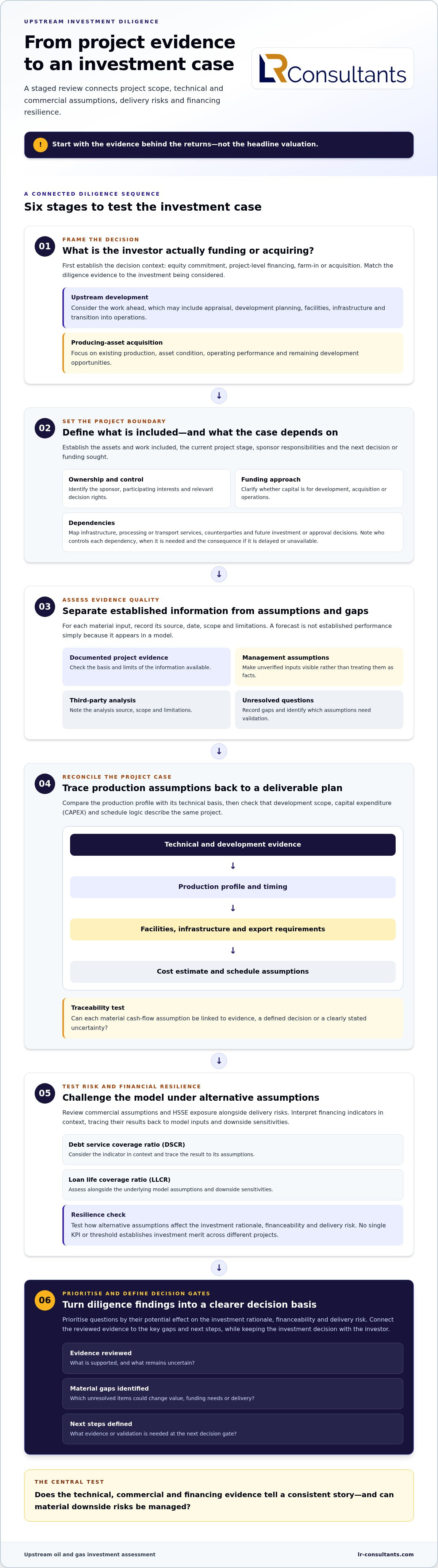
Investors can use the following structured sequence, adapting it to the project stage, transaction scope and proposed capital decision:
- Define the decision and scope. Confirm the asset or development under review, transaction boundaries, investor role, decision timetable and capital purpose. Set out the required workstreams and who owns each one.
- Establish the evidence base. Catalogue the key technical, development, commercial, financial, ESG and HSSE materials. Record source, date, scope and limitations so reviewers can distinguish evidence from assumptions.
- Test cross-workstream consistency. Compare technical production and development assumptions with CAPEX, schedule, revenue and financial-model inputs. Coordinate reviews around shared interfaces, such as export infrastructure, where one finding may affect several workstreams.
- Challenge the model and scenarios. Trace material inputs into the investment case, test relevant downside combinations and identify which findings could change valuation, funding needs or delivery feasibility.
- Agree the decision and actions. Convert significant findings into model updates, mitigation actions, further analysis, stage gates or explicit investment conditions. Record accountable owners and the evidence needed to close each action.
Prioritisation matters. Start with questions that could invalidate the investment rationale, materially affect financeability or disrupt execution. Then assess risks that can be mitigated through defined actions, dependencies that remain outside the sponsor’s control, and issues requiring further specialist analysis. This directs effort towards decision-critical uncertainties rather than treating every open item as equally material.
Move from diligence findings to a prioritised decision record
For each material finding, record the supporting evidence, affected assumption, potential consequence and accountable workstream. Classify the issue as a mitigable risk, an unresolved dependency or a matter requiring further specialist analysis. State how it should be addressed: update the model, complete an action, pass a decision gate or set an investment condition. This makes the reasoning traceable after the review.
Align due diligence with the capital decision
Match diligence scope to the proposed financing strategy and the information relevant to intended capital providers. Identify gaps that could delay transaction readiness or prompt further review, such as unclear risk allocation, unsupported cost assumptions or incomplete evidence on a material dependency. The aim is not to predict a provider’s decision, but to prepare a coherent, evidence-based project case.
LR Consultants’ project finance and capital advisory connects diligence findings with financeability, capital strategy, transaction coordination and preparation for financial close.
How a structured financeability review supports an informed investment decision
A financeability assessment is useful when an investor or sponsor needs to understand whether the project case is sufficiently coherent to support a capital decision, and which gaps need attention before investor or lender engagement. It can bring technical, commercial, cost, schedule and financing assumptions into one review, highlighting where evidence supports readiness and where further work is needed. It does not replace the investor’s judgement or guarantee funding.
For investors considering an upstream oil and gas project, a structured review turns diligence findings into prioritised actions. It can distinguish a model input that needs substantiation from a project dependency that needs an owner, or identify a gap that could affect transaction readiness. Conclusions should remain tied to the evidence reviewed, the assumptions tested and the limitations of the analysis.
Turn assessment findings into financeability actions
A Bankability Gap Analysis can organise findings against project readiness and set out a prioritised action plan. The practical questions are which gaps matter to the financing case, what action may address them, and what should be resolved before the next decision gate. This helps the sponsor focus effort on material issues instead of treating every open item as equally urgent.
Financing readiness may bring together financial model review, CAPEX and OPEX assessment, a project risk register and sensitivity analysis. Considered together, these elements help test whether the capital requirement, cash-flow case and identified risks are aligned. Findings can then inform a capital strategy and preparation for engagement with prospective lenders or investors, without implying that any particular financing outcome is assured.
LR Consultants’ PROJECT FINANCE & CAPITAL ADVISORY is organised around four connected pillars: Financeability, Capital Strategy, Transaction and Financial Close. As a strategic adviser, transaction coordinator and sponsor-side representative, LR Consultants can connect the project case, readiness actions and transaction process.
Set clear boundaries for the investment decision
Advisory analysis supports the decision; it does not make it. The investor or client retains responsibility for whether to proceed. A financeability review does not provide lending, funding approval or legal representation. A sound assessment states its scope, evidence base and limitations so decision-makers can see what has been tested and what remains uncertain.
That distinction matters in transaction planning. A review can identify actions, coordinate relevant workstreams and support preparation for financial close, but it cannot guarantee capital-provider decisions or eliminate project risk. Its purpose is to strengthen the basis on which those decisions are made.
Make the next investment decision evidence-led
The next step is to turn diligence into a clear decision pathway: determine which uncertainties need resolution, which actions can strengthen readiness, and what evidence is required before capital is committed. What investors should examine before investing in an upstream oil and gas project depends on the specific asset, transaction and investment decision, not a standard checklist or an isolated return metric.
For complex energy and infrastructure projects, LR Consultants provides senior-led, sector-specialist advisory that connects a defensible project case with a structured capital strategy. Its support can span financeability, capital strategy, transaction coordination and preparation for financial close, while leaving investment and funding decisions with the relevant parties.
If an upstream opportunity is approaching an investment or transaction gate, start a conversation with LR Consultants about project finance and capital advisory. A focused assessment can clarify priorities and establish a practical basis for the next decision.
Frequently Asked Questions
Can a technically viable upstream project still be difficult to finance?
Yes. Technical viability alone may not resolve concerns about cash-flow timing and reliability, cost uncertainty, contractual arrangements or the allocation of delivery risks. A development may have a credible production concept but depend on export infrastructure that is not yet secured. Investors should identify which conditions capital providers may need addressed and whether the sponsor has a credible plan to resolve them before financing discussions advance.
What does DSCR tell an investor about an upstream project?
DSCR helps show when scheduled debt repayment may come under pressure, particularly during the weakest coverage period. Compare periods consistently and inspect the underlying cash-flow timing rather than relying on an average that may conceal a shortfall. A low point around production ramp-up, for example, warrants scrutiny of repayment timing and the assumptions governing the start of revenue. The ratio is a prompt for investigation, not a standalone investment verdict.
How is LLCR different from DSCR in project finance?
LLCR gives investors a loan-life perspective, while DSCR can reveal pressure in a particular repayment period. Use both views to assess whether a tight period is isolated or part of a broader weakness across the debt term. Check that the loan-life calculation and period-by-period schedule use compatible cash-flow assumptions and dates. Differences in calculation scope can make comparisons between cases or financing structures misleading.
Should investors use one standard KPI threshold for every upstream project?
No. A threshold that appears suitable for one opportunity may be misleading for another with a different development stage, production profile, risk allocation or repayment structure. Assess KPIs against the project’s evidence and financing context, then examine how they behave under relevant downside cases. The decision should reflect the combined evidence and risk profile, not pass or fail on a single ratio.
What should an investor do when production or cost assumptions are uncertain?
Make the uncertainty explicit in the investment case. Identify its source, the evidence needed to narrow it and the decision it could affect. For example, separate a production assumption awaiting further technical support from a cost item dependent on scope definition. Model credible alternative cases, record their implications for capital needs and returns, and set a decision gate or action to address uncertainty that could change the investment rationale.
When should an investor commission a project financeability assessment?
Commission one when a project is approaching a material investment or financing decision and the sponsor needs a structured view of readiness, gaps and priorities. It can be useful before investor or lender engagement, after a material change to scope or capital requirements, or when diligence findings are difficult to reconcile. The assessment should have a defined scope and inform the investor’s judgement, not replace it or imply that funding is assured.
Partner with LR Consultants to Validate Your Next Upstream Acquisition
Navigating an upstream oil and gas acquisition, farm-in, or capital restructuring requires certainty that project value is backed by executable plans and resilient financing structures. LR Consultants acts as an independent strategic adviser, transaction coordinator, and sponsor side representative, ensuring your investment committee proceeds on defensible evidence rather than unhedged optimism.
If your organisation is evaluating an upstream project asset or preparing to engage debt and equity providers then contact the energy advisory practice at LR Consultants to schedule a preliminary transaction briefing with our senior leadership team. Ensure your capital deployment is built on verified evidence, disciplined risk allocation, and institutional credibility.
Validate the Asset. Stress-Test the Economics. Secure the Deal.


