


Article by
Jacob Nieuwenhuijze
Jacobus Nieuwenhuijze (CEO, and Founder of LR Consultants) is a senior energy executive with over 40 years of international experience across five continents and more than US$23 billion in successfully executed projects. He specialises in project initiation, concept development, front-end loading (FEL), CAPEX optimisation and project financing, transforming complex concepts into bankable business cases and high performing assets. His experience spans major greenfield and brownfield developments, with a proven track record in technical, commercial and strategic leadership across complex energy and industrial projects. Jacobus’s expertise in complex energy infrastructure projects has evolved into applying “Big Oil” execution rigor to the “Energy Transition”, where he currently leads decarbonisation and low carbon fuel developments, ensuring the next generation of energy assets are built on sustainable principles.
Executive Summary
Renewable energy project returns often rely on untested combinations of generation and financing assumptions, risking hidden cash-flow pressure. To secure investment, developers must integrate technical performance, offtake terms, construction delivery and debt structures into a single, traceable case, so that stakeholders understand what drives cash flow, how downside conditions affect debt capacity, and whether the project can withstand scrutiny.
Key Takeaways
- Connect the Entire Project System: Project finance modelling must connect technical, commercial, operational, and financing assumptions so that any change in one area—such as resource output—immediately and traceably flows through to debt-service capacity and investor returns.
- Anchor with Evidence, Not Defaults: Maintain a controlled assumptions register that identifies the source, owner, unit, date, and rationale for every material input. Distinguish documented project-specific evidence from generic market defaults.
- Rigorous Scenario Testing: Compare base, downside, and upside cases. Isolate cause and effect through single-variable sensitivities before combining risks (e.g., lower generation paired with delay and weaker merchant pricing) to evaluate true debt capacity under stress.
- Assertive Model Review: Establish trust by verifying formula integrity, timing alignment, and unit consistency across the development, operations, and financing timeline. An independent review is essential for uncovering hidden risks.
- Drive Financing Readiness: Use the model’s insights as an active roadmap to resolve "bankability gaps" and align technical, legal, and financial workstreams for transaction coordination.
For developers, sponsors and investors, the challenge is not simply forecasting revenue. It is understanding which assumptions drive cash flow, how downside conditions affect debt capacity, and whether the outputs can withstand scrutiny.
This article sets out a practical workflow: define project inputs, forecast generation and operating costs, model revenue and funding, and calculate cash available for debt service. It explains how to test sensitivities and combined scenarios, interpret measures such as DSCR and equity returns, and review a model for unsupported inputs or hidden risks. The aim is a transparent, reviewable financing case that supports decisions, not merely a spreadsheet that balances.
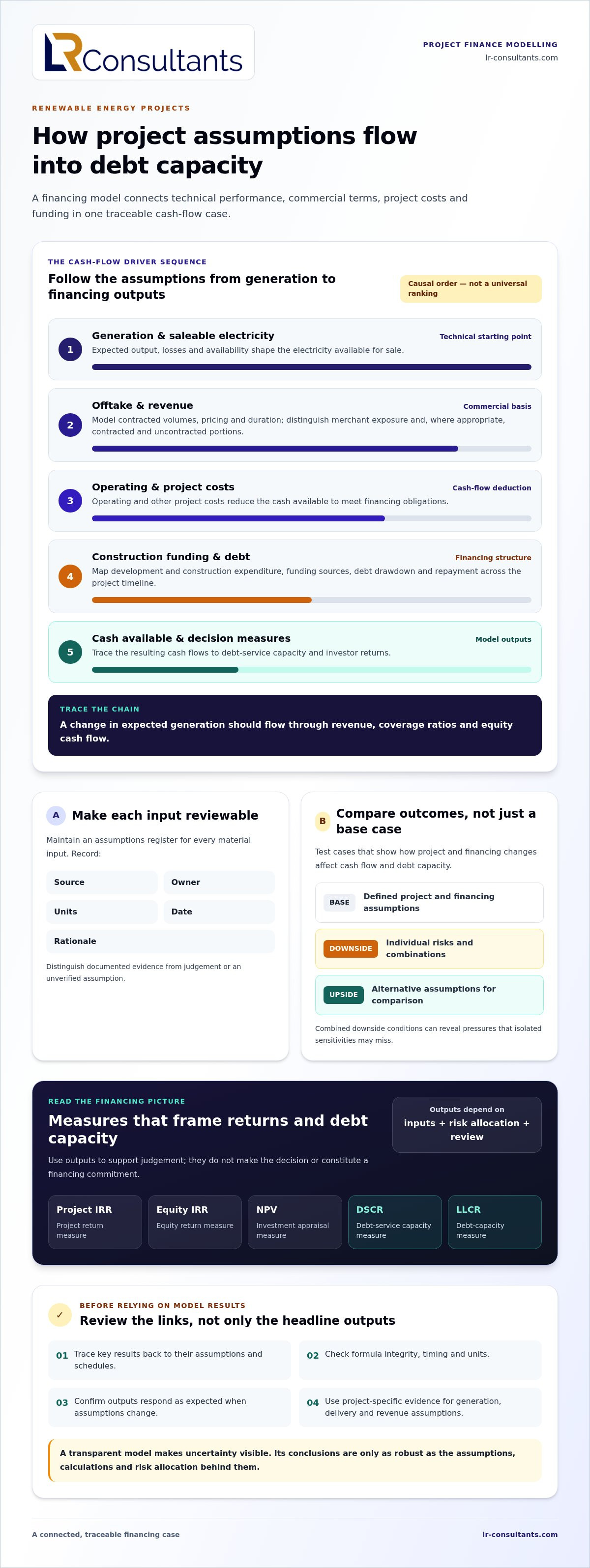
Project finance modelling for renewable energy projects should represent the project as a connected system. Technical and commercial assumptions drive operating cash flows, which in turn inform financing outcomes. The purpose is not to produce a single return figure. It is to show how assumptions translate into cash available to investors and lenders, and how that position changes when the project or financing structure changes.
A project finance model differs from an operating forecast. An operating forecast may estimate generation, revenue and costs. A financing model also maps development and construction expenditure, funding sources, debt drawdown and repayment, and cash flows available to equity. This integrated structure supports investment appraisal and financing readiness. The general role and structure of a Project Finance Model are also described in the reference literature.
Which decisions should the renewable energy financial model inform?
Tie each decision to explicit assumptions and outputs. A sponsor deciding whether to advance development can assess how resource estimates, delivery timing, operating costs and revenue arrangements affect project viability. During financing preparation, measures such as Project IRR (internal rate of return), Equity IRR, NPV (net present value), DSCR (debt service cover ratio) and LLCR (loan life cover ratio) help frame returns, debt-service capacity and the resilience of the proposed capital structure.
These measures support judgement; they do not make the decision or constitute a financing commitment. A model may indicate that a project is viable under defined conditions, but the conclusion depends on input quality, risk allocation and review by relevant parties.
What makes renewable project cash flow modelling distinctive?
Generation assumptions sit at the start of the cash-flow chain. Expected output, losses and availability influence saleable electricity. Generation should be expressed as probability-based estimates: the P50 case is the output expected to be met or exceeded with 50% probability, while the P90 case is the more conservative output expected to be met or exceeded with 90% probability. Revenue then depends on the offtake arrangements, and operating and other project costs reduce the cash available for debt service. Preserve these links so that a change in production can be traced through revenue, coverage ratios and equity cash flow.
Revenue modelling should reflect the project’s actual commercial structure. For a contracted project, such as one under a power purchase agreement (PPA), use inputs consistent with its offtake terms, such as contracted volumes, pricing and duration. A project exposed to merchant sales needs a distinct set of price and volume assumptions, with the resulting variability visible in cash flow. For hybrid structures, model contracted and uncontracted portions separately where appropriate.
There is no universal renewable model template. Relevant assumptions depend on technology, contract and project structure, as well as the development and financing plan. Use project-specific evidence for the generation profile, delivery arrangements and revenue basis instead of relying on generic market assumptions.
- Investment appraisal: test whether expected project cash flows support the sponsor’s stated investment criteria.
- Financing readiness: assess whether forecast cash flows can support proposed debt obligations under the stated assumptions.
- Scenario comparison: identify how changes to project design or commercial structure alter financial outcomes.
Model outputs inform decisions; they do not guarantee investment returns, lender approval or financial close. Their value depends on transparent assumptions, traceable calculations and a clear account of uncertainty.
How to build project finance cash flow modelling from project inputs
A disciplined build sequence makes a model easier to explain, update and review. In project finance modelling for renewable energy projects, schedules should follow the project’s development and funding logic rather than an assumed template. Start by defining the decisions the model must inform and the period it needs to cover. Then document inputs, build linked schedules, calculate cash flows and test whether outputs behave as expected.
- Define purpose: agree the investment, development or financing questions the model must answer.
- Document assumptions: record material inputs and their provenance in a controlled register.
- Structure schedules: separate technical, commercial, operating, construction and financing calculations.
- Calculate cash flow: link schedules to the project timeline, from development expenditure through operations and financing.
- Test outputs: trace key results back to assumptions and check how they respond to changes.
The assumptions register should identify each input’s source, owner, unit, date and rationale. It should also distinguish evidence from judgement: a documented resource assessment is different from an unverified planning assumption. Use project-specific evidence and relevant commercial inputs rather than importing defaults from another market. Information from the International Renewable Energy Agency (IRENA) can provide wider sector context, but it does not replace project-level technical or contractual evidence.
How should generation, revenue and operating assumptions be structured?
Keep the technical basis visible. Record the source and relevant date for generation, availability, losses and any degradation assumptions, then connect those inputs to the energy forecast. Model contracted offtake and merchant exposure as distinct revenue components, based on the project’s actual arrangements. Include operating costs and degradation only where project evidence supports them. Unsupported defaults can create false precision and distort cash flow.
How do construction and funding assumptions flow into cash flow?
Construction timing determines when expenditure is incurred, funding is drawn and operations, and therefore revenue, can begin. Link the schedule to the project’s development and delivery assumptions so a timing change flows through funding needs and the start of cash flows. Represent debt, equity and financing costs according to the project-specific capital structure. Repayment logic and other debt-schedule features should reflect the proposed funding arrangement, not assumed universal terms.
Once the schedules are linked, check that the model tells a coherent project story: inputs have evidence, timing is consistent, and financing outputs follow from forecast cash flows. LR Consultants’ capital advisory practice connects financing preparation across Financeability, Capital Strategy, Transaction and Financial Close.
How to test model assumptions, debt capacity and downside exposure
Testing should show not only how results change, but which assumptions cause the change. In project finance modelling for renewable energy projects, prioritise sensitivities according to project-specific uncertainty and potential cash-flow effect. A variance in resource or generation may affect both revenue and debt-service capacity. A construction delay can defer revenue and extend the period before operations begin.
Start with single-variable sensitivities to isolate cause and effect. Then combine assumptions into coherent scenarios. A downside case might pair P90 generation with weaker revenue and delayed completion, provided each change is plausible for the project. Do not treat every adverse movement as independent when risks are linked, or combine extreme assumptions without a defensible basis.
Which sensitivities matter in renewable energy project finance modelling?
Rank tests using evidence about uncertainty and exposure rather than applying a generic list. For each material input, record the case assumption, its basis and the resulting change in cash flow and financing outputs. Consider resource and generation, offtake and merchant revenue, operating costs, construction timing and financing terms. A single-variable sensitivity isolates one driver; a combined downside scenario tests how interacting risks may affect the financing case.
Base case
- Assumptions: The sponsor’s supported central estimates for generation, revenue, costs, delivery timing and financing.
- Outputs to compare: Project and equity returns, NPV, DSCR and LLCR.
Downside case
- Assumptions: Defensible adverse movements in selected project inputs, tested individually and in relevant combinations.
- Outputs to compare: Changes in returns, cash available for debt service, coverage over time and any periods of pressure.
Upside case
- Assumptions: Supported favourable conditions, without treating unverified improvements as established facts.
- Outputs to compare: Potential improvements in returns and coverage, and the assumptions on which they depend.
How should debt and equity outputs be interpreted?
DSCR compares cash available for debt service with scheduled debt service for a period. LLCR considers cash available over the remaining loan life in relation to outstanding debt. Both help assess debt-service capacity, but their interpretation depends on the modelled structure and the capital provider’s criteria.
Project IRR assesses returns at project level, while Equity IRR reflects returns to equity under the modelled funding structure. NPV expresses forecast value relative to the selected discount rate. Read these measures together: strong headline returns alone do not establish that debt can be serviced through weaker periods.
Debt capacity is not a universal percentage of project cost. It depends on forecast cash flows, timing, offtake and operating risks, the proposed financing structure and capital-provider requirements. Assess those criteria against the specific transaction rather than borrowing them from another project. Document scenario assumptions and results clearly so sponsors can see where a financing case is robust, where it is vulnerable and which inputs need further evidence.
How to review a renewable energy financial model before relying on it
A model review should establish whether calculations are sound, evidence is traceable and outputs are fit for the decisions under consideration. In project finance modelling for renewable energy projects, an attractive headline result is not enough. Reviewers need to follow material assumptions through linked schedules to cash flow and financing metrics. An independent review can expose inconsistencies that are difficult to spot when the model’s builder is also interpreting its results.
Review the model systematically, then document findings and their significance. A practical check should cover:
- Inputs: confirm material assumptions have a source, owner, date, unit and stated rationale. Identify unsupported estimates and unresolved data limitations.
- Formula integrity: inspect key formulas, copied ranges and calculation logic. Check sign conventions so inflows, costs and funding movements are treated consistently.
- Timing: verify that periods align across construction, operations, revenue and debt schedules. Confirm that start dates and cash-flow commencement are consistent with the project timeline.
- Units: check that energy, capacity, currency and time-period units are consistent, with conversions visible and correct.
- Outputs: reconcile summary results to supporting schedules and trace key metrics back to underlying assumptions.
What checks improve model integrity and traceability?
Separate hard-coded inputs from calculated outputs and label them clearly, so reviewers can distinguish assumptions from formula-driven results. Test whether linked schedules reconcile and whether changing a material input produces an intelligible effect throughout the model. Record the assumption owner, source, revision date and limitations. Maintain a controlled change log so reviewers can identify what changed, why it changed and which outputs were affected.
Reconciliation is essential. Revenue in the summary, for example, should agree with the relevant generation and offtake calculations, while debt balances should follow the drawdown and repayment schedules. A concise limitations section should state the model’s scope, key uncertainties, excluded items and any inputs awaiting stronger evidence. This helps decision-makers distinguish calculated outcomes from areas requiring judgement.
How should model review findings inform financing readiness?
Prioritise findings according to their relevance to cash flow, risk assessment and financing decisions. A unit inconsistency affecting projected generation may need immediate resolution; a documentation gap on a less material assumption may call for a different response. Link each finding to its affected schedule, output, owner and proposed action, then assess whether it changes the interpretation of the financing case.
Model review should sit alongside CAPEX and OPEX assessment, revenue and offtake analysis, and debt-capacity review. It supports decision-making, but does not assure financing, project performance or the accuracy of evidence that remains unverified. A structured review can also feed a Bankability Gap Analysis and prioritised action plan, helping sponsors focus further work on issues that matter to financeability.
LR Consultants’ financing readiness review can connect model findings with PROJECT FINANCE & CAPITAL ADVISORY across Financeability, Capital Strategy, Transaction and Financial Close.
How project finance modelling supports financing readiness and next steps
A reviewed model becomes more useful when its findings lead to clear actions. It can support a Bankability Gap Analysis by identifying where evidence, project definition or financing assumptions need further work, then help rank those gaps by their effect on cash flow, risk and financeability. The result should be a prioritised action plan, not simply a list of model corrections.
For sponsors, this creates a practical link between financial analysis and financing preparation. Model outputs can inform lender and investor discussions, while review findings help coordinate the technical, commercial, financial, legal, ESG/HSSE and stakeholder workstreams that contribute to the overall project case. Project finance modelling for renewable energy projects makes assumptions and their consequences visible. It does not itself secure capital or replace due diligence.
What should a financing-ready model package make clear?
Decision-makers need a concise account of the model’s basis and implications, not only a workbook. Supporting materials should set out the principal assumptions, case definitions, key outputs, sensitivities and material limitations. They should distinguish inputs supported by project evidence from estimates and show how changes affect investment and financing measures.
This analysis can inform an investment memorandum and due-diligence preparation by providing a consistent reference for the project’s financial case. It should align with the underlying technical design, commercial arrangements, cost estimates, delivery schedule and risk assessment. If a change in project scope appears in the technical information but not in the model assumptions, resolve that mismatch before relying on the outputs in external discussions.
When can project finance advisory add value to modelling?
Advisory input is useful when model findings need to inform financing strategy and be coordinated across a transaction. LR Consultants’ PROJECT FINANCE & CAPITAL ADVISORY is organised around four connected pillars: Financeability, Capital Strategy, Transaction and Financial Close. This can bring model review together with financing readiness, debt and equity structuring, and lender and investor engagement, while representing the sponsor’s interests and coordinating relevant workstreams.
This is a strategic advisory and transaction coordination role, not a capital-providing role. The model informs decisions; the wider assessment identifies what must be strengthened, evidenced or aligned as the project advances. Clear ownership of actions helps sponsors move from financial analysis to a coherent financing process without treating a favourable output as a commitment from a funder.
Learn about LR Consultants’ project finance and capital advisory for sponsor-side support connecting model findings with financing preparation.
Turn model findings into a clear financing path
Convert unresolved questions into decisions with clear ownership and timing. Sponsors can identify which evidence needs strengthening, which assumptions require approval and what information is needed before the next investment or financing milestone. This makes project finance modelling for renewable energy projects part of an active decision process rather than a static forecast.
Assign an owner to each priority issue and agree how its resolution will be reflected in the project case. This creates a disciplined basis for progressing the opportunity while keeping investment decisions grounded in the project’s current evidence.
A clear next step is to discuss project finance and capital advisory with LR Consultants, connecting model findings to the decisions and financing work ahead.
Frequently Asked Questions
What is project finance modelling for renewable energy projects?
It is a project-specific framework for examining how defined assumptions translate into financial outcomes. Its scope should state which assets, revenues, costs and funding arrangements are included, and how sponsor-level items are treated. This boundary matters when a project sits within a wider development portfolio: readers can distinguish project economics from corporate overheads or other assets, rather than attributing consolidated results to the individual project.
How is a renewable energy financial model different from a corporate model?
A project model isolates the economics of a defined asset or undertaking; a corporate model may combine several activities and financing sources. Before comparing the two, establish how shared services, central costs and sponsor contributions are allocated or excluded. This helps prevent corporate-level assumptions from distorting project-level performance and clarifies which figures relate to the project and which depend on the wider organisation.
Can a project finance model compare PPA and merchant revenue?
Yes. For a useful comparison, hold the underlying project configuration and generation basis consistent, then distinguish contracted output from volumes exposed to merchant pricing. Record contract-specific features, including volume or settlement conditions that affect receipts, separately from market assumptions. This makes the source of each revenue difference clearer and avoids presenting a blended result that hides the project’s actual exposure.
What does DSCR show in renewable energy project finance modelling?
DSCR indicates how forecast cash available for debt service compares with scheduled debt service in a given period. Review the period-by-period profile, not only a project-wide average: the timing of receipts and payments can reveal temporary pressure even where aggregate cash generation appears adequate. Also state how the model defines cash available for debt service, so the ratio can be interpreted consistently against the proposed financing structure.
How should battery storage be represented in a renewable energy project model?
Model storage using assumptions that reflect its intended operating strategy. Depending on the configuration, relevant inputs may include charging source, dispatch constraints, energy losses, degradation and any augmentation plan. If the commercial case depends on more than one revenue stream, show the assumptions for each and consider whether they can operate together under the proposed dispatch strategy. This helps avoid counting incompatible operating outcomes as simultaneous revenue.
Does a financial model prove that a renewable energy project is bankable?
No. A model cannot resolve evidence gaps outside its calculations. Forecast receipts may rely on contract terms that still require commercial review, for example, or expected output may depend on technical evidence that is still developing. A financing assessment should test whether key model inputs correspond to current project documents and workstream conclusions. The model is one part of the investment case, not a substitute for transaction due diligence.
How often should a project finance model be updated?
Set update points around material project decisions and transaction milestones rather than relying on a fixed universal interval. Before issuing a model for a new investment or capital-provider discussion, establish a reporting date and a clear assumption cut-off. Preserve the version used for each decision so later changes can be compared with the case reviewed at that point. This creates a reliable record of how the financial case developed.
How LR Consultants Supports Your Financing Path
A reviewed model is only as valuable as the actions it prompts. Through its Project Finance & Capital Advisory practice, LR Consultants helps sponsors connect model findings with transaction preparation across four integrated pillars:
- Financeability: Evaluating model assumptions against lender requirements and identifying bankability gaps.
- Capital Strategy: Structuring the capital stack and analyzing debt capacity.
- Transaction: Managing and coordinating due diligence and preparing transaction materials.
- Financial Close: Navigating financing negotiations to secure commitments.
By aligning your financial models with current project evidence, LR Consultants helps transform complex data into a clear, bankable path toward financial close.


