


Article by
Jacob Nieuwenhuijze
Jacobus Nieuwenhuijze is a senior energy executive with over 40 years of international experience across five continents and more than US$23 billion in successfully executed projects. He specialises in project initiation, concept development, front-end loading (FEL), CAPEX optimisation and project financing, transforming complex concepts into bankable business cases and high-performing assets. His experience spans major greenfield and brownfield developments, with a proven track record in technical, commercial and strategic leadership across complex energy and industrial projects.
A capital project stage gate process is one of the most critical governance controls available to owners, sponsors, and boards directing major upstream oil and gas developments. Yet across the international energy sector, multi-billion-dollar investments continue to encounter schedule blowouts, scope creep, and capital erosion. In many instances, the failure does not stem from an absence of governance meetings, but from a fundamental misunderstanding of what a stage gate is designed to accomplish.
A decision gate approval is not a sound investment decision simply because an executive committee has endorsed a slide pack or signed off on a milestone report. In capital-intensive energy projects, a stage gate creates genuine value only when each decision rigorously tests whether the scope definition, technical and subsurface assumptions, commercial frameworks, risk allocations, and delivery capabilities justify committing the next tranche of capital.
Each gate must answer an uncompromising question:
Is there sufficient, verified evidence to justify committing further capital, accepting heightened risk, and advancing the asset to the next development phase?
That distinction is decisive. Early commitments frequently gather organisational momentum long before subsurface, engineering, commercial, environmental, and financial workstreams have reached an equivalent level of maturity. Once capital expenditure ramps up, contracts are tendered, and commercial agreements are initiated, challenging the underlying development concept becomes exponentially harder—even when emerging data shows that the original investment thesis is deteriorating.
A well-structured oil and gas project stage gate process establishes an institutional pause. It creates a formal opportunity to test alternatives, verify design assumptions, expose unmitigated risks, and determine whether an asset remains technically viable and commercially competitive. This discipline is vital across every major milestone: Concept Selection, Front-End Loading (FEL), pre-FEED, detailed FEED, and the transition into execution at Final Investment Decision (FID).
Key Takeaways
- Capital Allocation Discipline: A capital project stage gate process exists primarily to protect capital allocation quality, ensuring projects advance based on verified maturity rather than calendar schedules or delivery momentum.
- Gates vs Milestones: A milestone records an event that has occurred; a stage gate determines whether the asset is justified in moving forward, pausing for remedial work, or stopping altogether.
- Integrated Decision Evidence: Robust decisions require the synthesis of subsurface, engineering, commercial, HSSE, financial, and execution data rather than isolated workstream summaries.
- Proportionate Governance: Stage gate requirements must scale with capital exposure, geological and technical complexity, and regulatory interfaces, preventing bureaucratic paralysis while maintaining rigorous scrutiny.
- Independent Assurance: Owner-side project assurance and stage gate reviews provide objective, unvarnished challenge to project assertions without displacing delivery accountability or substituting for contractor execution.
- Actionable Gate Outcomes: Governance forums must not treat gate approval as binary; decisions must produce clear determinations: proceed, proceed with binding conditions, pause for further definition, or terminate.
Why a Capital Project Stage Gate Process Matters from the Outset
An upstream oil and gas development progresses from exploration appraisal to operational production through a sequence of complex, irreversible commitments. Subsurface appraisal leads to reservoir modeling; reservoir models dictate production profiles; production profiles determine processing capacity and off-take infrastructure; and infrastructure scope shapes commercial agreements, regulatory approvals, and engineering contracts.
A disciplined capital project stage gate process provides the structural architecture for these interconnected decisions. It separates the project lifecycle into distinct, resourced stages where engineering and commercial definition is matured, separated by formal decision gates where stakeholders assess readiness before releasing subsequent funding.
This discipline is critical in the earliest phases of project development. Decisions made during concept framing and preliminary definition establish the cost baseline and operational parameters for the asset's operating life. If key subsurface uncertainties, fluid characterisations, export constraints, or fiscal regimes remain poorly understood, they inevitably become embedded in cost estimates, project execution plans, and procurement packages. By the time detailed engineering commences, rectifying foundational errors costs orders of magnitude more than resolving them during early definition.
What Changes Between a Project Stage and a Decision Gate?
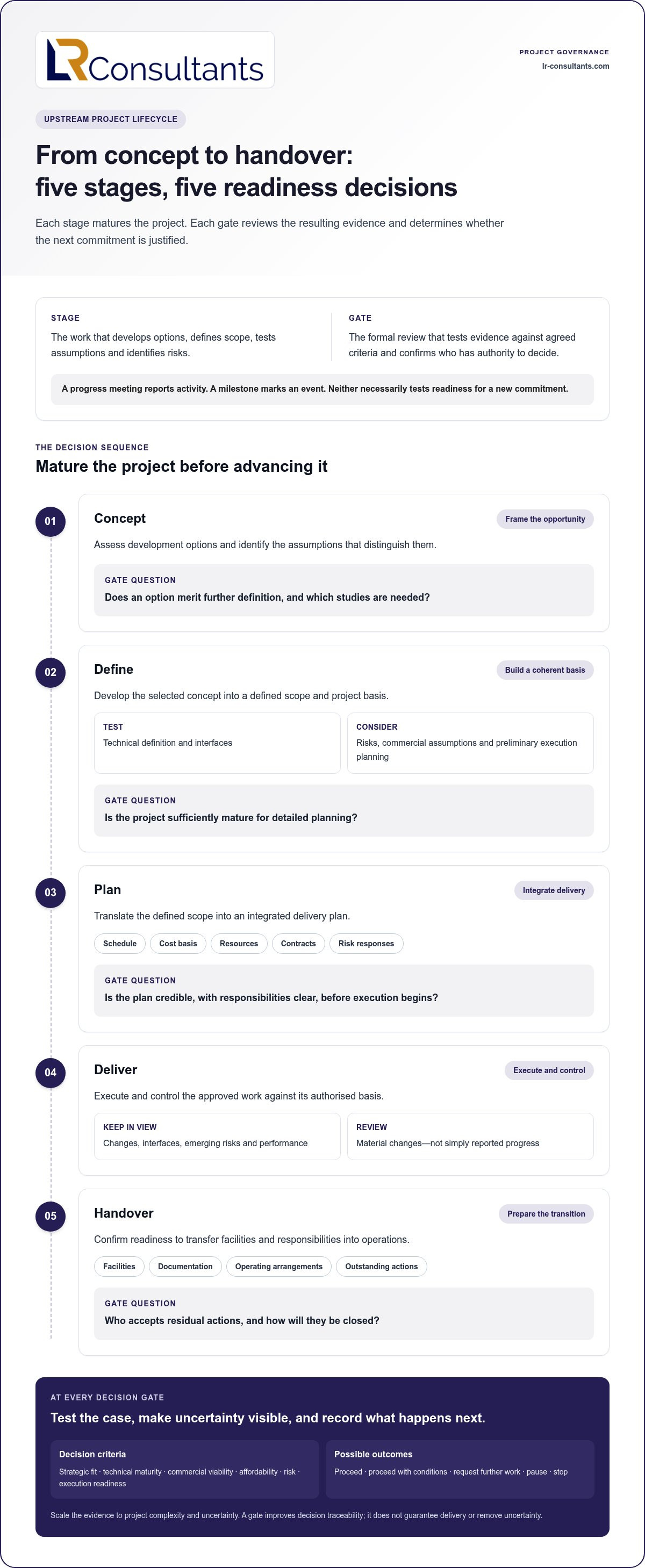
Project leadership often blurs the line between stage activities and gate decisions. Maintaining governance integrity requires keeping these two functions distinct:
- A Stage consists of the multidisciplinary work executed to mature the asset. It involves engineering studies, field development planning, environmental baseline surveys, market and commercial modeling, procurement strategy development, and risk identification. Its purpose is to generate technical and commercial clarity.
- A Gate is a discrete, independent decision point. It assesses the outputs of the stage against predefined readiness criteria. Its purpose is not to perform engineering, but to interrogate the quality of the evidence, evaluate residual risk, and determine whether the business case justifies further capital commitment.
A monthly project progress meeting tracks schedule performance, budget burn, and engineering deliverable counts. A gate review assesses whether the project is ready to take on substantial new risk. The phase-gate process as applied in capital-intensive sectors operates as a capital allocation filter, ensuring that unvetted risk is not passed into subsequent lifecycle phases.
Passing a gate confers formal authorisation to proceed into the next phase within an agreed budget and scope envelope. It does not guarantee delivery success, nor does it imply that external risks have vanished. Instead, it confirms that the known risks are quantified, the scope is sufficiently mature, and the residual uncertainty falls within the organisation's risk tolerance.
Why Early Project Decisions Deserve Disciplined Scrutiny
In upstream projects, early decisions establish the operational boundaries of the asset. The selection of an offshore development concept—such as a fixed jacket platform with dry trees versus a floating production storage and offloading (FPSO) vessel tied to subsea manifolds—fundamentally dictates the capital intensity, operating expenditure, reservoir drainage efficiency, and abandon cost profiles for thirty years.
A gate is a decision point supported by reviewed evidence, not a ceremonial endorsement of work already under way.
When decision-makers treat early gates as administrative check-boxes, projects succumb to premature commitment. Instead of asking whether the team has finished its planned tasks, investment committees and project boards must challenge the project across several dimensions:
- Subsurface and Reservoir Confidence: What range of uncertainty remains in the P10, P50, and P90 recovery estimates, and how flexible is the surface facility design if the reservoir behaves unexpectedly?
- Scope and Design Maturity: Is the process flow configuration based on reliable fluid samples, or are assumptions regarding sour gas, sand production, or wax appearance creating hidden exposure?
- Execution Deliverability: Are the proposed schedule assumptions grounded in actual supply-chain capacity, shipyard fabrication availability, and regional installation vessel constraints?
- Regulatory and Permitting Baselines: What environmental, stakeholder, and host-government approvals represent hard constraints before the next major expenditure phase?
- Decision Alternatives: What changes would trigger a review of the preferred concept, a project deferral, or a complete exit?
Uncertainty cannot be completely eliminated from upstream projects. Offshore drilling, complex processing facilities, and international logistics involve inherent unpredictability. However, a rigorous stage gate process ensures that uncertainty is made transparent, quantified within economic models, and paired with actionable mitigation strategies before funds are released.
Why Stage Gates Matter to Capital Investment
The primary purpose of a stage gate process is to protect the quality of capital allocation across an organisation's portfolio. In the energy industry, capital allocation failure rarely occurs overnight; it is the cumulative result of small, unchecked compromises across successive lifecycle phases.
The fundamental economic principle underpinning stage gate governance is the cost-of-change curve. During concept framing, modifying a field architecture, altering export pipeline routes, or changing gas-reinjection strategies requires altering engineering calculations or economic models. The financial cost is minimal, while the ability to create and preserve value is at its absolute peak.
Once a project reaches detailed engineering, procurement of long-lead equipment, and fabrication, changing design parameters requires physical rework, purchase order cancellations, vendor claims, and substantial schedule delays. By the time fabrication starts, 80% to 90% of the project's ultimate capital cost is structurally committed, even if only a fraction of the total cash has left corporate accounts.
Without rigorous stage gates, projects frequently succumb to the commitment trap. Once an organisation expends tens of millions of dollars on pre-FEED and FEED, an internal momentum develops that makes canceling, pausing, or reshaping the project politically difficult within the enterprise. Capital project stage gates serve as the institutional firewall against this momentum. They ensure that sunk costs are ignored in favour of forward-looking economic and execution fundamentals.
How the Stage Gate Process Works Across the Upstream Lifecycle
Upstream oil and gas assets typically progress through a structured Front-End Loading (FEL) framework. While corporate terminologies vary, the underlying progression follows five distinct phases: Concept Assessment, Concept Definition (Pre-FEED), Detailed Project Definition (FEED), Execution (EPC/EPCIC), and Commissioning into Operations.
Applying the same checklist across all gates is ineffective. The nature of the evidence, the degree of definition, and the focus of the review team must adapt as the asset matures from conceptual ideas to steel in the water. The Project Production Institute notes in its analysis of stage gate implications that rigid, bureaucratic gate implementations often impede project production systems if the criteria fail to address real execution dependencies.
Phase 1: Concept Framing and Selection (Gate 1 / FEL-1)
The objective of Phase 1 is to define the development opportunity, establish the strategic boundaries, and evaluate all credible development concepts to identify the single most viable option.
During this stage, multidisciplinary teams evaluate reservoir data, production decline curves, fluid compositions, facility concepts, export routes, and preliminary fiscal terms. The review compares various architectures: standalone platforms, subsea tie-backs to third-party hosts, floating production systems, or phased developments.
Gate 1 Decision Focus: Does the asset merit further investment in definition, and has a clear development concept been selected using sound technical, commercial, environmental, and risk criteria? Advancing past Gate 1 commits the organisation to funding Pre-FEED on the selected concept while standing down rejected alternatives.
Phase 2: Concept Definition and Pre-FEED (Gate 2 / FEL-2)
Once a concept is selected, Phase 2 matures the chosen option to demonstrate technical and commercial viability. This phase optimises the development architecture, confirms preliminary processing capacities, fixes facility locations, resolves major utility and export strategies, and initiates formal regulatory and environmental impact assessments.
During Pre-FEED, subsurface models are updated with appraisal data, early constructability reviews are performed, and commercial frameworks (such as gas sales agreements, host-government production sharing contracts, and transport tariffs) are established.
Gate 2 Decision Focus: Is the development concept sufficiently optimised and de-risked to justify the substantial capital commitment required for Front-End Engineering Design (FEED)? The gate review tests whether the design envelope is stable or if core scope questions remain unresolved.
Phase 3: Front-End Engineering Design to FID (Gate 3 / FEL-3)
The FEED phase is the crucible of capital project governance. The objective of FEED is to define the project scope, engineering details, procurement packages, commercial terms, and execution strategies with sufficient precision to establish a reliable cost estimate, a robust schedule baseline, and an executable EPC contract structure.
Phase 3 resolves technical interfaces, completes safety and process hazard studies (such as HAZID, HAZOP, and QRA), finalises equipment specifications, secures statutory environmental permits, and negotiates formal commercial off-take and joint-venture financing agreements. It culminates in the preparation of the Final Investment Decision (FID) package.
Gate 3 Decision Focus: Is the asset fully investable and executable? Gate 3 is the ultimate capital commitment point. Passing Gate 3 authorises the award of major Engineering, Procurement, and Construction (EPC) or EPCIC contracts, releases multi-year capital funding, and commits the organisation to project execution.
Phase 4: Detailed Engineering, Procurement, and Construction (Gate 4 / Deliver)
Following FID, the project transitions into execution. Detailed engineering transforms FEED packages into fabrication drawings; major equipment packages are manufactured and delivered; yards fabricate topsides, jackets, or modules; and offshore/onshore installation operations commence.
While execution is managed via integrated project controls, stage gate governance continues through intermediate hold-points and delivery gates (often structured prior to shipyard load-out, offshore installation campaigns, or major subsea connection programmes).
Gate 4 Decision Focus: Is the physical installation complete, verified against quality and safety standards, and ready for hydrocarbon introduction? Passing Gate 4 transitions the asset from construction into pre-commissioning and integrated systems testing.
Phase 5: Commissioning, Start-Up, and Handover (Gate 5 / Operate)
The final phase transitions the asset from the project delivery organisation to the operating asset team. It encompasses dry and wet commissioning, system energisation, hydrocarbon introduction, first oil/gas production, performance testing, and the formal resolution of punch lists.
Gate 5 Decision Focus: Are the facilities safe to operate, are operating management systems, safety cases, and asset integrity regimes fully operational, and has the operating organisation formally accepted care, custody, and control? Passing Gate 5 concludes the capital project lifecycle and integrates the asset into commercial operations.
Final Investment Decision: More Than Another Project Milestone
In the governance of capital projects, the Final Investment Decision is frequently mischaracterised as an internal celebration or a scheduled engineering milestone. It is neither. FID is an irreversible capital allocation decision.
Prior to FID, capital expenditure is limited to study teams, engineering service contracts, site surveys, and minor long-lead purchase commitments. Post-FID, the corporate balance sheet is exposed to massive capital drawdowns, complex multi-party commercial liabilities, fabrication risk, and strict statutory commitments.
Achieving FID readiness requires that three independent pillars reach maturity at the same time:
- Technical and Execution Maturity: Engineering definition must be complete to a level that prevents subsequent scope changes. In oil and gas facilities, this generally requires piping and instrumentation diagrams (P&IDs) to be frozen, plot plans fixed, constructability reviews executed, and major vendor data incorporated. Construction packages, logistics plans, and installation strategies must be fully vetted.
- Commercial and Financing Bankability: Joint venture agreements, unitisation frameworks, gas off-take contracts, pipeline access agreements, host-government fiscal arrangements, and third-party debt/equity terms must be fully drafted and executable. Lenders' technical advisers (LTA) must have completed their due diligence, confirming the project's risk-adjusted cash flows and debt service coverage ratios.
- Governance and Operational Readiness: Clear contract terms, robust dispute resolution mechanisms, comprehensive insurance placements, operations readiness teams, maintenance management baselines, and safety cases must be established and resourced.
If any one of these pillars lags, proceeding to FID exposes the project to the classic root causes of major project failure: awarding EPC contracts on immature engineering, signing commercial off-take deals with unachievable delivery windows, or mobilising construction sites before permits are secured.
Which Gate Criteria Make Capital Project Decisions More Robust?
To avoid subjective assessments, a capital project stage gate process relies on balanced, comprehensive evaluation criteria. In upstream projects, this demands examining strategic alignment, technical maturity, commercial feasibility, financial return, HSSE risk, and execution readiness together.
A positive return on investment cannot compensate for unresolved subsurface complexity or unpermitted environmental discharges. Similarly, perfect technical engineering is irrelevant if host-government fiscal terms render the asset unbankable. Gate criteria must reflect the decision context of the specific phase:
| Workstream | Gate 1: Concept Selection | Gate 3: Final Investment Decision (FID) | Gate 4: Construction to Commissioning |
|---|---|---|---|
| Strategic Fit & Portfolio | Asset aligns with corporate strategy, regional portfolio, and ESG/carbon intensity baselines. | Capital allocation approved within corporate capital expenditure plan; sovereign risk accepted. | Asset integration aligned with corporate production forecasts and market off-take schedules. |
| Subsurface & Technical | Appraisal data evaluated; credible range of reservoir models and fluid profiles established. | P&IDs frozen; FEED complete; equipment specifications final; 3D model reviews completed. | Mechanical completion verified; punch lists categorised; as-built engineering drawings signed off. |
| Commercial & Financial | Preliminary economic models indicate positive NPV/IRR under base and downside pricing scenarios. | Off-take agreements finalised; financing secured; Class 3 (+/- 10-15%) cost estimate established. | Operational budget (OPEX) finalised; spares procurement complete; revenue metering verified. |
| Regulatory & HSSE | Initial environmental screening; identification of critical path statutory approvals. | Environmental impact assessments (ESHIA) approved; major hazard safety case approved; permits in hand. | Operating permits active; pre-start up safety reviews (PSSR) closed; fire and gas logic verified. |
| Delivery Readiness | Broad execution approaches evaluated (EPC vs EPCm vs split-package). | EPC contract terms negotiated; supply chain capacity confirmed; detailed schedule baseline fixed. | Commissioning procedures approved; operations personnel trained and certified on-site. |
How Technical, Commercial, and Delivery Evidence Fit Together
The components of a stage gate evaluation package are deeply interdependent. Subsurface recovery rates and fluid compositions govern facility sizing and materials selection. Facility design drives weight and footprint, which determine whether fabrication can occur in local yards or requires transport from international facilities. Transport logistics and seasonal installation weather windows dictate the critical path of the project schedule.
In parallel, the schedule drives debt financing costs and gas off-take commitment dates. If technical engineering encounters delays, commercial off-take obligations may incur substantial financial penalties. A stage gate review must not review workstream packs in silos. It must evaluate the project as an integrated delivery system, testing how a schedule shift in engineering affects procurement lead times, cash-flow drawdowns, and operational readiness.
How Uncertainty and Changing Assumptions Affect Decisions
Throughout an upstream development's lifecycle, the external environment changes continuously. Oil and gas commodity prices fluctuate, service costs vary, geopolitical dynamics shift host-government policies, and local supply chains face disruption.
A resilient stage gate process explicitly isolates and tests the critical assumptions underpinning the business case. Review packages must move beyond deterministic base-case models to incorporate structured sensitivity analysis, probabilistic cost and schedule risk modeling (Quantitative Schedule Risk Analysis / Quantitative Cost Risk Analysis - QSRA/QCRA), and scenario planning.
Project leadership must clearly differentiate between two categories of evaluation issues:
- Evidence Gaps: Areas where necessary analysis, field testing, or commercial negotiations have simply not reached the required maturity. Evidence gaps can often be resolved through additional engineering studies or deferred via conditional gate approval with clear close-out timelines.
- Intolerable Risks: Conditions that threaten asset viability, personnel safety, regulatory compliance, or economic bankability—such as unresolvable facility integrity issues, severe structural fabrication defects, or severe reservoir underperformance. Intolerable risks cannot be bypassed with conditions; they require changing the design, postponing the commitment, or terminating the project.
Readiness depends on the quality and integrity of verified evidence, not on ticking boxes on an administrative checklist.
How to Design a Proportionate Stage Gate Process
Stage gate governance frequently receives criticism from project directors who feel it creates unnecessary bureaucracy, generating hundreds of pages of slide decks while slowing critical path decisions. When stage gates become an administrative compliance exercise, project teams focus on producing paperwork that passes the review rather than resolving actual execution risks.
To remain effective, a capital project stage gate process must be designed with proportionality. A greenfield deepwater development with complex subsea processing demands multi-tiered, independent assurance across every discipline. In contrast, a brownfield compression addition or an onshore pipeline loop should follow a streamlined governance structure reflecting its lower technical and capital risk.
Organisations can maintain proportionality by anchoring their governance design on core principles:
- Clear Decision Rights: The governance framework must explicitly identify which body has approval authority (e.g., Asset Team, Capital Projects Committee, Executive Leadership Team, or Board of Directors) and the limits of delegated financial authority.
- Focused Deliverable Packages: Gate submissions should prioritise exception reporting, critical decision roadmaps, interface registers, and risk exposure profiles over voluminous administrative reports.
- Evidence Maturity over Calendar Dates: Gate reviews should be scheduled around the verified completion of technical deliverables and commercial negotiations, not arbitrary calendar quarters. Holding a gate review when engineering maturity is demonstrably deficient wastes corporate effort and generates false assurance.
Who Prepares, Challenges, and Approves Gate Evidence?
Sound governance relies on the institutional separation of three distinct roles:
- Preparation (The Project Delivery Team): The project manager, engineering managers, commercial managers, and controls leads are responsible for developing the project deliverables, compiling the gate support package, and articulating the recommendation to proceed.
- Independent Challenge (Assurance & Peer Review): An objective, independent review team—comprising experienced technical, commercial, and project controls practitioners who have no stake in the project's schedule or compensation—evaluates the evidence, tests assumptions, and drafts an unvarnished readiness assessment.
- Approval (The Governance Authority): The executive committee, project board, or investment panel reviews both the project team's submission and the independent assurance report to render a formal, binding decision.
When the team that prepares the evidence also possesses the authority to approve the gate without independent challenge, governance is compromised. Internal cognitive biases, corporate optimism, and schedule pressures inevitably obscure emerging risks.
What Outcomes Can a Gate Decision Produce?
A well-run stage gate meeting does not simply rubber-stamp project momentum. The governance forum must have the institutional authority to deliver four potential outcomes:
- Unconditional Approval (Proceed): The submission satisfies all readiness criteria, critical risks are mitigated within acceptable tolerances, and the project is authorised to execute the next phase within its approved scope, budget, and schedule baseline.
- Conditional Approval (Proceed with Actions): The project may proceed into the next phase, but specific, non-critical evidence gaps must be closed by named owners within defined timeframes. Crucially, the authority to verify action close-out must be assigned to an independent party, not left to informal discretion.
- Deferral (Return for Further Work): Significant evidence gaps, unquantified risks, or commercial misalignments prevent an informed decision. The gate remains open, and the project team is directed to refine scope, renegotiate terms, or mature engineering, returning to the committee when verified criteria are met.
- Termination or Off-Ramp (Stop): The evaluation demonstrates that changes in reservoir performance, market economics, fiscal terms, or technical complexity have undermined the project's investment case. The project is formally paused indefinitely or abandoned, preserving capital for higher-value opportunities across the portfolio.
An organisation that never defers or stops a project at a stage gate does not have a governance process; it has an expensive administrative ritual.
How Independent Project Oversight Supports Stage Gate Decisions
Complex capital projects operate under intense schedule pressures and corporate scrutiny. Project delivery teams, committed to their project's success, naturally focus on solving daily engineering, procurement, and logistical hurdles. Under these conditions, emerging systemic risks can be inadvertently downplayed, treated as manageable operational variances rather than indicators of deeper project distress.
Independent project oversight provides boards, sponsors, and investment committees with an objective, experienced counterweight. An independent review team evaluates the health of the project, cutting through reporting optimism to test whether the underlying engineering, contractual, and controls baselines are robust.
Crucially, independent project oversight and assurance do not substitute for contractor execution or project management delivery. Contractors remain fully responsible for delivering their contracted scope of work, and the owner's project management team remains responsible for managing execution. Independent assurance strengthens client control, equipping decision-makers with the objective intelligence required to exercise their fiduciary and governance responsibilities.
What an Independent Gate Review Adds
Engaging independent specialists to conduct stage gate reviews and project assessments delivers measurable governance advantages:
- Unbiased Scrutiny of Baselines: Independent reviewers evaluate cost estimates, integrated master schedules, and risk registers against real-world benchmark data, exposing hidden optimism bias in deliverable productivity, fabrication turnaround times, and commissioning durations.
- Cross-Disciplinary Integration: External practitioners review how technical interface complexities (such as subsea-to-topsides controls, high-pressure/high-temperature metallurgy, or host facility tie-ins) align with the commercial structure and dispute mechanisms in the EPC contract packages.
- Verification of Operational Readiness: Independent reviewers trace whether the asset's design incorporates practical constructability, process safety management, maintenance accessibility, and operational handover requirements, preventing costly modifications late in the commissioning phase.
- Stakeholder and Lender Confidence: A gate review backed by independent, professional assurance provides co-venturers, investment boards, and commercial financing institutions with the documented confidence required to commit capital.
How LR Consultants Connects Gate Oversight with Project Delivery
LR Consultants provides senior-led, independent project management and technical-commercial advisory for complex energy and industrial capital investments. Guided by five foundational principles—Value-led, Risk-focused, Integrated, Controlled, and Independent—the firm supports asset owners, developers, and capital providers across the full project lifecycle, from early feasibility through execution and operational handover.
Operating across its specialized service lines—including Project Management Services, Integrated Project Controls, and Assurance Services—LR Consultants brings structured clarity to project governance. Engagements can cover a single phase gate review, a targeted work-package evaluation, or end-to-end owner-side oversight across the lifecycle phases of Concept, Define, Plan, Deliver, and Handover.
Through services such as Phase Gate Reviews and Decision Support and objective Project Health Checks, LR Consultants assists client leadership in evaluating technical maturity, interrogating schedule baselines, reviewing contractor procurement interfaces, and confirming operational readiness. The focus remains steadfast: preserving client control, enhancing decision quality, and turning complex energy projects into investable, executable, and sustainable operating assets—without ever encroaching upon or substituting for the contractor's execution responsibilities.
To explore how senior-led assurance can protect your next major capital commitment, explore LR Consultants' project management approach.
Frequently Asked Questions
Can a capital project stage gate process be tailored to different project scopes?
Yes. The stage gate process must be scaled to the asset's specific capital exposure, technical complexity, environmental sensitivity, and operating environment. While a major greenfield offshore development requires comprehensive, multi-tiered gate documentation across every discipline, an onshore brownfield debottlenecking project can utilise a streamlined governance model focusing on operational interfaces, shutdown windows, and tie-in integrity. The underlying discipline remains identical: define the decision required, assemble verified evidence, evaluate critical assumptions, and document accountable decisions.
What happens when project assumptions change significantly after a gate approval?
If a material change occurs following gate approval—such as a major shift in commodity pricing, an adverse appraisal well result, a sharp escalation in supply-chain fabrication rates, or host-government fiscal changes—the project must not proceed blindly under the obsolete approval. The project team must evaluate the impact against the authorized baseline. If the variance breaches approved governance thresholds, the project should trigger an out-of-cycle review or return to the governing body for re-authorisation under a revised business case.
Is a stage gate process suitable for brownfield modifications?
Brownfield projects benefit significantly from stage gate governance, though the focus of the criteria shifts. For brownfield modifications, gate reviews prioritise the accuracy of existing asset engineering documentation, hot-work safety constraints, shutdown scheduling, space and weight allowances on existing structures, simultaneous operations (SIMOPS) risks, and structural/piping integrity. The process prevents teams from committing to fabrication before offshore surveys and laser scanning have verified physical site realities.
Can engineering work proceed while gate actions remain outstanding?
Under a conditional approval ("proceed with actions"), specific, authorized engineering activities may continue within strict budgetary and scope boundaries. However, clear hold-points must be established. If an outstanding action directly affects core design assumptions—such as finalizing environmental discharge limits or verifying fluid corrosive properties—downstream engineering that depends on that data must be placed on hold until the condition is formally closed by the appointed authority.
How should a project team manage a gate approval with multiple conditions?
Every condition attached to a gate decision must be formally documented in a gate decision log. Each action must have an assigned individual owner, a clear, measurable definition of what constitutes completion, an explicit delivery deadline, and an independent verification authority. Open conditions must be tracked within the project controls reporting system, and any failure to close a critical condition before its hold-point must trigger formal escalation to the project board.
Do stage gate reviews replace the day-to-day role of project controls?
No. Project controls and stage gate reviews perform complementary but distinct functions. Project controls operate continuously during a stage, monitoring schedule progress, cost accruals, change orders, productivity metrics, and emerging risks. Stage gates are periodic, macro-level governance events that utilise project controls data to evaluate whether the overall asset remains viable, financeable, and ready to take on its next major phase of commitment.
How can an organisation prevent stage gates from slowing project execution?
To avoid delivery bottlenecks, gate reviews must be integrated directly into the project's integrated master schedule from project initiation. The gate review should be scheduled based on the verified completion of substantive stage deliverables rather than arbitrary calendar dates. Furthermore, decision packages must focus on exception reporting and critical risk trade-offs, and governance committees must be empowered to render definitive determinations without delegating decisions to further ad-hoc review panels.
Make the Next Project Decision More Deliberate
Major upstream developments succeed or fail by the quality of the decisions made before capital is committed to the field. By treating stage gates as deliberate, evidence-based tests of project maturity rather than administrative approvals, owners and investors can reliably identify design flaws, align complex commercial arrangements, and protect balance sheets against capital destruction.
Before advancing your asset to its next major lifecycle transition, verify that your project governance is operating as an effective capital filter. Interrogate your underlying assumptions, demand independent challenge to your cost and schedule baselines, and ensure that every capital commitment is grounded in rigorous, verified project maturity.
For independent, owner-aligned support designed to safeguard your major investments, contact LR Consultants.


