


Article by
Jacob Nieuwenhuijze
Jacobus Nieuwenhuijze is a senior energy executive with over 40 years of international experience across five continents and more than US$23 billion in successfully executed projects. He specialises in project initiation, concept development, front-end loading (FEL), CAPEX optimisation and project financing, transforming complex concepts into bankable business cases and high-performing assets. His experience spans major greenfield and brownfield developments, with a proven track record in technical, commercial and strategic leadership across complex energy and industrial projects.
What keeps an oil and gas project aligned when scope, schedule, cost and technical risk are all under pressure? It is not a single control document or delivery team. Project management for oil and gas projects depends on clear ownership and connected decisions across engineering, procurement, construction, commissioning and operations.
For project decision-makers, the challenge is to maintain that alignment as a project moves from definition into execution and handover. Schedule or budget pressure can influence choices with consequences for scope, HSSE and long-term operability. Recognising these connections early helps teams make informed trade-offs without losing sight of the approved objectives.
This article explains the key project phases and the decisions required at each, from defining scope and engineering requirements to managing commercial controls, risk and operational readiness. It also shows how integrated oversight can make emerging issues more visible and support a prepared handover. The focus is practical: how disciplined governance connects technical delivery with commercial priorities throughout the project lifecycle.
Key Takeaways
- Clear ownership across engineering, procurement, construction and operations helps keep project scope and delivery decisions aligned.
- Lifecycle decision gates test readiness before a project moves from definition and feasibility into execution and handover.
- Integrated controls bring scope, schedule, cost, quality and risk information together to support better-informed decisions.
- A practical sequence is to clarify outcomes, assess project maturity, assign accountability and tailor governance to the project’s scale and complexity.
- Project management for oil and gas projects connects strategic objectives with delivery controls and operational readiness.
What project management for oil and gas projects must bring under control
Project management for oil and gas projects coordinates scope, schedule, cost, quality, risk and interfaces to deliver approved objectives and prepare the asset for operation. It connects technical work with commercial decisions and operational requirements. It is not simply the administration of tasks or progress reports. These Project Management Principles need to be applied to the engineering and operating context of each asset.
Project management training develops an individual’s knowledge and capability; project delivery management governs a particular project. It establishes who makes decisions, how workstreams depend on one another, how changes are controlled and how risks are escalated. Training may support people in these roles, but it does not replace project-specific governance, integrated planning or clear accountability.
What makes oil and gas project delivery complex?
Engineering, procurement, construction and commissioning are interdependent. A change to a technical requirement can affect equipment orders, construction sequencing, testing and the date an asset is ready to operate. Project controls should therefore make dependencies visible rather than treat each discipline’s plan as a separate commitment.
Existing facilities add further constraints. Access, operating procedures, equipment condition and the need to maintain ongoing operations can shape work sequencing and shutdown planning. The context also varies: upstream developments, midstream transport and processing assets, and downstream facilities have different configurations and interfaces. The management approach should reflect the asset and delivery model, not assume one standard plan fits every project.
Which outcomes should project management align?
Delivery decisions should remain anchored to approved objectives. Scope defines what the project must provide; schedule and budget frame the authorised plan; and quality criteria establish what will be accepted. These controls need to be considered alongside HSSE, technical integrity, risk and operational readiness. For example, assess a schedule recovery proposal not only for its effect on dates but also for its implications for work sequencing, quality requirements and readiness to operate.
Sponsors can make these trade-offs more disciplined by defining acceptance criteria and decision rights early. Teams need to know who approves scope changes, who accepts technical deliverables and who determines whether handover requirements have been met. Clear accountability helps distinguish a controlled change from an unapproved shift in objectives, while giving decision-makers a shared basis for weighing delivery pressures against asset performance and safe operation.
How project management governs the oil and gas project lifecycle
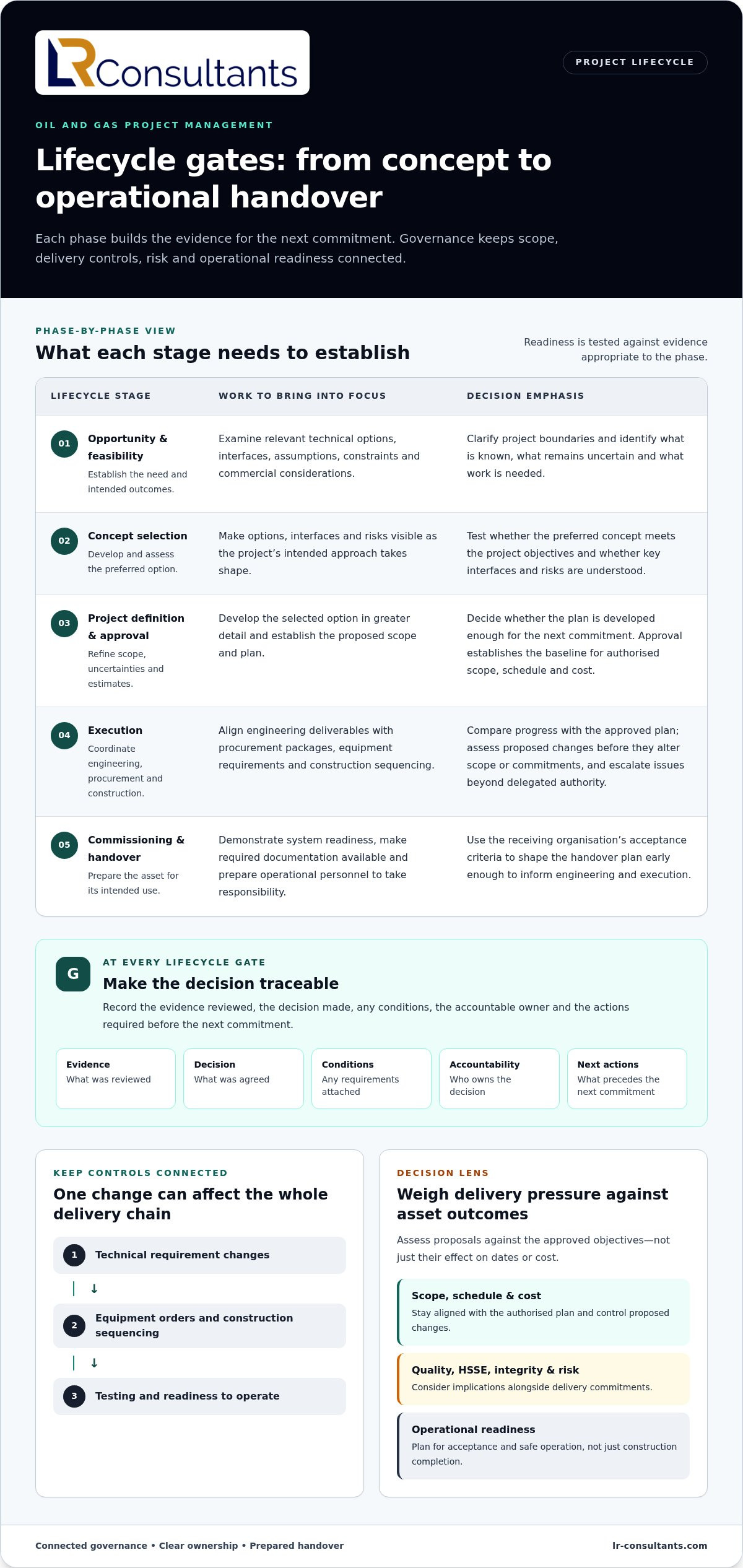
Lifecycle governance provides a sequence of decisions, not just a schedule of activities. In project management for oil and gas projects, the route typically runs from opportunity definition and feasibility through concept selection, project definition, approval, execution, commissioning and handover. The sequence should reflect the project’s context and delivery model. Its purpose is to test whether the case, scope and evidence are mature enough for the next commitment.
From concept selection to an approved project baseline
Early work establishes the need for the project, its intended outcomes and its boundaries. Feasibility examines relevant technical options, interfaces, assumptions, constraints and commercial considerations. As definition advances, selected options are developed in greater detail, uncertainties are made visible, and scope and estimates are refined. This progression helps decision-makers distinguish what is known from what remains uncertain and identify the work needed before authorising delivery.
A decision gate should test readiness against evidence appropriate to that phase. A sponsor can consider whether the preferred concept meets project objectives, whether key interfaces and risks are understood, and whether the plan is developed enough for the next decision. Approval establishes a baseline for monitoring authorised scope, schedule and cost. It does not mean every detail is fixed: proposed changes should be assessed, approved and recorded against the agreed objectives.
From execution to commissioning and handover
During execution, engineering deliverables need to support procurement packages, equipment requirements and construction sequencing. Progress monitoring compares actual status with the approved plan, while change control assesses proposed changes before they alter scope or commitments. Issues that exceed delegated authority or threaten key objectives need a defined route for escalation and resolution.
Commissioning and handover should be planned as delivery work, not left until construction is complete. The project needs to demonstrate that systems are ready for their intended use, required documentation is available and operational personnel can take responsibility for the asset. The receiving organisation’s acceptance criteria should shape the handover plan early enough to inform engineering and execution.
At each lifecycle gate, record the evidence reviewed, the decision made, any conditions, the accountable owner and the actions required before the next commitment. The Department of Energy Project Management provides a reference for the role of performance baselines in formal project oversight. Its guidance offers a point of comparison, not a substitute for project-specific governance.
How integrated controls improve oil and gas project decisions
Integrated controls connect scope, schedule, cost, quality and risk information so leaders can see how a change in one area affects the others. A procurement delay, for example, may affect construction sequencing, commissioning activities and forecast completion. Reporting each issue in isolation can obscure these dependencies and leave decision-makers without a reliable view of the project’s position.
More reporting alone does not create stronger control. The value comes from consistent information, clear ownership and a defined route from variance to decision. Useful project controls make emerging variance visible early enough for an accountable owner to assess its impact and act.
Fragmented reporting and integrated controls
| Fragmented reporting | Integrated, decision-oriented controls |
|---|---|
| Discipline updates use different assumptions or reporting periods. | Scope, progress, forecast and risk data are aligned to a common baseline and status date. |
| Variances are recorded without a clear owner or decision route. | Each material variance has an accountable owner, impact assessment and escalation path. |
| Changes are tracked separately from schedule, cost or quality effects. | Change records show implications for approved objectives and identify the required decision. |
| Reports describe status but leave leaders to infer what needs action. | Decision registers capture approvals, actions, owners and outstanding matters. |
Which project controls help leaders act early?
A practical control set includes an approved scope, schedule and cost baseline; measured progress against planned work; current forecasts; change records; and a decision register. Variance analysis should explain what differs from plan, why it differs, what it may affect and who is responsible for proposing or approving a response.
Reporting cadence and escalation thresholds should reflect project governance. A developing issue at a critical interface may need attention sooner than a minor variance within a team’s authority. Clear thresholds help prevent both late escalation and unnecessary referral of routine decisions to sponsors.
How do interfaces, HSSE and technical risk connect?
Controls should show dependencies between engineering deliverables, procurement, contractors, construction and operations. A design change, for instance, could affect equipment specifications or installation sequencing. On a project within an operating facility, it may also require reassessment of access or work planning. These examples depend on the project context and are not risks common to every project.
HSSE and technical risk reviews are most useful when they inform planning and change decisions. If a proposed recovery measure changes work sequencing, the relevant teams can assess its safety and technical implications alongside schedule and cost effects. This connection helps leaders make trade-offs with a clearer view of delivery consequences.
How sponsors can strengthen project management for oil and gas projects
Sponsors strengthen delivery by fitting governance to the project, rather than adding process for its own sake. Start by clarifying intended outcomes, assessing project maturity, assigning decision accountability and checking whether controls provide the information needed to act. Revisit these points as scope develops and uncertainty reduces.
What should a project sponsor establish first?
Start with the business objectives and the decisions that will determine whether the project meets them. Set clear scope boundaries, success measures and decision rights, including who can approve changes and which matters require sponsor review. Then test the project’s assumptions and dependencies: where must engineering, procurement, construction and operations align, and which interfaces could affect delivery?
A useful sponsor review asks:
- Are the project outcomes and acceptance criteria clear?
- Which assumptions or interfaces could materially affect the plan?
- What decisions remain open, who owns them, and by when are they needed?
- What evidence is required before the project moves into its next phase?
Set a governance cadence that gives owners enough time to resolve issues and escalates decisions before they constrain delivery. The appropriate frequency depends on project scale, complexity, delivery model and decision needs.
How can delivery controls remain practical?
Assign named owners to maintain baselines, update forecasts, assess proposed changes and progress risk actions. This turns control information into accountable work rather than a collection of status updates. Reporting should distinguish decisions required from information provided for awareness. Each decision request should state the issue, consequences, options and accountable decision-maker.
Governance should be proportionate. A project with multiple contractors, complex technical interfaces or work within an operating asset may need closer coordination and more explicit escalation routes than a simpler scope. As definition advances, sponsors can review whether assumptions remain valid, interfaces are being managed and the delivery plan reflects current information.
At phase transitions, focus the review on readiness: are required deliverables available, unresolved matters understood, risks owned and next-stage commitments supported by evidence? This keeps governance connected to delivery progress without assuming every project needs identical procedures or reporting detail.
How LR Consultants approaches oil and gas project management advisory
LR Consultants provides project management advisory for complex engineering and capital projects, connecting strategic objectives with structured delivery oversight. The work focuses on schedule, budget and quality benchmarks in the context of each project’s objectives, maturity and complexity. For oil and gas projects, this means bringing technical, commercial and operational perspectives into management decisions rather than treating delivery controls as a reporting exercise.
LR Consultants helps sponsors and delivery teams assess whether plans, responsibilities and controls are aligned, where decisions are needed, and how changes may affect commitments. The purpose is to support clearer visibility and disciplined decision-making, not to promise a particular schedule, cost or project outcome.
What can project management advisory contribute?
Structured advisory can support planning, coordination and governance by examining how delivery arrangements connect to intended outcomes. Schedule, budget and quality benchmarks provide a practical reference for oversight, while project-specific risk, HSSE, process safety and asset integrity considerations inform the wider delivery picture. Operational excellence also brings attention to how project decisions relate to future asset performance and operating context.
The emphasis can change as a project matures. Early-stage work may call for scrutiny of objectives, assumptions and definition; later oversight may focus on delivery visibility, coordination and decision discipline. The appropriate level of support depends on the project’s circumstances, not a fixed template.
When may additional project oversight be useful?
Additional perspective can help when scope is evolving, interfaces are difficult to manage, delivery responsibilities are distributed across organisations, or uncertainty makes it harder for sponsors to see the implications of emerging issues. An advisory perspective can identify gaps in ownership, challenge assumptions and connect technical concerns with commercial and operational decisions, while accountability remains with the project’s designated decision-makers.
LR Consultants’ practice is led by former senior industry executives and partners. This experience informs advisory for complex engineering and capital projects, with project controls considered alongside risk, HSSE and operational priorities. The value of oversight lies in making these connections useful to the project’s own governance and decisions.
Strengthen oversight from project definition to handover
Oil and gas project delivery depends on keeping scope, schedule, cost, quality and risk connected throughout the lifecycle. Clear decision gates help sponsors judge readiness as project definition advances, while integrated controls make emerging variances and their implications easier to assess. Effective oversight also considers HSSE, technical integrity and operational readiness alongside commercial priorities.
For decision-makers, the practical priority is to establish clear outcomes, accountable owners and controls proportionate to project complexity. These foundations help teams make informed changes and carry delivery requirements through to handover.
LR Consultants provides project management advisory for complex engineering and capital projects, focused on schedule, budget and quality. Its practice is led by former senior industry executives and partners. To discuss how structured oversight could support your project, discuss project management advisory with LR Consultants. Clear governance and connected decisions help teams maintain focus from definition through delivery.
Frequently Asked Questions
What does project management for oil and gas projects involve?
Project management for oil and gas projects coordinates scope, schedule, cost, quality, risk and interfaces from early definition through execution and handover. It aligns engineering, procurement, construction, commissioning and operational requirements under clear governance. Teams establish objectives and acceptance criteria, maintain delivery baselines, assess changes and escalate decisions to accountable owners. The appropriate controls depend on the asset, project maturity, delivery model and operating context.
Why is project management important in oil and gas?
It helps teams manage interdependent technical and commercial decisions as one delivery effort. A change to an engineering requirement, for example, may affect procurement, construction sequencing or commissioning. Project management makes these connections visible, assigns ownership and supports timely decisions. It also helps sponsors consider schedule and budget pressures alongside quality, HSSE, technical integrity and operational readiness, rather than treating each as a separate concern.
How are oil and gas projects managed from concept to handover?
Projects typically progress through opportunity definition, feasibility, concept selection, project definition and approval before execution, commissioning and handover. At decision gates, sponsors review whether the evidence and plans are sufficiently mature for the next commitment. Scope and estimates develop as definition advances. During execution, teams monitor progress against approved baselines, manage changes and resolve issues. Commissioning and handover planning addresses required documentation, readiness and the transfer of asset responsibility.
What are the main project management challenges in oil and gas?
Challenges include coordinating engineering, procurement, construction and commissioning; managing contractor and asset interfaces; and responding to scope changes without losing control of approved objectives. Existing facilities can introduce operating constraints that affect access, work sequencing or planning. Teams must also connect HSSE and technical risk considerations with commercial and schedule decisions. The specific challenges differ between upstream, midstream and downstream projects and depend on the asset and delivery context.
How can project teams control schedule and cost?
Establish approved scope, schedule and cost baselines, then measure progress consistently against planned work. Maintain current forecasts and change records so decision-makers can see the likely impact of emerging variances, not just past performance. Assign owners to investigate causes, propose proportionate responses and escalate issues at agreed thresholds. Assess schedule recovery or cost decisions for their effects on quality, risk, HSSE and operational readiness as well.
What is the difference between project management training and project management consultancy?
Project management training develops an individual’s knowledge and capability, while consultancy provides advice and structured oversight for a specific project or organisation. Training may help staff understand planning or risk concepts; consultancy can apply project-specific analysis to governance, delivery controls, coordination and decision-making. LR Consultants provides project management advisory for complex engineering and capital projects, with a focus on schedule, budget and quality benchmarks.
When should an organisation seek project management advisory for an oil and gas project?
Advisory can be useful when complex interfaces, evolving scope or delivery uncertainty make it difficult for sponsors to maintain a clear view of progress and decisions. It can also support a review of project maturity, governance, accountability and delivery controls before a major phase transition. An advisory perspective can help identify where assumptions, risks or responsibilities need attention, while project decision rights remain with the organisation’s accountable leaders.


