

Article by
Jacob Nieuwenhuijze
Jacobus Nieuwenhuijze is a senior energy executive with over 40 years of international experience across five continents and more than US$23 billion in successfully executed projects. He specialises in project initiation, concept development, front-end loading (FEL), CAPEX optimisation and project financing, transforming complex concepts into bankable business cases and high-performing assets. His experience spans major greenfield and brownfield developments, with a proven track record in technical, commercial and strategic leadership across complex energy and industrial projects.
EXECUTIVE SUMMARY
In capital intensive industries and complex engineering programmes, project delivery failure rarely stems from a lack of data. Instead, it arises when governance structures disconnect information gathering from executive decision-making. Conventional project management offices often evolve into administrative clearinghouses, producing extensive status reports and multiplying approval gates without resolving underlying delivery bottlenecks. When a PMO lacks formal authority, inconsistent governance across business units obscures schedule delays, budget overruns, interface friction, and systemic project risks until remediation becomes costly.
Transforming the PMO into a strategic asset requires replacing bureaucratic compliance with a clear, mandate driven operating model. An effective enterprise PMO framework aligns its remit directly with corporate investment priorities and possesses explicitly codified decision rights. Rather than imposing rigid, uniform controls across every initiative, it deploys proportionate governance calibrated to asset scale, technical complexity, and delivery risk. By combining streamlined escalation mechanisms with measurable stage-gate oversight, the mandate-driven PMO safeguards capital expenditure, enhances cross-functional coordination, and provides executives with the unvarnished visibility required to steer major investments with confidence.
Introduction
What if a stronger portfolio view depends less on adding reports and more on giving the PMO a clear mandate? A well-designed project management office setup connects oversight to decision-making, helping leaders compare delivery performance and act on emerging issues.
In complex engineering and capital portfolios, inconsistent governance can obscure schedule, cost, dependencies and risk. Adding approval gates or reporting templates alone will not necessarily solve the problem. The PMO needs defined decision rights, effective escalation routes and services proportionate to the projects it supports.
This guide explains how to establish that foundation without creating unnecessary bureaucracy. It covers how to align the PMO’s mandate with organisational priorities, set proportionate governance and reporting, and clarify responsibilities across projects and functions. It also sets out a staged implementation approach, with practical ways to assess adoption and value. The aim is a PMO that strengthens oversight of schedule, budget, quality and risk while helping leaders make informed portfolio decisions.
Key Takeaways
- Anchor project management office setup in a defined delivery problem and a mandate linked to organisational priorities.
- Choose an enterprise, portfolio or project-level scope, then centralise or distribute responsibilities to suit the portfolio.
- Set clear approval, review, change-control and escalation routes so governance supports timely decisions.
- Use a concise portfolio dashboard to bring schedule, cost, scope, quality, dependencies and risk into view.
- Introduce PMO services in stages, piloting them against specific needs before refining and scaling the model.
Why project management office setup starts with a clear delivery problem
A PMO is a function that establishes or enables consistent project or portfolio governance and delivery oversight. Its value comes from improving the quality and timeliness of decisions, not from adding a reporting layer for its own sake. A sound project management office setup therefore starts by identifying where delivery control is breaking down: fragmented status reports, unclear ownership, inconsistent change controls or risks reaching leaders too late.
These weaknesses make performance difficult to compare and act on. A schedule variance may be reported differently across projects, while a dependency affecting cost or commissioning remains buried in a team-level update. The PMO’s mandate should address those specific gaps and reflect portfolio priorities, complexity, organisational maturity and risk. It should complement project teams and existing governance bodies, not take over delivery responsibilities or duplicate their authority. Software can support data collection and reporting, but it cannot define decision rights or resolve unclear accountability. For a foundational overview, see Project Management Office (PMO) definition and types.
What does a project management office do?
Depending on its mandate, a PMO may design governance, consolidate portfolio reporting, provide assurance and support delivery teams with planning or control practices. It gives decision-makers a coherent view of performance, exceptions and decisions required. Accountable sponsors retain their defined authority: the PMO informs decisions, records escalations and tracks follow-through, but does not replace the sponsor’s approval or the project manager’s responsibility for execution.
Consider a hypothetical industrial facility upgrade involving engineering, equipment procurement and commissioning. If delivery of equipment for one project is slipping, a common reporting approach can show whether commissioning dates or another project’s interface are also at risk. The PMO can make the dependency visible, identify the appropriate escalation route and bring the issue to the right decision-maker before separate project updates obscure its wider impact.
When is a PMO setup justified?
Look for recurring delivery problems rather than starting with a preferred organisation chart. Signals include inconsistent methods between projects, unclear escalation routes, limited portfolio-wide visibility, or leaders unable to reconcile schedule, budget, quality and risk information. The case for a PMO is stronger where projects share resources, suppliers, infrastructure or operational interfaces, because a local decision can affect wider delivery outcomes.
The response should be proportionate. A portfolio with a small number of related projects may need a focused function that standardises essential reporting and escalation, rather than a large central team with extensive controls. Define the information leaders need, the decisions the PMO supports and the gaps it is authorised to address. This gives the function a practical purpose while keeping accountability with the people who own delivery and approval.
How to choose a PMO operating model that fits the portfolio
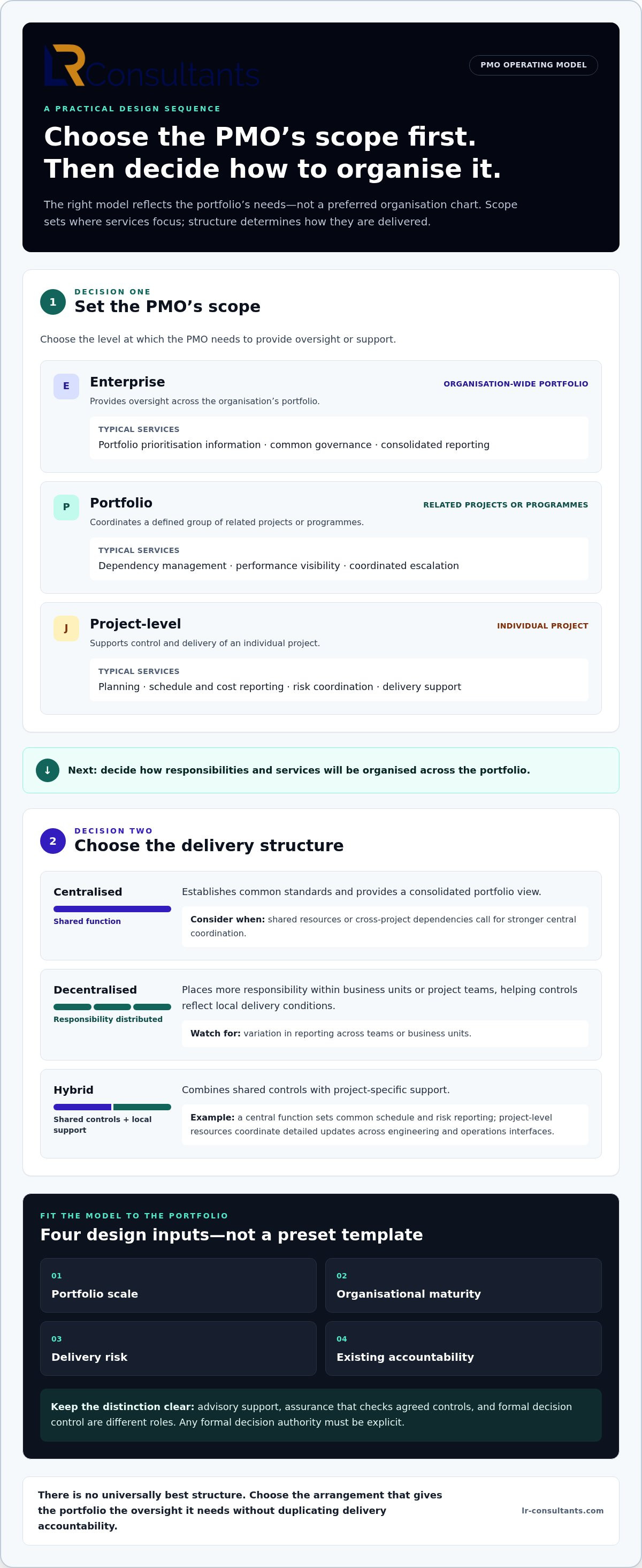
The right operating model reflects what the portfolio needs the PMO to do, not a preferred organisation chart. A project management office setup should account for portfolio scale, organisational maturity, delivery risk and existing accountability. It should also distinguish between advisory support, assurance that tests whether agreed controls are working, and formal control over decisions. Any formal decision authority must be explicit.
What are the main PMO operating models?
First decide the PMO’s scope. Scope determines where its services focus, while the organisational structure determines how those services are delivered.
| PMO scope | Primary purpose | Typical services |
|---|---|---|
| Enterprise | Provide oversight across the organisation’s portfolio | Portfolio prioritisation information, common governance and consolidated reporting |
| Portfolio | Coordinate a defined group of related projects or programmes | Dependency management, performance visibility and coordinated escalation |
| Project-level | Support control and delivery of an individual project | Planning, schedule and cost reporting, risk coordination and delivery support |
A centralised structure can establish common standards and provide a consolidated portfolio view. A decentralised structure places more responsibility within business units or project teams. This can help controls reflect local delivery conditions, but may create variation in reporting. A hybrid model combines shared controls with project-specific support. For example, a central function might define common schedule and risk reporting, while project-level resources coordinate detailed updates across engineering and operations interfaces.
No structure is universally best. Portfolios with shared resources and significant cross-project dependencies may need stronger central coordination. Where projects differ substantially and local controls are established, a lighter central function with decentralised delivery support may be more proportionate.
How should the PMO’s mandate and authority be defined?
Start with the decisions leaders expect the PMO to inform, coordinate or control. Then map responsibilities across sponsors, project managers, finance, operations and assurance roles. For each decision, identify who recommends an action, provides evidence, approves it and follows through. This prevents the PMO from being held accountable for outcomes it cannot direct.
Specify which services are mandatory, which are advisory and how assurance findings are escalated. Match staffing and capability to the approved mandate and portfolio demand, including relevant financial, operational and risk interfaces. This alignment gives the PMO a defined role, supports consistent oversight and limits duplication of existing responsibilities.
How to design PMO governance, reporting and assurance
Governance should make decisions, exceptions and accountability visible without requiring every project to follow an identical process. In a project management office setup, agree a cycle that connects approval, regular review, change control and escalation. The depth of each review should reflect the project’s risk, complexity and stage, while keeping core information comparable across the portfolio.
For each reporting measure, define what it means, who owns the underlying data, when it is updated and what change warrants leadership attention. Thresholds should prompt a decision or investigation, not simply colour a dashboard. For example, a forecast change could trigger review when it affects an approved milestone, a critical dependency or an agreed tolerance. Set the trigger as part of the governance design rather than relying on informal judgement during each reporting cycle.
Which measures should a PMO report?
A concise portfolio view should cover schedule, cost, scope, quality, dependencies and risk. Prioritise measures that explain movement against the approved plan, identify constraints and expose decisions still required. A variance without its cause, forecast effect and owner gives leaders little basis for action.
Distinguish leading indicators from lagging measures. Emerging supplier constraints, unresolved design interfaces or overdue risk mitigations may signal future delivery pressure. Actual cost, completed milestones and quality outcomes show performance already realised. Both matter, but the balance should help leaders act before an adverse outcome is fixed.
Consistent definitions and accountable data owners are more valuable than a crowded dashboard. If projects use different baselines or interpret “complete” differently, portfolio comparisons can mislead. The PMO should establish shared definitions, record material assumptions and set a reporting cadence that fits decision forums and project conditions.
How should assurance and escalation work?
Assurance should test agreed controls and evidence at relevant decision points, within the PMO’s mandate. Its scope may include schedule logic, cost forecasts, change records, risk responses or readiness at a project stage gate. Technical, commercial, HSSE and operational specialists retain responsibility for their respective judgements. The PMO coordinates the view and routes material findings to the appropriate decision-maker.
Every finding needs an accountable owner, a due date, a defined response and a route for unresolved or material residual risk. The PMO should track actions through evidence-based closure, not close them solely because a target date has passed. Where a mitigation changes the forecast or leaves exposure outside agreed tolerance, the relevant sponsor or authority should receive the issue, its implications and the available decision options.
How to implement a PMO in stages and avoid unnecessary bureaucracy
A PMO is more likely to gain practical adoption when its services address demonstrated delivery needs. Treat project management office setup as a staged organisational change, not a one-off launch or software installation. A proportionate sequence is to diagnose needs, agree the mandate, design services, pilot them, refine the model and then scale what proves useful.
What should a PMO setup assessment cover?
Map how governance and information currently move through the portfolio. Record reporting requirements, decision rights, approval and escalation routes, and where project information is created, checked and used. Assess organisational maturity, delivery constraints and recurring oversight challenges. For example, an assessment might find that schedule updates are available, but dependencies between project teams and operations are not routinely consolidated.
Prioritise gaps by strategic importance, risk exposure and capacity for change. This prevents the design from becoming a list of every desirable process. Agree a mandate that targets the most consequential gaps, then select a focused set of services for the pilot, such as common portfolio reporting, a defined escalation route or targeted delivery assurance.
How can a PMO demonstrate value after launch?
Establish a baseline before implementation so the organisation can assess whether the PMO is improving oversight. Select a focused set of measures, such as:
- Decision timeliness: whether issues reach the appropriate decision-maker with enough time to act.
- Information quality: whether reports are consistent, complete and useful for understanding forecast movement and dependencies.
- Control adoption: whether teams use agreed governance and escalation routes in practice.
- Process burden: whether reporting and review effort is proportionate to the decisions and risks involved.
Track process compliance, but do not treat it as proof of value on its own. A completed template matters only if it supports a clearer decision, earlier escalation or more reliable oversight. Sponsor engagement, clear roles, practical guidance and regular feedback from project teams help reveal where controls work and where they create friction.
Review the pilot against its baseline and the delivery problems it was intended to address. Use evidence and stakeholder feedback to refine services, adjust controls and decide what should be scaled. If portfolio visibility improves but teams face duplicated reporting, simplify the information flow before expanding the model.
How to move from PMO design to stronger project oversight
A PMO design becomes effective when leadership decisions translate into clear operating arrangements. Senior leaders should confirm the delivery problem, appoint a sponsor, approve the mandate and scope, and define the PMO’s authority. They should also agree which controls are essential and how teams will adopt them. Without these decisions, a PMO may be accountable for oversight without the influence or information needed to provide it.
Portfolio oversight needs more than project status. Project management brings visibility of schedule, budget, quality and delivery constraints. Financing perspectives connect project progress with funding assumptions and commercial decisions. Risk, HSSE and operational expertise can reveal interfaces that affect execution, asset readiness or transition into operations. The PMO should bring these perspectives together where they inform portfolio decisions, while keeping specialist accountabilities clear.
The objective is disciplined delivery, not an additional administrative layer. A practical design translates portfolio priorities and constraints into a tailored mandate and operating model, then specifies the services, decision rights, reporting expectations and assurance interfaces that support it. Implementation stages should identify accountable owners and measures for review, allowing leaders to adapt the model as portfolio needs change.
What should a PMO design engagement deliver?
A useful design should leave leaders with clear decisions: what the PMO exists to improve, which projects or portfolios it covers, what services it provides and where its authority begins and ends. It should also define how project teams, sponsors, finance, operations and assurance roles interact with the function. Staged implementation and review measures make the proposed model testable rather than leaving it as a static organisation chart.
What are the next steps for senior leaders?
Begin by agreeing the delivery problem and the outcomes expected from a PMO. Confirm sponsorship and decision authority before introducing new processes or reporting requirements. Then assess the portfolio’s interfaces and oversight demands to determine which services should be introduced first.
Review the model against evidence from implementation and feedback from the people using it. Refine the mandate, controls or service scope where they do not support sound decisions or effective delivery. This keeps the PMO aligned with the portfolio as its needs evolve.
Turn PMO design into stronger delivery oversight
A PMO earns its place by addressing a defined delivery need, not by adding layers of process. Effective project management office setup aligns the mandate and operating model with portfolio priorities, makes decision rights clear, and gives leaders consistent insight into schedule, cost, quality, dependencies and risk.
Implementation should be proportionate and staged. Pilot services against specific challenges, then refine them using evidence of information quality, timely decisions and practical adoption. The result should be disciplined oversight that supports sponsors and project teams without displacing their accountability.
For complex engineering and capital projects, LR Consultants’ project management advisory applies structured delivery frameworks focused on schedule, budget and quality, alongside connected experience in project financing, risk and operational excellence. Discuss your project management office setup to identify a practical route from portfolio priorities to stronger oversight. With a clear mandate and measured implementation, your PMO can provide a dependable foundation for better-informed delivery decisions.
Frequently Asked Questions
What is a project management office?
A project management office is an organisational function that supports consistent project or portfolio delivery through services such as governance, reporting, assurance and delivery guidance. Its scope and authority depend on the organisation’s needs. A useful PMO has a clear mandate, defined relationships with sponsors and project teams, and services that address real delivery challenges. It should inform decisions and improve oversight, rather than introduce processes without a clear purpose.
How do you set up a project management office?
Start by identifying the delivery problems and outcomes the PMO must address. Secure a sponsor, assess current governance and information flows, then define the mandate, services and decision rights. Design reporting and assurance to match the portfolio, and pilot the model before refining and scaling it. Agree measures of effectiveness from the outset, such as information quality, decision timeliness and practical adoption, so implementation can be assessed against a defined baseline.
What are the different types of project management office?
PMOs may operate at enterprise, portfolio or individual project level, and can be structured centrally, within business units or as a hybrid. Scope describes what the function oversees; structure describes how it is organised. Neither arrangement is inherently superior. The appropriate model depends on portfolio complexity, organisational maturity, risk and decision needs. Define accountability clearly, especially where sponsors, project managers or existing governance functions already hold approval or assurance responsibilities.
What should a PMO include?
A PMO may provide governance standards, portfolio reporting, assurance, delivery guidance and support for project planning or controls. Its service mix should follow its mandate and the portfolio’s needs, not a standard catalogue. For each service, define its owner, users and decision purpose. For example, a reporting service should clarify which portfolio decisions its information supports. Services without clear demand, ownership or authority can increase workload without strengthening project oversight.
How can a PMO avoid becoming bureaucratic?
Connect each required control, report or review to a decision, assurance need or delivery outcome. Keep processes proportionate to project complexity and risk, clarify ownership, and pilot new requirements before wider rollout. Seek feedback from project teams and remove steps that do not add demonstrable value. Assess whether information supports better decisions and timely escalation, not only whether procedures have been followed. This keeps governance purposeful while preserving necessary oversight.
How long does it take to set up a PMO?
There is no universal timeframe for setting up a PMO. The work depends on its intended scope, portfolio complexity, existing governance and organisational readiness. A focused design and pilot will differ from a wider operating-model change. Define stages, owners and review points, then sequence implementation according to capacity and evidence from the rollout. Establish the required decisions and work before setting a deadline, rather than assuming every PMO follows the same schedule.
How do you measure whether a PMO is effective?
Measure whether the PMO improves the information and controls leaders need to oversee the portfolio. Relevant measures include reporting quality, decision timeliness, adoption of agreed controls, escalation of material issues and visibility of dependencies. Establish a baseline before implementation and interpret results in context. No single indicator proves value: combine evidence that services are being used with evidence that leaders have clearer information and can make informed oversight decisions.


