

Article by
Jacob Nieuwenhuijze
Jacobus Nieuwenhuijze is a senior energy executive with over 40 years of international experience across five continents and more than US$23 billion in successfully executed projects. He specialises in project initiation, concept development, front-end loading (FEL), CAPEX optimisation and project financing, transforming complex concepts into bankable business cases and high-performing assets. His experience spans major greenfield and brownfield developments, with a proven track record in technical, commercial and strategic leadership across complex energy and industrial projects.
Executive Summary
Delivering a pioneering green methanol asset requires translating technical decarbonisation concepts into lender-grade risk mitigation structures. While engineering feasibility confirms that electrolysis, biogenic or captured carbon dioxide inputs, and methanol synthesis can technically perform as an integrated system, capital providers evaluate an asset strictly on its debt service coverage, contractual robustness, and downside resilience.
A project’s commercial viability often stumbles on uncontracted offtake, speculative green price premiums, or mismatched feedstock and renewable electricity guarantees. To achieve financial close, sponsors must replace indicative memorandums of understanding with enforceable, bankable agreements and transparent financial models that accurately quantify interface risks, operational availability, and lifecycle emissions.
Whether structured through private equity, non-recourse senior debt, or blended capital (including regional sovereign, commercial, and Islamic finance facilities), bankability demands a disciplined sequencing of development milestones. By systematically aligning feedstock pricing, offtake commitments, policy alignment, and technical interfaces, sponsors can demonstrate transaction readiness and secure institutional capital for commercial-scale deployment.
Introduction
This is article is written by LR Consultants, a boutique management consultancy based in Dubai, UAE; specializing in supporting the development of complex industrial projects in oil and gas and renewable energy.
LR Consultants is currently acting as owners engineer, responsible for project and commercial structuring, and raising project finance for the development of a commercial scale e-methanol production facility in Nigeria.
Delivering a pioneering energy transition asset within an emerging market requires addressing intricate commercial, regulatory, and capital risks before the project can reach financial close and begin construction.
A technically credible green methanol plant can still be unfinanceable. For sponsors assessing project financing green methanol uae, the central test is whether the commercial case, project inputs and delivery plan stand up to lender scrutiny together.
Revenue forecasts can hinge on offtake that is not contracted or a market premium that remains uncertain. At the same time, renewable power, hydrogen production, carbon supply and process technology must work as an integrated system, with their costs and risks reflected in the financial model.
This article examines what may need to be in place for a green methanol project to attract finance. It considers the evidence lenders and investors may seek, the assumptions that can materially affect bankability, and how development choices connect to financing and delivery risks. The aim is to provide a practical assessment framework that links technical feasibility and commercial viability to transaction readiness, rather than treating finance as a final step.
Key Takeaways
- Bankability means presenting credible evidence for funding decisions, not assuming finance is guaranteed. Align the project’s commercial case, technical feasibility and delivery plan.
- Build the financing case in sequence, from a clear project definition and feasibility assessment to validated assumptions and transaction readiness.
- Test how capacity, utilisation, feedstock, energy, operating costs and product sales affect the financial model before relying on its projections.
- Compare equity, debt and blended approaches by considering control, risk allocation, repayment exposure and the evidence each may require.
- For project financing green methanol uae, distinguish signed commitments from indicative discussions and unresolved assumptions across inputs, offtake and governance.
Why green methanol project financing depends on bankability
A compelling decarbonisation case is not, by itself, a financeable project. For a sponsor, lenders and investors need evidence that the proposed production pathway can operate as modelled, essential inputs can be secured, and projected sales and delivery plans are credible. These questions are connected: a change to the power supply or carbon source can affect operating costs, production assumptions and the basis for environmental claims.
Bankability is the quality of evidence that enables a lender or investor to assess a project’s risks, cash flows, contracts and delivery readiness; it is not a guarantee of finance. Technical feasibility asks whether a project can work. Bankability also considers whether its risks are understood and allocated well enough to support a particular financing decision.
What makes a green methanol project different to finance?
The production pathway and the origin of its inputs shape both project economics and environmental performance. Renewable electricity, hydrogen production, the carbon source and conversion technology need to be considered as an integrated system. Configurations can rely on different inputs and assumptions, so a financing case needs to describe the specific pathway proposed rather than treating all green methanol projects as equivalent.
A project concept outlines an intended outcome. Feasibility evidence tests whether the proposed process, inputs, site and commercial assumptions can support it. Investment-ready documentation goes further, presenting developed evidence for financial stakeholders to evaluate risks, cash flows, agreements and execution planning. These stages are related, but they are not interchangeable.
What does bankability mean for a project sponsor?
Project-specific interfaces matter. A sponsor must consider how the selected site connects with power supply, feedstock and carbon sources, technology providers, logistics and prospective product markets. The relevant counterparties and commercial arrangements depend on the project. Location alone does not establish that inputs, sales or financing terms are secured.
Green credentials also need a documented basis. Define the project boundary, identify the sources and characteristics of material inputs, state the assumptions behind environmental claims, and establish how those claims will be verified. Without this clarity, stakeholders may struggle to assess whether projected revenues, operating assumptions and environmental attributes refer to the same project configuration.
For project financing green methanol proposals, the practical test is whether evidence connects technical choices to commercial outcomes and delivery responsibilities. Lender and investor requirements vary by transaction and project circumstances, so bankability is assessed against the specific financing case, not a universal checklist.
How to build a credible green methanol project finance case
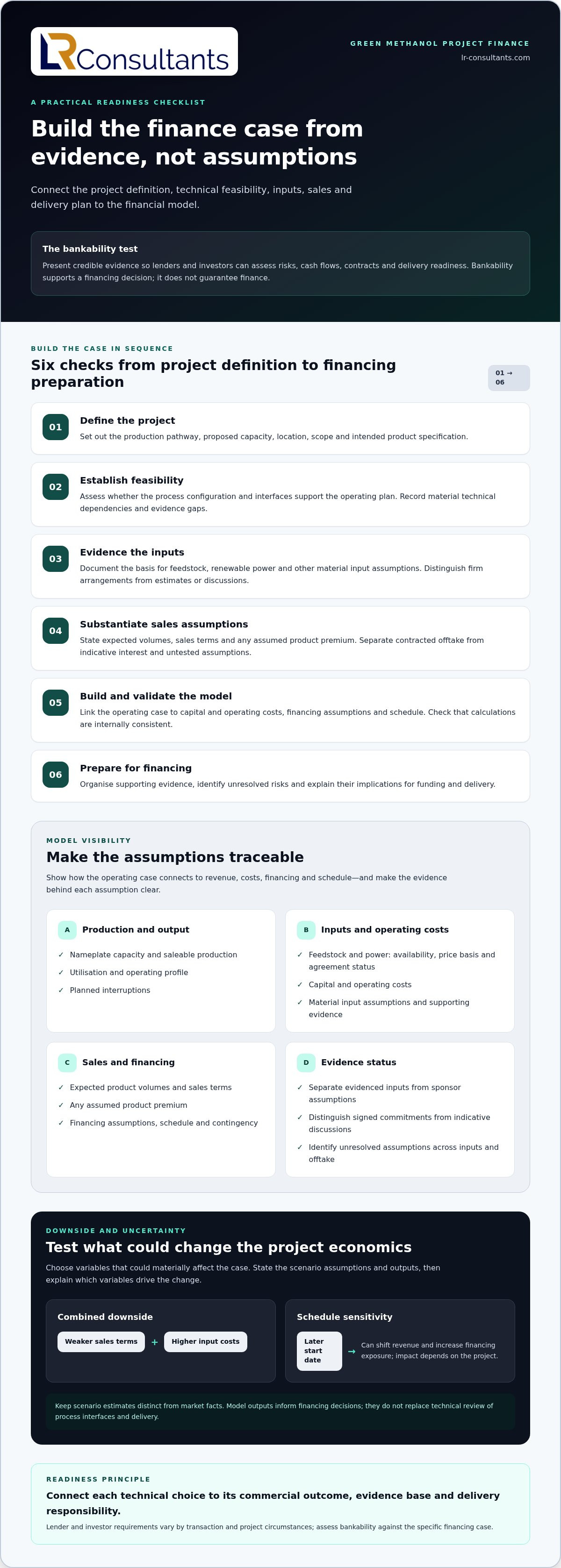
A financial model is only as credible as the evidence behind it. Build the case in sequence, make assumptions traceable, and show how uncertainty could affect project economics and financing decisions.
- 1. Define the project. Set out the production pathway, proposed capacity, location, scope and intended product specification.
- 2. Establish feasibility. Assess whether the process configuration and interfaces support the proposed operating plan. Record material technical dependencies and evidence gaps.
- 3. Evidence the inputs. Document the basis for feedstock, renewable power and other material input assumptions. Distinguish firm arrangements from estimates or discussions.
- 4. Substantiate sales assumptions. State expected volumes, sales terms and any assumed product premium. Separate contracted offtake from indicative interest and untested assumptions.
- 5. Build and validate the model. Link the operating case to capital and operating costs, financing assumptions and schedule. Check that calculations are internally consistent.
- 6. Prepare for financing. Organise supporting evidence, identify unresolved risks and explain their implications for funding and delivery.
Which assumptions should the financial model make visible?
Show how nameplate capacity translates into saleable production, taking account of utilisation, operating profile and planned interruptions. Lower output may reduce revenue while leaving some costs in place. Tie feedstock and power assumptions to project-specific evidence, including availability, price basis and agreement status. Make operating costs, product sales, financing terms, schedule and contingency visible. For example, a delayed start can shift revenue and increase financing exposure; the impact depends on the project.
How should sponsors test downside and uncertainty?
Separate evidenced inputs from sponsor assumptions, then test variables that could materially change project economics. Scenarios might combine weaker sales terms with higher input costs, or assess the effect of a later start date. State each scenario’s assumptions and outputs, and explain which variables drive the change. Avoid presenting estimates as market facts or relying on unsupported benchmarks.
Model outputs inform financing decisions; they do not replace technical review of process interfaces and delivery schedules, or commercial diligence on supply and sales arrangements. For project financing green methanol, this distinction keeps the model grounded in the project’s evidence and uncertainties.
Compare green methanol financing options and bankability evidence
Equity, debt and blended approaches allocate risk differently. The appropriate route depends on project maturity, sponsor capacity, contractual position and who can bear construction, operating and market risks. Early-stage uncertainty can make funding discussions more difficult, but sponsors can present evidence in stages, showing what is established, what remains conditional and what must be resolved before a financing decision.
| Approach | Risk allocation | Control and repayment exposure | Evidence focus |
|---|---|---|---|
| Equity | Investors share project risk and potential returns through ownership. | May affect sponsor ownership and control; there are no scheduled debt repayments, but returns depend on project performance. | Project rationale, sponsor capability, feasibility, risk management and a credible route to commercial operation. |
| Debt | Repayment obligations place emphasis on predictable cash generation and management of downside risks. | Typically entails repayment and financing costs; control arrangements depend on the transaction. | Cash-flow support, contracts, input and sales arrangements, delivery readiness and a clear assessment of repayment capacity. |
| Blended approach | Combines capital sources, which may distribute risks and returns across different participants. | Can involve multiple interests, repayment profiles and governance arrangements that need to work together. | Clear terms between participants, coherent risk allocation and a financial model reflecting each source of capital. |
How do equity and debt differ for project sponsors?
Equity can provide risk bearing capital, but sponsors may share ownership, influence and future returns. Debt can limit equity dilution, yet introduces repayment obligations that the project’s cash flows must support. Neither is universally preferable or assured. A project with unresolved technology interfaces, uncertain supply or immature sales arrangements presents a different risk profile from one with developed feasibility and documented contracts. That difference shapes discussions with potential capital providers.
What evidence can strengthen a financing assessment?
Evidence should allow reviewers to trace the project’s key claims to supporting information. This may include feasibility findings, the rationale for the selected technology, an input supply strategy, offtake evidence and a delivery plan with responsibilities and dependencies. Contracts can clarify volumes, terms, conditions and allocation of risk. Any assumptions that remain uncontracted should be identified as such. This staged approach helps distinguish gaps requiring further development from risks that can be assessed now.
For sponsors considering project financing green methanol, a structured assessment connects project maturity and commercial viability to financing readiness. Read more about LR Consultants’ project financing advisory.
A practical readiness review for UAE green methanol financing
A financing discussion is more productive when the project’s evidence is organised, its status is clear and unresolved questions have owners. This readiness review helps sponsors distinguish established commitments from indicative discussions and assumptions that still need testing. It also connects technical, commercial, sustainability and delivery workstreams, so a gap in one area can be assessed for its implications elsewhere.
- Project definition: Record the proposed scope, location, production pathway, capacity and product specification. Identify decisions that could change the project basis.
- Feasibility and technology: Summarise the feasibility findings, selected technology rationale, key interfaces and material technical risks.
- Inputs: Document the basis and status of feedstock, power, carbon-source and other material supply assumptions. Separate signed arrangements from proposals and estimates.
- Offtake: Set out target customers, sales strategy, expected product volumes and terms. Label contracted sales separately from indicative interest or untested assumptions.
- Model and risks: Link financial assumptions to their evidence, maintain a risk register and show how key uncertainties affect project outcomes.
- Governance and delivery: Assign accountable owners to workstreams, decisions and evidence gaps. Show dependencies, decision dates and the plan for closing material gaps.
What should be prepared before financing discussions?
Bring these materials together in a controlled project basis: feasibility findings, technology and input strategies, product specification, sales plan, model assumptions and risk register. Each document should have an owner and a clear status, such as confirmed, under discussion or unresolved. This prevents an indicative supply proposal from being treated as a commitment and gives reviewers a direct line from the project plan to its financial assumptions.
How should sustainability claims be supported?
Define the project boundary and production pathway before making emissions claims. Document the assumed sources of energy and carbon inputs, explain the lifecycle assessment methodology and retain the technical evidence behind key inputs. Claims should reflect the specific project configuration and its boundaries. Avoid applying a label or threshold without an authoritative basis relevant to the project.
For a green methanol project, maintain a separate register of policy, permitting and approval matters that may affect development. Record the relevant authority and source for each item, and verify current requirements against authoritative sources rather than relying on general market commentary. This keeps the financing review factual without turning an early assessment into an unsupported legal conclusion.
For sponsors preparing project financing green methanol, LR Consultants connects feasibility assessment, commercial viability planning and transaction readiness. Further information is available on project financing advisory.
How LR Consultants can support green methanol project financing
Financing decisions are stronger when financial analysis is connected to the project’s technical basis, commercial assumptions and delivery plan. LR Consultants provides project financing advice covering feasibility assessment, commercial viability planning and transaction readiness. For a green methanol proposal, this means helping sponsors organise the evidence behind the case, identify material gaps and understand how project risks influence financing discussions. A model or funding plan is not a guarantee of finance.
Linking financial viability with project delivery
Schedule, scope and technical interfaces can shape capital requirements, revenue timing and operating assumptions. A delay to a critical input arrangement, for example, may affect the planned start of production and the cash-flow profile. Financial assessment therefore needs to reflect the project’s current delivery basis, rather than relying on assumptions detached from its development status.
LR Consultants can connect project financing advice with project management, operational excellence and risk advisory where relevant. This integrated view helps sponsors consider whether responsibilities, dependencies and material risks are reflected in the commercial case. The advisory scope can be tailored to the project’s maturity, objectives and available evidence, supporting clear decisions about what is established and what requires further work.
From feasibility to transaction readiness
Moving from feasibility towards transaction readiness requires a coherent account of the project. Technical and financial assumptions should be traceable to their supporting evidence; commercial viability planning should identify how sales, inputs and operating expectations underpin projected cash flows. Governance and risk considerations then help clarify decision ownership, unresolved issues and delivery dependencies.
This structure is useful even when a project is at an early stage. It gives sponsors a basis for prioritising evidence development and assessing whether the project’s current position supports the next financing step. For sponsors evaluating project financing green methanol, the objective is a grounded assessment that connects feasibility, commercial viability and execution considerations, not an assurance of funding or a claim of project-specific outcomes.
LR Consultants’ project financing advice is informed by senior industry experience and supports sponsors seeking a structured assessment of their objectives and evidence base. Find details of project financing advisory.
Turn project evidence into a clear financing pathway
For project financing green methanol, bankability rests on more than a promising concept. Sponsors need a coherent case linking technical feasibility, credible commercial assumptions, documented inputs and a delivery plan. Separating firm commitments from indicative discussions and unresolved assumptions helps investors and lenders assess the project on its actual evidence.
Financing structures should reflect project maturity, sponsor capacity and the allocation of risk, rather than follow a standard formula. Financial analysis is most useful when connected to the practical decisions that shape project delivery.
LR Consultants provides project financing advice spanning feasibility assessment, commercial viability planning and transaction readiness. Led by former senior industry executives and partners, the practice can also connect financing assessment with project management and risk advisory where relevant. This integrated perspective supports structured decision-making without promising a particular financing outcome.
Discuss your project objectives and the evidence needed for the next stage. Discuss your project financing requirements.
Frequently Asked Questions
What makes a green methanol project bankable?
A green methanol project is bankable when its evidence allows potential funders to assess risks, expected cash flows, contracts and delivery readiness. This includes a credible feasibility basis, support for key technology and input assumptions, a realistic sales case, and clear treatment of material risks. Bankability is not a guarantee of finance. It describes how assessable the project is for a particular funding decision, given its maturity and circumstances.
How is green methanol project financing structured?
Financing may involve equity, debt or a combination, but there is no universal structure suitable for every project. Equity can affect ownership and control, while debt introduces repayment obligations that need to be supported by project cash flows. A blended approach brings together different capital sources and interests. For sponsors assessing project financing green methanol opportunities, the structure depends on project maturity, sponsor capacity, contracts and how risks are allocated.
What should a green methanol project finance model include?
A project finance model should link production and sales assumptions to the costs and funding needed to deliver the project. It should make capacity, utilisation, feedstock, renewable power, operating costs, product sales, schedule and financing assumptions visible. It should also distinguish evidenced inputs from sponsor estimates and test how changes affect cash flows. Model outputs inform financing decisions, but do not replace technical, commercial or delivery diligence.
Why can green methanol projects be difficult to finance?
Green methanol projects can be difficult to finance because their commercial and technical dependencies need to be assessed together. The selected production pathway affects technology and input requirements; uncertain supply, power costs, sales terms or delivery timing can all influence projected cash flows. If the evidence is incomplete, funders may find the risks difficult to assess. Staged feasibility work and clear documentation can help expose gaps and guide further development.
How does offtake affect green methanol project financing?
Offtake arrangements inform expected sales volumes, revenue timing and the assumptions supporting projected cash flows. A signed agreement provides different evidence from an expression of interest or an indicative discussion. Sponsors should make the status, terms and conditions of each sales arrangement clear, and identify any assumed premium separately from contracted revenue. This allows funders to assess how exposed the case may be to uncertain demand or pricing.
What is the role of a project finance adviser in green methanol development?
A project finance adviser can help sponsors assess feasibility, commercial viability and transaction readiness. The work can organise project assumptions and supporting evidence, identify material gaps, and connect financial analysis with relevant delivery and risk considerations. LR Consultants provides project financing advice, with project management and risk advisory available to complement the assessment where relevant. An adviser supports decision-making but cannot guarantee that funding will be secured.
How should a green methanol project assess sustainability claims?
A green methanol project should define its production pathway and assessment boundary before making emissions claims. Document assumptions about energy and carbon inputs, explain the lifecycle assessment methodology, and retain suitable technical evidence for the information used. Claims should accurately reflect the project configuration and be supported by appropriate verification. Sponsors should avoid applying thresholds, labels or regulatory interpretations without an authoritative basis relevant to the project.


