


Article by
Dr Mark Vine
Dr. Mark Vine is a Senior HSE & Operational Excellence Leader and strategic M&A advisor for LR Consultants, with over 25 years of global experience de-risking multi-billion-dollar energy mega-projects. He specializes in bridging complex HSE and asset integrity risks with transaction bankability and corporate governance. His extensive career spans the UK, Middle East, Africa, and Southeast Asia, safeguarding major capital assets across deepwater drilling, midstream/downstream oil and gas, and pioneering energy transition Power-to-X projects (CCUS, green hydrogen, methanol and renewables).
Executive Summary
Acquiring an operating oil and gas asset involves more than evaluating production, reserves and financial performance. Behind apparently satisfactory operating results, a facility may carry unresolved asset integrity deficiencies, maintenance backlogs, degraded process safety barriers and operational weaknesses that affect safe operations, future expenditure and the investment case.
These exposures are not always apparent from a transaction data room. Inspection records may be incomplete, maintenance deferrals may obscure the extent of outstanding work, and documented safety studies may not demonstrate that critical safeguards remain effective in practice. Without a structured, evidence-led assessment, buyers risk carrying unresolved technical and operational uncertainties into ownership.
Effective technical due diligence examines the condition and operating capability of the target asset, with particular emphasis on asset integrity, maintenance and reliability, process safety, HSSE and operating performance. It tests available records against site observations and management explanations, distinguishes verified findings from assumptions, and identifies gaps where further investigation is warranted.
Asset integrity and process safety deserve particular scrutiny. Buyers need to understand whether corrosion, equipment deterioration, overdue maintenance and recurring failures are being effectively managed. They must also assess whether major accident hazards are controlled through demonstrably effective safeguards, including safety-critical elements, operating procedures, management of change and appropriate technical assurance. A completed HAZOP, SIL assessment or Safety Case is not, in itself, proof that identified risks are adequately controlled in current operations.
The value of this work lies in connecting technical evidence to the decisions facing the transaction team. Prioritised findings can identify matters requiring clarification before completion, inform discussions about investment requirements and deal considerations, and establish practical priorities for the initial post-acquisition operating plan. Technical conclusions should remain distinct from commercial and financial diligence, while providing relevant evidence to inform those workstreams.
A decision ready assessment should explain what the evidence supports, why material findings matter, where uncertainty remains and what action is appropriate. It should also state the scope and limitations of the review, avoiding unsupported assurances about asset condition or future performance.
For investors, private equity, lenders and energy companies acquiring operating assets, independent, senior led Technical and HSSE Due Diligence is an important means of making acquisition decisions with a clearer understanding of asset integrity, process safety and operational exposure. The objective is not simply to identify defects, but to establish which risks matter to the transaction, what requires further investigation and how outstanding issues should be managed
Introduction
An operating oil and gas asset can appear sound in a transaction data room and still carry integrity, process safety or maintenance exposures that affect its value after completion. Technical due diligence for operating oil and gas acquisitions is not simply a catalogue of defects. It is a structured assessment of which evidence matters to safe operations, future costs and the investment case.
Asset condition and operating performance can affect an acquisition decision, but the evidence may be incomplete, risks may be spread across sites, and technical findings can be difficult to distinguish from issues covered by commercial or financial diligence. A useful review connects the evidence to decisions the deal team needs to make, while keeping workstream responsibilities clear.
This article sets out a transaction-focused framework for assessing asset integrity, maintenance backlogs, operational performance, HSSE and process safety. It explains how to rank material exposures, test assumptions against available evidence, and identify implications for valuation, deal terms and post-acquisition plans. The result should be a clearer view of what the buyer is acquiring, what may require investment and where uncertainty remains.
Key Takeaways
- Use technical due diligence for operating oil and gas acquisitions to connect asset and operational evidence with investment decisions.
- Prioritise integrity, maintenance, reliability, process safety and HSSE findings according to operational relevance and the strength of the supporting evidence.
- Keep the technical review distinct from commercial and financial due diligence, while making its findings useful to both workstreams.
- Follow a clear sequence: define the decision, organise evidence, test consistency, rank findings and identify where further investigation is needed.
- Set a defined scope and expect prioritised conclusions, transparent limitations and senior-level technical judgement to support the acquisition decision.
What technical due diligence for operating oil and gas acquisitions should establish
Technical due diligence for operating oil and gas acquisitions is an evidence-led assessment of an asset’s physical condition, operating practices, maintenance, integrity and associated risks. Its purpose is to help an acquirer understand what is being purchased and how technical and operational exposures could affect safe, reliable operations and the investment case. It does not certify an asset as risk-free or replace management’s responsibility for operating it.
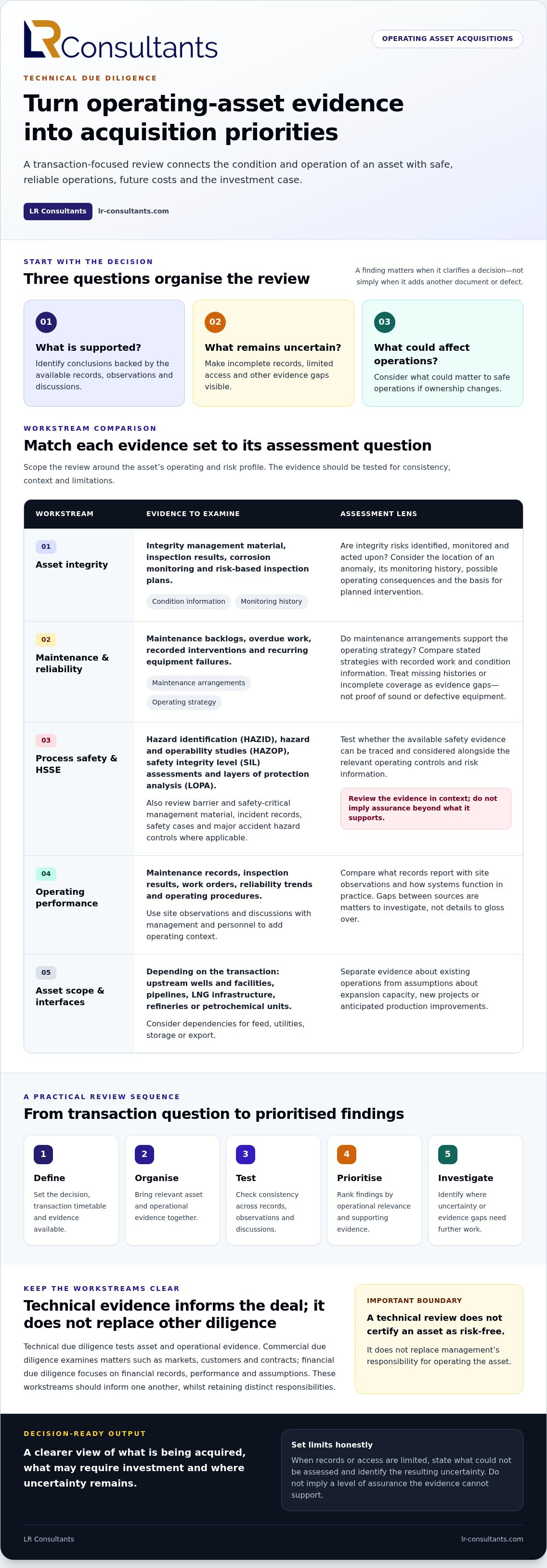
The review should answer three questions: what is supported by evidence, what remains uncertain, and what could affect operations if ownership changes? A corrosion anomaly, for example, should be considered in context: where it is, what its monitoring history shows, what operating consequences are possible, and what supports any planned intervention. Findings become useful when they clarify a decision, not simply when they add to a list of documents or defects.
This is one distinct workstream within due diligence in mergers and acquisitions. Technical review tests asset and operational evidence. Commercial due diligence examines matters such as markets, customers and contracts, while financial due diligence focuses on financial records, performance and assumptions. The workstreams should inform one another, but technical findings do not replace either analysis.
What makes an operating asset different from a development project?
An operating asset has a performance history that can be examined. Reviewers can compare maintenance records, inspection results, work orders, reliability trends and operating procedures with how the facility is currently run. Records show what was reported and acted upon; site observations help assess physical condition and working practices; discussions with management and personnel can explain how systems function in practice. Gaps between these sources are findings to investigate, not details to gloss over.
Separate current-condition questions from future development assumptions. Available evidence may support an assessment of existing wells, processing facilities, pipelines or LNG infrastructure. By contrast, expansion capacity, new projects and anticipated production improvements depend on additional assumptions. They should not be treated as established operating performance.
Who uses the findings, and when?
Investors, private equity, banks, lenders and asset owners use technical findings to inform acquisition assessment, risk evaluation and planning after completion. Set the scope around the transaction timetable, the decisions still open and the evidence available. If access or records are limited, state what could not be assessed and identify the resulting uncertainty. Do not imply a level of assurance the evidence cannot support.
Prioritised findings help decision-makers distinguish operational concerns from longer-term improvement opportunities and questions that need further investigation. This distinction can inform investment judgement and shape the initial post-acquisition work programme, without turning technical due diligence into a valuation model or a promise of future performance.
Which technical due diligence workstreams matter across an oil and gas asset
Technical due diligence for operating oil and gas acquisitions should follow the asset’s operating and risk profile, rather than rely on a generic document list. The review typically brings together asset integrity, maintenance, reliability, process safety, HSSE and operating performance. Depending on the transaction, the scope may include upstream wells and facilities, pipelines, LNG infrastructure, refineries or petrochemical units. It should also consider interfaces where one asset depends on another for feed, utilities, storage or export.
For each workstream, connect the decision question to the available evidence and its limitations. This helps distinguish a documented control from an assumption, and an isolated issue from a recurring pattern. A legal perspective on transaction review is addressed in Legal aspects of due diligence in oil and gas acquisitions; the technical assessment should focus on asset condition, operations and risk.
Asset integrity, maintenance and reliability evidence
Assess whether integrity risks are identified, monitored and acted upon, and whether maintenance arrangements support the operating strategy. Review available integrity management documents, inspection results, corrosion monitoring, risk-based inspection plans, maintenance backlogs, overdue work and recurring equipment failures. Compare stated strategies with recorded interventions and condition information. Missing histories or incomplete coverage limit the conclusions that can be drawn. Record them as evidence gaps, rather than treating them as proof that equipment is sound or defective.
Process safety, HSSE and operating controls
Review relevant hazard identification (HAZID), hazard and operability studies (HAZOP), safety integrity level (SIL) assessments and layers of protection analysis (LOPA), alongside barrier and safety-critical management material. Examine incident records, major accident hazard controls and the facility's Safety Case or COMAH report where applicable, using it as part of technical verification to test whether the documented hazards, safety-critical elements and barriers match what is found on site. The key test is traceability: can each identified hazard be linked to defined safeguards, accountable roles, operating procedures and evidence of assurance? A study on file does not, on its own, demonstrate that its actions or controls remain effective in practice.
Take a risk based approach that concentrates effort on production and safety critical elements and the barriers that prevent or mitigate major accidents and production loss, rather than sampling all equipment equally. Where available, use Technical Integrity Verification (TIV) reports within the technical due diligence process. They show how far safety-critical elements have been independently verified as fit for service, and they highlight open findings and gaps in assurance.
Assurance should be comprehensive and cover three areas:
- Design integrity: the engineering design basis, and the management of change and plant modifications that have altered it since.
- Technical integrity: the condition and performance of equipment, safety-critical elements and barriers over time.
- Operating integrity: whether procedures, competence and operating discipline keep the asset within its safe limits.
Include a Process Safety Management (PSM) review to assess the safety and operating culture and the cultural fit with the acquiring business. Differences in leadership, reporting, and attitudes to procedures and barriers can affect how safely the asset is run after completion.
Account for creeping risk. Over time, management of change, temporary overrides, bypasses, deferred repairs and similar workarounds can erode barriers without any single decision appearing significant. Review the register of active overrides and bypasses, how long they have been in place, and how modifications were assessed and approved.
Operational performance completes the picture. Production or throughput trends, availability information, shutdown history, operating constraints and work management records can help test whether the asset performs consistently with transaction assumptions. Interpret these in context: data definitions, reporting periods, operating conditions and changes in operating practice can affect comparability. For an integrated facility, assess whether constraints at one point, such as compression, processing, storage or export, affect the performance attributed to another.
- Maintenance: Are backlogs and deferrals visible, prioritised and supported by a recorded response?
- Reliability: Do failure and downtime records point to recurring equipment or system weaknesses?
- HSSE: Do incident and assurance records show how controls are monitored and corrective actions tracked?
- Operations: Are performance measures consistent with the assumptions used in the acquisition case?
These workstreams are interdependent. An integrity concern may require maintenance intervention, which could affect operating continuity. A process safety finding may also call into question assumptions about current operating limits. Assess related findings together and make evidence limitations explicit. LR Consultants’ Technical and HSSE Due Diligence brings technical, HSSE and risk considerations into a transaction-focused assessment of operating assets.
How technical due diligence differs from commercial and financial due diligence
Technical, commercial and financial due diligence examine different evidence to answer different acquisition questions. Their findings should inform the same investment decision, but their scopes are not interchangeable. Technical due diligence for operating oil and gas acquisitions assesses asset condition and operational capability. It does not determine market attractiveness, interpret commercial agreements or validate financial records. Clear boundaries help prevent duplicated work and make cross discipline findings easier to act on.
Technical due diligence versus commercial due diligence
Technical review asks whether the asset can operate as described, given its observed condition, operating history and known constraints. Commercial review considers the market and contractual context in which it operates. For example, a pipeline’s physical throughput constraint may affect assumptions about deliverability. The technical team should explain the constraint and the supporting evidence; assessing its commercial consequences belongs within the commercial workstream.
Technical due diligence versus financial due diligence
Financial due diligence focuses on financial information and assumptions. Technical review tests whether relevant operating assumptions have a credible basis in asset evidence. Maintenance records or reliability information may prompt questions about planned expenditure, availability or production assumptions. They can inform the financial team’s analysis, but they do not verify financial records, determine model outputs or replace financial diligence or an audit.
Coordination matters most where the workstreams meet. If an operating limitation could affect a production assumption, the technical finding should state the limitation, its evidence and any uncertainty. The commercial and financial workstreams can then assess the implications within their respective scopes. This preserves accountability while giving the acquisition team a consistent view of the issue.
A practical division of responsibility is straightforward: technical reviewers establish what the asset evidence supports; commercial reviewers assess market and contractual implications; financial reviewers examine financial information and assumptions. Log shared questions and resolve them across workstreams, attributing each conclusion to the discipline equipped to make it.
A practical checklist for turning operating-asset evidence into acquisition priorities
A transaction review becomes decision-useful when it follows a clear sequence, from the acquisition question to prioritised actions. For technical due diligence for operating oil and gas acquisitions, show how evidence informs each decision rather than leaving decision-makers to interpret a catalogue of observations.
- Define the decision. Identify the acquisition, operating or post-completion decisions the review must inform. Set boundaries around the assets, facilities and systems in scope.
- Organise the evidence. Create a structured record of technical documents, maintenance information, incident records, site observations and management responses.
- Test consistency. Compare records with one another and with relevant observations. Flag conflicting dates, incomplete histories and statements without supporting evidence.
- Prioritise findings. Assess each issue against the strength of the evidence, its operational relevance and the need for further investigation.
- Report implications. State what is known, what remains uncertain, why it matters to the transaction and what decision or follow-up may be required.
Set scope and establish the evidence base
Define the facilities and systems under review, the transaction questions to be answered and the evidence available during the diligence period. Organise the material so reviewers can trace a finding to its source, such as an inspection record, work order, incident entry or management explanation. Record information that is missing, conflicting or out of date. An absent document is an evidence limitation, not proof of a defect. It also cannot support assurance that the relevant condition has been assessed.
Keep evidence types distinct. Label each point as an observed condition, recorded fact, management statement, assumption or unresolved information gap. This prevents proposed work from being mistaken for a completed intervention. It also shows where conclusions rest on records and where they depend on clarification. Record the status of open actions so the transaction team can track unresolved matters as the decision progresses.
Prioritise findings for decision-makers
Use project-specific criteria rather than an unexplained low, medium or high rating. Consider the potential operational consequence, the asset or system affected, the strength and consistency of the evidence, and whether the issue could affect a transaction assumption or require timely follow-up. A documented condition supported by current records may warrant a different response from a concern based mainly on incomplete information.
A concise findings register can capture the issue, location or system, evidence reference, evidence status, operational context, uncertainty, decision relevance and recommended next action. This gives the deal team a traceable basis for discussion and helps distinguish matters requiring resolution during the transaction from those suitable for post-acquisition planning.
How independent, senior-led technical due diligence supports the acquisition decision
In a high-stakes transaction, useful technical judgement depends on more than the volume of information reviewed. A defined scope keeps the assessment aligned with the asset and the decisions at hand. Senior practitioners directly involved in the work can apply sector-specific judgement to distinguish issues that warrant escalation from observations that need monitoring or clarification. Independent analysis helps the acquirer assess evidence objectively, while recognising that uncertainty cannot always be eliminated.
What a useful diligence output should make clear
A decision-ready report should make it straightforward for an investment committee or transaction team to understand the basis and significance of each material finding. Connect evidence to operational context, identify uncertainty and set out a practical next step. Recommendations can distinguish issues requiring attention before a decision from considerations that can be addressed through ownership planning.
- Basis: What evidence supports the finding, and what are its limitations?
- Relevance: Why does the issue matter to the asset or acquisition decision?
- Action: What clarification, follow-up or management consideration is appropriate?
State scope limitations clearly. If access to a facility or information set was restricted, explain how this affects the assessment. Advisory findings inform decisions; they do not guarantee asset condition or future performance.
When to engage transaction-focused technical advisers
Independent technical advice is useful when a transaction team needs specialist judgement on operating, integrity or HSSE evidence. Shape the engagement around the asset, the questions that remain material to the decision and the information available. LR Consultants provides senior-led, transaction-focused Technical & HSSE Due Diligence, drawing on asset integrity, process safety and risk expertise to support an informed assessment of operating energy assets.
Make the next acquisition decision evidence-led
The value of technical due diligence for operating oil and gas acquisitions lies in helping decision makers act with a clearer view of exposure, uncertainty and priorities. Before commitments are fixed, identify which open questions could change the investment case, which need resolution during the transaction and which should shape the initial operating plan after completion.
This discipline also connects acquisition assessment with value realisation. A finding has practical value when it informs a defined decision, an owner and a follow-up action. Where evidence remains incomplete, make the uncertainty visible and decide how it will be managed rather than allowing an assumption to pass untested into the operating plan.
For an independent, transaction-focused assessment of an operating energy asset, discuss your acquisition due diligence requirements with LR Consultants. Bring the key transaction questions and available evidence into a focused review, so your team can make its next decision with a clearer view of the asset and its risks.
Frequently Asked Questions
What does technical due diligence cover in an oil and gas acquisition?
It examines whether operational evidence supports the target’s stated condition and performance. Buyers can use technical due diligence for operating oil and gas acquisitions to test priority assumptions against selected records, site observations and discussions with asset personnel. Focus on systems that underpin the investment case, such as production and safety critical equipment or key facility interfaces. This helps the deal team identify where further evidence would materially improve its understanding.
If a target asset has a long, consistent history of production, why do we need deep technical due diligence?
Historically stable production can be highly deceptive. Past performance often reflects previous capital expenditure, not future viability. It is common for sellers to defer routine maintenance, starve asset integrity programs, or "high-grade" reservoir production (depleting the easiest-to-reach reserves) in the 24 to 36 months leading up to a sale to inflate cash flows.
Technical due diligence goes beneath the surface to evaluate the "true" state of the asset. We assess latent corrosion, well-integrity fatigue, and the back-log of deferred maintenance. This prevents you from inheriting a "capex time bomb" where you are forced to spend your acquisition budget on urgent remediation rather than growth.
How is technical due diligence different from commercial due diligence?
The distinction is in who owns each conclusion and how a shared issue passes between workstreams. If technical reviewers identify a restriction that may affect delivery commitments, they should describe the condition, supporting evidence and uncertainty. The transaction team can then direct the commercial question to the relevant reviewers. A shared issue log, with an owner and status for each question, helps prevent important interfaces from being lost between reports.
How is technical due diligence different from financial due diligence?
Use technical findings to frame questions for the financial workstream, not as model adjustments in their own right. If records point to recurring equipment outages, for example, the team can ask which operating assumptions rely on that equipment and whether the rationale is documented. The financial workstream can consider those questions within its analysis. This preserves clear accountability and avoids implying that technical reviewers have verified financial inputs.
How does technical due diligence impact our financial model and valuation?
Technical assumptions are the foundation of your entire financial model. If the technical inputs - like production ramp-up, decline curves, well delivery, and CAPEX/OPEX—are wrong, the financial outputs (like NPV, IRR, and debt capacity) are meaningless.
You should "reconcile" the technical evidence with your financial case. For example, if the seller assumes first production in 12 months, you should stress test the supply chain, regulatory approvals, and execution schedules to see if 18 or 24 months is more realistic. Identifying just a 6 month delay or a 15% CAPEX overrun can dramatically alter the purchase price, debt-service coverage, and your overall return on investment.
When should an acquirer commission technical due diligence?
Plan the review once the transaction team can identify the target perimeter, key decision dates and likely access arrangements. This gives the team time to organise document requests, schedule relevant discussions and route urgent questions to decision-makers. If access is phased, set review points so emerging concerns can inform later information requests. The aim is to align diligence with the transaction’s decision process, rather than leave important technical questions until reporting is complete.
What documents are reviewed during oil and gas technical due diligence?
Start with an indexed, current document set with clear asset boundaries and revision status. Alongside technical records, request a document register, action trackers and a record of open queries. These help reviewers identify superseded material, connect supporting documents and track responses. A controlled index also makes it easier for the transaction team to see which priority questions have evidence behind them and which still need attention.
Can technical due diligence guarantee that an acquired asset is safe or defect-free?
No review can provide that guarantee. Its value lies in helping the buyer decide what to do with the findings, including assigning ownership for follow-up after completion. For example, an unresolved inspection question can be recorded with a responsible role, a required clarification and a point for review in the operating plan. This turns a diligence observation into a managed action while leaving operational decisions with the asset owner.
Before You Acquire the Asset, Understand the Risks You May Be Inheriting
A successful acquisition depends on understanding more than the asset's reported performance. It requires a clear view of the integrity of its facilities, the effectiveness of its process safety barriers and the operational liabilities that may emerge after completion.
LR Consultants provides independent, senior led Technical & HSSE Due Diligence for investors, lenders, private equity and energy companies assessing operating oil and gas and other energy assets.
Our transaction focused approach brings together:
- Asset integrity: Inspection evidence, corrosion management, equipment condition and unresolved integrity concerns.
- Process safety: Major accident hazards, safety critical elements, barrier assurance, management of change, creeping risk and operating integrity.
- Maintenance: Deferments, backlogs, overdue work, recurring failures and potential implications for operational continuity.
- HSSE and operating performance: Safety management, incident trends, operating constraints and the evidence supporting reported performance.
- Acquisition priorities: Clear, evidence-based findings that identify material exposures, unresolved questions and recommended follow-up actions.
We help acquisition teams distinguish documented facts from assumptions, understand the limitations of the available evidence and focus attention on the issues most relevant to the transaction and the initial post-acquisition plan.
Before committing capital, make sure you understand the asset integrity and process safety risks behind the data room.
Discuss your acquisition due diligence requirement s with LR Consultants


