


Article by
Jacobus Nieuwenhuijze
Jacobus Nieuwenhuijze (CEO, and Founder of LR Consultants) is a senior energy executive with over 40 years of international experience across five continents and more than US$23 billion in successfully executed projects. He specialises in project initiation, concept development, front-end loading (FEL), CAPEX optimisation and project financing, transforming complex concepts into bankable business cases and high performing assets. His experience spans major greenfield and brownfield developments, with a proven track record in technical, commercial and strategic leadership across complex energy and industrial projects. Jacobus’s expertise in complex energy infrastructure projects has evolved into applying “Big Oil” execution rigor to the “Energy Transition”, where he currently leads decarbonisation and low carbon fuel developments, ensuring the next generation of energy assets are built on operational excellence principles.
Executive Summary
A capital-intensive Liquefied Natural Gas (LNG) project may possess a robust cost estimate, an integrated schedule, and a comprehensive risk register, yet still lack a viable delivery route from sanction to first cargo. In mega-scale gas developments, delivery failure rarely stems from a lack of individual functional plans; it occurs when those plans operate as isolated administrative silos rather than a unified delivery system. Developing a Project Execution Plan (PEP) is the discipline of connecting scope, joint venture governance, commercial covenants, proprietary technology interfaces, and project controls into a single operating framework.
For asset owners, joint venture operating committees, and project sponsors, this framework establishes how to build, maintain, and govern a live delivery baseline across every phase of the asset lifecycle. It harmonises four essential dimensions:
- Commercial and Joint Venture Governance: Aligns Unincorporated Joint Venture (UJV) structures, Operating Committee (OpCo) voting cycles, and Joint Operating Agreement (JOA) cash-call procedures ahead of statutory commitments. It links project controls directly to Sale and Purchase Agreements (SPAs), Commercial Operation Date (COD) liquidated damages, and Independent Engineer audits under the Equator Principles.
- Licensor and Cryogenic Interfaces: Governs the triangular relationship between the asset owner, the EPC contractor, and proprietary liquefaction technology licensors (such as Air Products, ConocoPhillips, and Shell) to safeguard process guarantees. In parallel, it protects critical-path long-lead procurement—including main cryogenic heat exchangers (MCHEs), nickel-steel tanks, and compressor trains—by establishing explicit novation or free-issue boundaries.
- Decoupled Safety and Controls Modelling: Maintains a strict technical boundary between process safety Quantitative Risk Assessment (QRA), which evaluates blast, thermal radiation, and dispersion contours for siting permits, and project controls forecasting. Concurrently, Quantitative Schedule and Cost Risk Analyses (QSRA and QCRA) apply Monte Carlo simulation to establish P50 targets for delivery teams and P80 funding references for lenders.
- Lifecycle Stage-Gate Progression: Steers delivery systematically across defined milestones: Pre-FEED options appraisal; FEED design freezing and licensor selection; Final Investment Decision (FID) contracting and packaging; modular fabrication surveillance and transport envelopes; pre-commissioning turnover and perlite insulation drying; and sequential cryogenic cool-down, boil-off gas handling, flaring compliance, and first cargo loading.
The approved execution plan operates as a live control baseline rather than a static compliance manual. Maintained by a designated plan custodian, it is systematically updated at major decision gates or upon approved material changes, ensuring an orderly transition to commercial gas export.
Introduction
An LNG project can have a credible schedule, cost estimate and risk register, yet still lack a workable route from approval to first gas. The gap is often the connection between them. Developing a project execution plan means defining how scope, governance, resources, contracting and controls will operate as one delivery system, rather than assembling separate plans that compete for attention.
For project leaders, the challenge is practical: who owns each decision, how will interfaces be resolved, and when should issues be escalated? These questions matter throughout the project lifecycle, from concept selection and investment approval through engineering, procurement, construction, commissioning and handover. They become especially important when delivery choices, such as modular construction, create additional logistics, sequencing and quality interfaces.
This article explains how an owner can build an execution plan for an LNG facility that teams use to make decisions and control delivery, from Pre-FEED and FEED through Final Investment Decision (FID), construction, commissioning, cool-down, first cargo and performance testing. It shows how to connect scope, cost, schedule, risk, procurement and assurance; establish clear ownership and decision routes; and maintain a governed baseline as the project develops. The objective is a plan that stays relevant through change and supports a controlled transition to operations.
Key Takeaways
- Begin the execution plan before mobilisation, translating the approved mandate into clear delivery objectives, constraints and decision requirements.
- When developing a project execution plan, link scope, governance, cost, schedule, risk, procurement, quality and HSSE arrangements into one practical control framework.
- Make ownership and escalation routes explicit across the owner, consultants, contractors, suppliers and operational stakeholders.
- Use a structured development process to test assumptions and delivery readiness before approval and mobilisation.
- Keep the plan governed through delivery, updating it when approved changes affect assumptions, interfaces, risks, schedule or cost forecasts.
Why developing a project execution plan starts before mobilisation
An LNG project can receive approval with a clear commercial rationale and still be unprepared to move into delivery. The transition from approved concept to mobilisation requires decisions about scope, accountabilities, contracting, interfaces and controls. If these are left until teams and contractors are mobilising, gaps can become costly to resolve, and responsibilities may be unclear when decisions are needed.
A project execution plan is the project-specific framework for organising and controlling delivery. It translates approved objectives into coordinated scope, accountabilities, delivery arrangements and management decisions. Developing a project execution plan should therefore begin as the project moves towards execution, when the team can turn the approval basis into a workable approach and identify what remains uncertain.
What a project execution plan is, and what it is not
The plan is not a generic template or an expanded schedule. It sets out how the project will be delivered and governed, connecting the owner’s objectives with arrangements for managing work, decisions and interfaces. A business case justifies investment; a proposal seeks approval. A contract defines obligations between parties, while discipline procedures explain how specific work is performed. The execution plan aligns these elements without replacing them.
Its level of detail should match project maturity, complexity and delivery context. An early-stage LNG development may need to set out the proposed contracting strategy, key uncertainties and decisions still required. As the project advances, the plan can define responsibilities and controls in greater detail. It should distinguish confirmed direction from assumptions, so teams can see which matters are settled and which need resolution before commitments are made.
For a project with off-site module fabrication, for example, the plan needs to account for how fabrication, transport, site readiness and installation connect. These dependencies shape the delivery approach, not just the schedule. The broader Project management principles and phases provide useful context for understanding where execution sits within the project lifecycle.
When to develop and refresh the plan
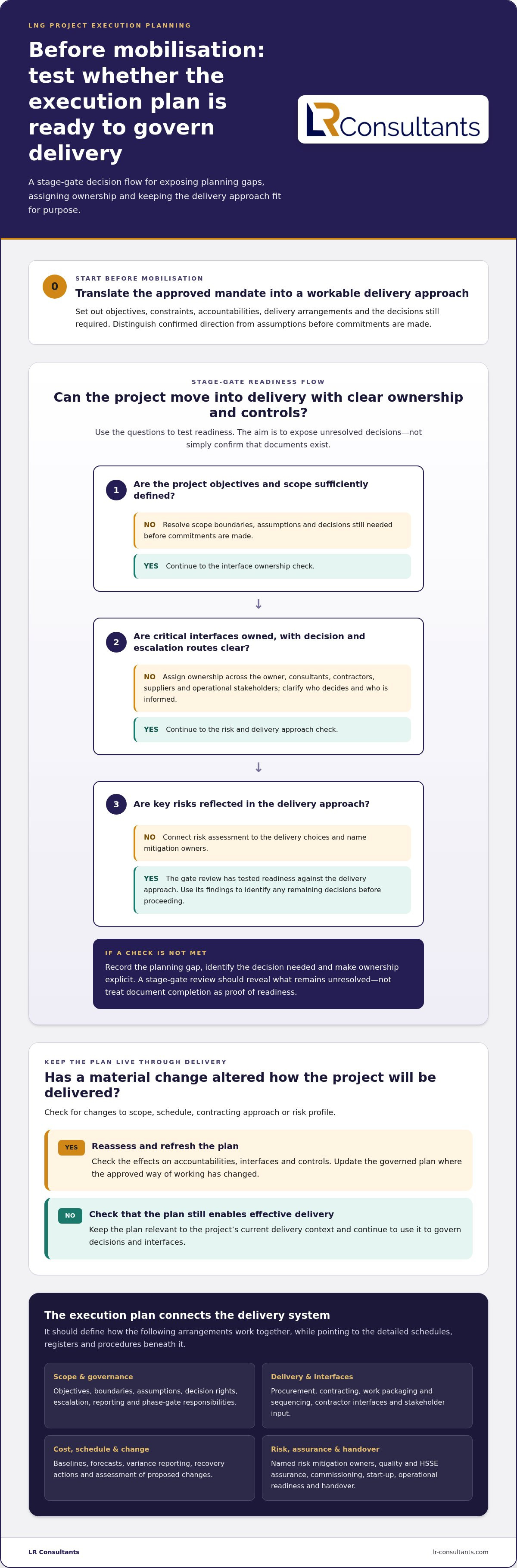
Start developing the plan before mobilisation, while there is still time to shape delivery choices and assign ownership. Use stage-gate reviews to test whether the project is ready to proceed: are objectives and scope sufficiently defined, are critical interfaces owned, and are key risks reflected in the delivery approach? A useful review exposes unresolved planning gaps and identifies the decisions needed, rather than simply confirming that documents exist.
Refresh the plan when a material change alters how the project will be delivered. A shift in scope, schedule, contracting approach or risk profile may affect accountabilities, interfaces and controls. The question is not only whether the baseline has changed, but whether the approved way of working still enables the team to deliver and govern the project effectively.
What a project execution plan should contain
A useful plan sets out how the project will be governed and delivered, then points to the schedules, registers and procedures that put those arrangements into practice. It should connect decisions across disciplines rather than reproduce every supporting document. For an LNG development, this means showing how scope, contracting, interfaces, controls and readiness arrangements combine to support delivery from the owner’s perspective.
Scope, governance and delivery strategy
Establish the project objectives, scope boundaries, assumptions and key interfaces. State how proposed scope changes will be assessed, authorised and reflected in the approved baseline. Governance should identify decision rights, escalation routes, reporting cadence and phase-gate responsibilities, so teams know who can decide, who provides advice and who must be informed.
The delivery strategy should explain how procurement and contracting support the project objectives. Set out the intended packaging and sequencing of work, the owner’s role in managing contractor interfaces, and how supplier and operating stakeholder input will be coordinated. The PMBOK Guide for project execution offers a broader reference for project management practices; the execution plan must translate relevant principles into arrangements suited to the project.
Controls, risk and readiness arrangements
Define how the team will establish and maintain cost and schedule baselines, produce forecasts, report variance and develop recovery actions. A forecast should support decisions, not simply describe performance. Connect risk assessment to named mitigation owners and decision-making, and explain how proposed changes will be reviewed for their effects on scope, cost, schedule, risk and interfaces.
At plan level, specify how quality and HSSE assurance will be organised, how commissioning and start-up will interface with construction, and how operational readiness and handover will be governed. Detailed inspection and test plans, risk registers and commissioning procedures sit beneath the execution plan. The plan defines their purpose, ownership and relationship to delivery controls.
The table below summarises the plan elements an owner should expect to see, who is accountable for each and the artefacts that evidence them. It is deliberately LNG-aware: licensor, feedgas, cryogenic procurement and cool-down arrangements sit alongside the conventional governance and controls elements. Each row of the plan elements table maps to a section of this article.
| Plan Element | Strategic Purpose | Accountable Owner | Supporting Artefact |
|---|---|---|---|
| Objectives and Scope | Define facility battery limits, feedgas envelope, and baseline assumptions. | Project Sponsor | Approved Scope Statement and Assumptions Register |
| Governance and Change | Set decision authority, partner voting thresholds, and change control. | Project Director | Decision-Rights Matrix (RACI) and Baseline Change Log |
| Delivery and Contracts | Align package boundaries, contracting models (LSTK vs split EPC), and interfaces. | Contracts Lead | Contracting Strategy and Master Procurement Schedule |
| Licensor Interfaces | Govern process guarantees, proprietary equipment supply, and vendor lists. | Technical Director | Licensor Interface Register and Guarantee Matrix |
| Long-Lead Procurement | Safeguard early orders for MCHEs, valves, compressors, and tanks (novation vs free-issue). | Procurement Lead | Long-Lead Tracking Schedule and Novation Deeds |
| Controls and Risk | Link integrated schedules with P50 and P80 reserves (QSRA/QCRA) and safety cases (QRA). | Controls Lead | Master Schedule, Cost Model, and SRA/CRA Outputs |
| Quality and Safety | Coordinate technical assurance, major hazard barriers, and operational readiness. | HSSE / Quality Lead | Facility Safety Case and Quality Verification Dossiers |
| Commissioning and Handover | Sequence purging, cool-down, BOG management, and first cargo loading. | Commissioning Lead | Commissioning Sequence and System Turnover Dossiers |
How to connect project controls, interfaces and delivery responsibilities
A project execution plan becomes a control framework only when its management processes work together. Separate cost reports, schedules and risk registers can each be accurate yet give decision-makers an incomplete picture if they use different assumptions or leave dependencies unowned. The plan should establish how information flows between them, how exceptions are assessed and who has authority to act.
An integrated control baseline links approved scope to the cost, schedule and risk information needed for consistent delivery decisions. This connection helps the project team trace a forecast variance to its source, assess the consequences and decide whether corrective action or formal change is required.
Integrating the cost, schedule, risk and change baselines
Start with approved scope and its work breakdown, which provide the basis for estimating the resources, contracts and activities required. The schedule should represent the logic and dependencies between that work, while cost estimates and forecasts should reflect the same scope, timing and resource assumptions. If one baseline changes without the others being assessed, the project can end up reporting progress against an increasingly inconsistent picture.
Risk and change processes must feed this control cycle. For example, a supplier delivery risk may require a mitigation action, a revised forecast or a decision about sequencing. Reporting should distinguish the approved baseline from the current forecast, explain material variance and identify the decision required, with an accountable owner and due point for each action.
Making interfaces and accountabilities visible
Use a responsibility matrix to assign an accountable owner for decisions, deliverables and approvals. It should make the boundary between owner oversight and contractor execution explicit. The owner sets objectives, approves changes within its authority and monitors performance; contractors remain accountable for executing their contracted scope and reporting through agreed arrangements. Consultants may support analysis or assurance without taking over either role.
An interface register records dependencies that cross work packages, sites, systems or organisations. For an LNG project, it could track a connection between a process package, utilities provision and the operating team’s acceptance requirements. Each interface needs an owner, the information or deliverable required, the relevant dependency date or decision point, and a route for resolving disagreement.
Interface accountability only works if each party’s role is stated plainly. At a minimum, map responsibilities across these parties:
- Owner: investment objectives, governance decisions, approved scope and acceptance criteria.
- Consultants: defined advisory, assurance or coordination deliverables under their agreed scope.
- Contractors and suppliers: execution and supply obligations, interface information and progress reporting under their contracts.
- Operating stakeholders: operational requirements, readiness input and agreed handover participation.
Link interface and change routes to project reporting and escalation thresholds. An unresolved technical dependency should not remain buried in meeting minutes: record its consequence, decision owner and escalation path. This is a practical discipline in developing a project execution plan that keeps emerging issues visible and enables the owner to exercise control without substituting for contractor delivery.
LNG lifecycle: from Pre-FEED to first cargo
An owner-side execution plan for LNG has to follow the asset through its distinct lifecycle stages, because each stage carries different decisions, risks and evidence requirements. Developing the plan is a structured exercise in turning the approved project basis into delivery arrangements that can be tested, owned and governed, so begin with the decisions the plan must enable rather than a blank template. The stages below, from the approved mandate through to performance acceptance, set out what the plan should address and the records the owner can govern at each point.
Pre-FID Definition
Pre-FEED, FEED and FID gating
Pre-FEED tests site, capacity, feedgas and commercial assumptions, and narrows technology and configuration options. FEED then fixes the design basis, including liquefaction technology licensor selection and refrigerant compressor driver trade-offs, such as gas turbine against electric motor drive. FID gating should require a defined scope, a contracting strategy, a risk-informed estimate and schedule, and confirmed commercial and regulatory positions before capital is committed.
Quantitative risk analysis and P50/P80 targets
A risk register alone does not set contingency, and three distinct analyses should not be conflated. Quantitative risk analysis (QRA) is probabilistic major accident hazard modelling, such as blast overpressure, thermal radiation contours and cryogenic pool dispersion, used for safety regulators and siting requirements. Quantitative schedule risk analysis (QSRA) and quantitative cost risk analysis (QCRA) instead use Monte Carlo simulation to model schedule and cost uncertainty. Contingency is then allocated from the gap between base estimate and the chosen confidence level, and the project sets P50 and P80 contingency reserves and dates for FID and Commercial Operation Date (COD). Owners typically hold the P80 position as the funding and commercial reference, while delivery teams manage to P50 targets.
Fabrication and Transport
Modularisation and stick-built logistics
The choice between modules and stick-built construction shapes the whole execution plan. For modular delivery, the plan should govern module fabrication yard selection, heavy marine transport, customs and importation clearance, and jetty offloading limitations. A weight-and-dimensional control process, with named ownership and formal change authority, keeps module envelopes consistent with transport, lifting and site-fit constraints.
Licensor, EPC contractor and owner governance
Technologies such as Air Products AP-C3MR, ConocoPhillips Optimized Cascade and Shell DMR bring a licensor into the delivery chain alongside the owner and the EPC contractor. The plan should define this triangular relationship: who holds and backs performance guarantees, how the approved equipment vendor list is maintained, how proprietary equipment is specified and delivered, and how design changes are approved without diluting guarantees.
Long-lead cryogenic procurement
Cryogenic valves, nickel-steel or 9% Ni containment tanks, main cryogenic heat exchangers (MCHEs) and large-frame gas turbines and compressors often sit on the critical path. Where they are ordered before full EPC mobilisation, the plan should state who places and manages the orders and how fabrication surveillance, expediting and delivery dates feed the integrated schedule. It must also state whether each item is novated or assigned/free-issued. Novation transfers contractual privity and warranty liabilities entirely to the EPC contractor; free-issue or principal assignment leaves underlying manufacturer interface risks with the owner.
Upstream and feedgas readiness
Feedgas readiness is a delivery dependency, not an external assumption. The plan should track upstream supply readiness, gas specification matching, feedgas pipeline tie-ins, slug catchers, acid gas removal units (AGRU) and mercury removal systems, with owned interfaces and dated decision points so first gas is not constrained by the upstream schedule.
Commissioning and Start-up
Cryogenic commissioning, cool-down and flaring
LNG commissioning follows a defined sequence: nitrogen leak testing, inerting and drying, including perlite and insulation drying, followed by cold-box cool-down, line packing and LNG storage tank cool-down. Boil-off gas (BOG) handling must be planned for each step. Environmental flaring constraints limit when and how long the facility can flare during commissioning, so the plan should link them to the start-up schedule and permits, leading through first cargo to performance testing.
LNG delivery, commercial and governance interfaces
LNG projects are shaped by partners, lenders, buyers and authorities as much as by contractors. The owner’s plan should show how each of these interests is reflected in project controls.
Contracting models and interface management
Interface exposure depends on the contract archetype. Split EPC or EPIC arrangements, multiple lump-sum turnkey (LSTK) packages, reimbursable convertible contracts and owner-managed interfaces each allocate risk differently. Under multiple LSTK packages, the owner often carries the interface risk between them; under a single wrap, the contractor does. The plan should state which model applies, who owns each interface and how disputes are resolved.
Unincorporated joint venture governance
In an unincorporated joint venture (UJV), the plan must go beyond an owner-contractor model. It should set Operating Committee (OpCo) review cycles, partner audit rights, joint technical committees and cash-call governance under the Joint Operating Agreement (JOA), so partner approvals are sequenced ahead of commitments and funding calls.
Offtake, financing and COD
Project controls should be tied to commercial drivers. Long-term Sale and Purchase Agreements (SPAs) set delivery windows, and COD liquidated damages make schedule slippage a direct financial exposure. Lenders will test bankability through Independent Engineer oversight, including under the Equator Principles, so reporting should be capable of withstanding that scrutiny. Our article on avoiding costly project financing mistakes covers related ground.
Regulatory, permitting and marine interfaces
The plan should schedule engagement with port and maritime authorities, define terminal exclusion zones, and track safety approvals such as those of the USCG and FERC or national equivalents. Environmental permits, including dredging, ballast water management and flaring limits, should be on the critical path with named owners. Permitting and engineering interfaces should also carry methane monitoring, leak detection and electrification or carbon-intensity baselines, so greenhouse gas and methane abatement requirements are met for bankability.
Early operational readiness
Operations and maintenance teams should be integrated 24 to 36 months before start-up. Their early work covers operating procedures, the computerised maintenance management system (CMMS), operator training simulators (OTS) and operator training, and oversight of factory acceptance testing (FAT), so operability is built in rather than discovered during commissioning.
A readiness review should test whether the people assigned to deliver the work understand their responsibilities and can act on the plan, not simply whether its sections are complete. This helps decision-makers identify where further definition, capability or coordination is needed before mobilisation proceeds.
Keep the project execution plan live through delivery and handover
An approved project execution plan is a controlled reference, not a document to file and forget. Governance reviews should test whether its assumptions, responsibilities and delivery arrangements still reflect approved scope and actual project conditions. The purpose is not to revise the plan for every routine fluctuation, but to identify changes that affect how the project is governed, controlled or prepared for operations.
Governance, assurance and controlled updates
Assign a named role to maintain the plan, define who approves revisions and establish how updates reach affected teams. A change to a delivery interface, for example, may affect contractor responsibilities, schedule logic, risk exposure and cost forecasts. Assess these effects together, then record the decision, approval and supporting project records so the current plan remains traceable to its authority.
Regular governance reviews and project health reporting should surface emerging risks, gaps in delivery arrangements and decisions that are becoming overdue. Assurance can test whether the plan is being followed and whether its controls remain effective, rather than simply confirming that documents are present. When an assumption changes, record the new basis, its implications and the owner responsible for action. Keep the approved baseline distinct from current forecasts, and make the reasons for any baseline revision clear.
From execution planning to operational handover
Handover should be governed as part of delivery, not treated as administrative close-out after construction. The execution approach needs to connect construction completion with commissioning, start-up and operational readiness, including responsibilities and acceptance points between project and operations teams. This helps identify information, decisions and resources that must be available before a facility can be transferred into operational control.
For an LNG facility, the handover process should make clear how completion records, operating information, outstanding actions and responsibility for remaining work are managed. The project and operating teams need an agreed view of what is complete, what remains open, who owns each action and how unresolved items are controlled. These arrangements should appear in governance and reporting, so readiness issues are visible before the transition rather than discovered at the point of transfer.
Set the next delivery decision up for control
Test whether your execution plan gives decision-makers a clear basis for action when it matters. Before the next gate or mobilisation commitment, identify which assumptions remain unresolved, what evidence will support the decision and who must act if conditions change. This review can show where developing a project execution plan needs further work, without treating the document as an end in itself.
LR Consultants brings senior-led involvement to client engagements, with integrated project controls across cost, schedule, risk, change and interfaces. Its independent oversight supports client control without substituting for contractor responsibilities.
Discuss independent, owner-aligned project management advisory with LR Consultants to establish a clear basis for your project’s next delivery decisions.
Frequently Asked Questions
What is the difference between a project execution plan and a project proposal?
A proposal supports a decision to approve or develop a project; an execution plan guides the organisation of authorised work. A practical distinction is audience and purpose: a proposal helps decision-makers assess the case and options, while the plan tells delivery teams how approved direction will be put into practice. If options remain open, record them as decisions to resolve rather than treating a preferred option as an approved commitment.
When should a project execution plan be developed?
Start the plan early enough to inform decisions that shape mobilisation, then increase its detail as project definition advances. The appropriate point depends on which decisions are approaching and how much is known about scope and delivery. If procurement packaging must be agreed before tender preparation, for example, define the relevant delivery strategy and accountabilities before that work begins, rather than after a contractor is selected.
Who is responsible for maintaining a project execution plan?
The project organisation should assign a named plan custodian, usually within its project management function, and document that responsibility in the governance arrangements. This role coordinates contributions and controls the authoritative version; it need not personally own every technical or commercial input. Discipline leads remain responsible for the accuracy of their information, while designated approvers retain authority over revisions that affect approved direction.
How often should a project execution plan be reviewed?
Set the review frequency to match governance meetings and decision gates, then review sooner when a change could affect delivery arrangements. A useful review checks whether the plan remains usable, not merely whether it has a recent revision date. The review record can capture the version considered, unresolved actions, decisions required and whether a formal update is warranted.
Does a project execution plan include commissioning and handover?
Yes, at the level of governance, responsibilities and interfaces. The plan should show how commissioning and transition to operations connect with the wider delivery sequence; detailed test procedures and handover dossiers belong in supporting documents. Check that operations representatives know when their input is required and how acceptance evidence, open items and transfer decisions will be managed.
Can a project execution plan change after project approval?
Yes. The plan can be revised through the project’s authorised governance process when an approved decision or material change alters delivery arrangements. Keep a revision history that identifies what changed, why, who approved it and which related documents require alignment. This distinguishes an authorised update from a working draft and clarifies the basis on which delivery teams are operating.
How does an owner-side project manager support execution without replacing the contractor?
An owner-side project manager helps the client organise oversight and make informed decisions, while the contractor remains responsible for delivering its contracted work. Support may include reviewing progress information, coordinating owner decisions and identifying matters that need escalation. Reflect the boundary in governance and contract interfaces, so oversight informs client action without creating ambiguity about who directs or performs contractor activities.
What should an LNG project execution plan include?
An LNG project execution plan should define how the project will be organised, governed, controlled and delivered from project definition through construction, commissioning and operational handover. Core elements typically include the project scope and objectives, delivery strategy, organisation and responsibilities, engineering and design management, procurement, construction, cost and schedule controls, risk management, interface management, quality assurance, HSSE, commissioning and operational readiness. The plan should also address LNG-specific requirements, including liquefaction technology and licensor interfaces, feedgas infrastructure, cryogenic equipment, storage and export facilities, LNG carrier interfaces and first-cargo readiness. Its purpose is to establish one integrated delivery framework rather than a collection of disconnected discipline plans.
When should an LNG project execution plan be prepared?
An LNG project execution plan should be initiated during early project development and progressively matured through Pre-FEED, FEED and the final investment decision (FID). Early versions establish the proposed delivery model, governance, responsibilities, project controls and key execution risks. As engineering and commercial definition advance, the plan should incorporate more detailed procurement strategies, contracting arrangements, construction methods, commissioning requirements and operational readiness activities. The level of detail should reflect the decisions that must be made at each stage gate, with the plan sufficiently developed to support FID and subsequent mobilisation.
What are the main execution risks in an LNG project?
Major LNG project execution risks include incomplete engineering definition, cost escalation, schedule delays, liquefaction technology interfaces, long-lead equipment procurement, feedgas infrastructure readiness, construction productivity, modularisation and transport constraints, contractor coordination, regulatory approvals and commissioning complexity. Commercial risks can also arise from misalignment between EPC contracts, LNG sales agreements, feedgas supply arrangements and shipping commitments. Effective execution planning identifies these interdependencies early, assigns accountable risk owners, establishes mitigation actions and integrates risk exposure into cost forecasts, schedule analysis and management decisions.
How does feedgas readiness affect LNG project execution?
Feedgas readiness is a critical dependency because the liquefaction facility cannot complete integrated commissioning and commence sustained LNG production without an adequate, specification-compliant gas supply and the necessary upstream and transportation infrastructure. The execution plan should coordinate upstream development, gas processing, pipelines, utilities, power supply, control systems and interface testing with the LNG plant’s construction and commissioning sequence. It should also define the evidence required to demonstrate gas availability, quality, pressure and delivery reliability before commissioning milestones. Poor alignment between feedgas infrastructure and LNG plant readiness can delay start-up even when the liquefaction facility itself is mechanically complete.
How should an LNG project execution plan manage EPC contractors and technology licensors?
The plan should establish clear contractual responsibilities, interface ownership, decision rights and escalation procedures across the owner, EPC contractors, engineering contractors, technology licensors and major equipment suppliers. It should identify interfaces involving process design, proprietary technology, equipment specifications, design approvals, vendor data, construction, commissioning and performance testing. An integrated interface register should assign an accountable owner and required completion date to each critical interface. Contractual boundaries must remain clear: coordination and owner oversight should improve integration without unintentionally transferring responsibilities or changing obligations established in the relevant contracts.
How should long-lead equipment be managed in an LNG project?
Long-lead equipment should be identified early through the procurement and engineering strategy, with procurement dates linked to design maturity, vendor data requirements, manufacturing capacity, inspection and testing, transport logistics and construction priorities. LNG developments may depend on specialised liquefaction equipment, compressors and drivers, cryogenic heat exchangers, storage tanks and other critical systems with lengthy manufacturing and delivery periods. The execution plan should track procurement milestones alongside the integrated project schedule, identify dependencies on engineering approvals and vendor documentation, and assess the consequences of late delivery. Early procurement can protect the schedule, but commitments should be governed by appropriate technical definition, commercial approvals and risk controls.
How should cost contingency and schedule risk be assessed for an LNG project?
Cost contingency and schedule risk should be assessed using a structured process that combines a credible project estimate and integrated schedule with identified risks, uncertainty analysis and management review. Quantitative cost risk assessment (QCRA) and quantitative schedule risk analysis (QSRA) can help evaluate the range of potential outcomes and the likelihood of achieving target dates or budgets. P50 and P80 results represent different confidence levels in the modelled outcomes; they are not universal rules for setting budgets or contingency. The appropriate funding basis and schedule commitments depend on project maturity, risk appetite, governance requirements, contractual arrangements and financing conditions.
What is the role of commissioning and operational readiness in an LNG project execution plan?
Commissioning and operational readiness must be planned before construction is complete, not treated as activities that begin only when the facility is handed over. The execution plan should connect systemisation, mechanical completion, pre-commissioning, commissioning, start-up, performance testing, operator training, procedures, maintenance readiness, spare parts and regulatory requirements. For an LNG facility, planning may also need to address feedgas introduction, liquefaction system start-up, cryogenic cool-down, boil-off gas management and coordination with storage, loading and shipping systems. Clear acceptance criteria and accountable handover arrangements help reduce delays between construction completion and reliable operations.
Does first LNG cargo mean an LNG project has achieved commercial operation?
Not necessarily. First LNG cargo is an important delivery milestone, but it does not automatically demonstrate that every contractual performance test has been passed, that all outstanding work is complete or that commercial operation has formally commenced. The definition of commercial operation depends on the relevant project agreements, financing documents, EPC contract and other applicable arrangements. The execution plan should distinguish first LNG production, first cargo loading and delivery, performance testing, contractual acceptance and any defined commercial operation date. These milestones should have clear prerequisites, accountable parties and documented evidence of completion.
How can an independent project management consultant improve LNG project execution?
An independent project management consultant can help an LNG project owner strengthen governance, challenge delivery assumptions, improve the integration of cost, schedule and risk information, and identify execution gaps before they become major problems. Depending on the agreed scope, support may include reviewing the project execution plan, assessing contractor and licensor interfaces, evaluating schedule and cost risks, examining procurement and commissioning readiness, and providing independent reporting to sponsors or investment committees. The consultant should work within a clearly defined mandate, preserve the owner's decision-making authority and avoid duplicating or obscuring the contractual responsibilities of EPC contractors and other delivery parties.
What should be completed before FID on an LNG project?
Before the final investment decision, the project sponsor should establish sufficient technical, commercial, financial, regulatory and execution definition to support an informed investment decision. The required evidence depends on the project structure and applicable approval requirements, but commonly includes a developed design basis, credible capital and operating cost estimates, an integrated development schedule, a contracting and delivery strategy, a risk assessment, a regulatory and environmental approvals plan, feedgas arrangements and a commissioning and operational readiness strategy. The project execution plan should make outstanding decisions, assumptions, dependencies and post-FID commitments visible so that the investment decision is based on a clear understanding of delivery requirements and residual risk.
How should an LNG project execution plan align with LNG sales agreements and shipping arrangements?
The execution plan should identify the interfaces between plant delivery and the commercial arrangements governing feedgas supply, LNG sales, shipping and export operations. These arrangements can impose requirements for production availability, cargo scheduling, LNG specifications, storage capacity, loading systems, vessel compatibility and delivery windows. The plan should translate relevant contractual obligations into engineering requirements, readiness criteria, interface responsibilities and schedule milestones. Early alignment helps expose mismatches between when the facility is expected to produce LNG and when the wider supply chain is contractually and operationally ready to receive and deliver it.
How can an LNG project execution plan reduce the risk of delayed first cargo?
A well-integrated execution plan reduces first-cargo delay risk by managing the dependencies that determine whether the entire LNG value chain is ready, rather than measuring the liquefaction plant in isolation. This includes engineering completion, critical equipment delivery, construction and system completion, utilities availability, feedgas readiness, commissioning procedures, operator competence, storage and loading readiness, shipping interfaces and required approvals. The plan should identify the critical path, establish measurable readiness criteria, assign accountable owners to cross-project interfaces and escalate emerging threats early. Regular integrated reviews should test whether the project is genuinely on track for first cargo, rather than relying solely on reported construction progress.
Deliver Your LNG Project with Greater Control and Confidence
Developing an LNG project from Pre-FEED through to first cargo requires more than sound engineering. It demands integrated project management, disciplined cost and schedule control, effective contractor and licensor interfaces, robust risk management and clear governance at every stage gate.
LR Consultants supports LNG project owners, investors and project sponsors with independent, owner-aligned project management advisory and execution assurance. We help clients strengthen project execution plans, integrate cost, schedule and risk controls, manage critical interfaces and improve visibility of the decisions that determine delivery performance.
Our approach helps identify execution gaps early, protect the owner's interests and maintain control as the project progresses from definition and FID through construction, commissioning and operational handover.
Planning an LNG development or preparing for the next project stage gate?
Contact LR Consultants to discuss how our energy-sector expertise can help strengthen your project execution strategy and establish a clear, controlled route to first cargo.


