

Article by
Jacobus Nieuwenhuijze
Jacobus Nieuwenhuijze (CEO, and Founder of LR Consultants) is a senior energy executive with over 40 years of international experience across five continents and more than US$23 billion in successfully executed projects. He specialises in project initiation, concept development, front-end loading (FEL), CAPEX optimisation and project financing, transforming complex concepts into bankable business cases and high performing assets. His experience spans major greenfield and brownfield developments, with a proven track record in technical, commercial and strategic leadership across complex energy and industrial projects. Jacobus’s expertise in complex energy infrastructure projects has evolved into applying “Big Oil” execution rigor to the “Energy Transition”, where he currently leads decarbonisation and low carbon fuel developments, ensuring the next generation of energy assets are built on sustainable principles.
Executive Summary
Post-merger integration (PMI) is where the strategic and financial rationale for an acquisition must translate into measurable business performance. Yet even well planned transactions can lose value after completion when integration priorities are unclear, accountability is fragmented, operational risks are underestimated or expected synergies fail to materialise.
A successful post-merger integration strategy requires more than combining organisational structures and systems. It needs a controlled execution framework that protects business continuity, establishes clear decision rights, manages interdependencies and tracks benefits against the original acquisition objectives.
The first 100 days are particularly important. Pre-close planning, Day 1 operational readiness, early stabilisation, coordinated integration workstreams and disciplined benefits tracking help establish control while avoiding unnecessary disruption. In energy and industrial businesses, this must also address asset integrity, process safety, HSSE, maintenance and reliability, capital expenditure priorities, project delivery and the interfaces between operating assets and ongoing projects.
Effective PMI combines integration governance, operational risk management, structured delivery plans and measurable synergy realisation. An executive dashboard should make progress, critical risks, unresolved decisions, integration costs and value delivery visible, enabling leadership to intervene before issues undermine performance.
LR Consultants supports energy and industrial businesses, investors and asset owners with independent, senior-led post-merger integration and M&A advisory. Services can include PMI strategy, first 100 days planning, integration governance, operational and project integration, risk and dependency management, executive reporting and independent reviews of value realisation.
Introduction
Closing a deal begins the operating transition; it does not prove that value has been secured. For oil and gas leaders, knowing how to manage post-merger integration means deciding what to combine, what to preserve and how to expand capital expenditure (CAPEX) without compromising safe, reliable operations.
Integration can falter when decisions lack clear owners, workstreams make conflicting assumptions, or changes to systems, teams and operating practices create unmanaged risk. Moving too quickly can disrupt asset performance; waiting too long can delay the value case. A sequenced operating plan helps leaders manage both risks.
This article sets out a practical approach to accountable governance, operational continuity and CAPEX prioritisation. It explains how to assess integration choices, link investment decisions to readiness, and track benefits, risks and actions through a delivery roadmap.
First 100 days: a practical PMI framework
A disciplined first-100-days plan connects pre-close preparation with safe operational control, integration execution and measurable value delivery. The sequence should be tailored to the transaction, but each stage should have defined entry criteria, decision rights and principal deliverables.
- Pre-close planning. Translate the deal rationale into a draft integration thesis, value-driver map and workstream structure. Identify critical assets, safety-critical elements, process-safety controls, maintenance obligations, HSSE requirements, operational interfaces and active CAPEX or projects that could be affected. Define the proposed sponsor, integration leader, workstream owners, decision rights, Day 1 actions, dependencies and escalation routes within applicable transaction and confidentiality constraints. Principal deliverables: draft integration roadmap; value-driver and synergy register; Day 1 readiness checklist; initial asset-integrity, process-safety and operational-continuity risk assessment; project and CAPEX interface map; governance charter; risk, dependency and decision registers.
- Day 1 readiness. Confirm that the combined organisation can operate safely and continuously from completion. Protect authority for operations, control rooms, maintenance, emergency response, HSSE reporting, permits, technical integrity and customer or infrastructure commitments. Confirm access to critical systems, contact lists, approvals, contractor arrangements and escalation channels without introducing untested changes to operating procedures or safety-critical controls. Principal deliverables: Day 1 command-and-control plan; continuity and emergency arrangements; confirmed accountable operational owners; communications pack; critical access and data checklist; open-issue log; first-week meeting and reporting cadence.
- Days 2–30: stabilisation. Establish a fact base and stabilise the operating environment before pursuing broad standardisation. Verify production and service continuity, process-safety performance, asset-integrity threats, maintenance backlogs, competence coverage, HSSE actions, regulatory commitments and critical supplier or contractor interfaces. Triage decisions into protect, validate and change, and stop or sequence changes where readiness or control evidence is insufficient. Principal deliverables: 30-day stabilisation report; validated critical-risk register; asset and maintenance baseline; process-safety and HSSE action plan; operational-readiness assessment; confirmed workstream charters; prioritised decision log; updated CAPEX and project-interface register.
- Days 31–60: integration execution. Start approved workstreams in the sequence agreed by leadership. Align operating-model changes with management of change, technical-integrity assurance, maintenance strategies, procurement, information systems and workforce capability. For active or proposed CAPEX, confirm scope maturity, cost and schedule basis, project controls, interfaces with operations and the receiving asset’s readiness for commissioning, handover and start-up. Use stage gates for material investment decisions rather than allowing integration momentum to substitute for project definition. Principal deliverables: approved workstream plans; integrated master schedule; dependency and interface matrix; management-of-change records; CAPEX gate packs; project-controls and assurance plan; training and competence plan; operational-readiness and handover plan.
- Days 61–100: benefits tracking and controlled transition. Move from activity reporting to evidence of outcomes. Validate early benefits against baselines, confirm that controls remain effective, reconcile integration expenditure and resource consumption, and reforecast benefits where assumptions or delivery conditions have changed. Review unresolved decisions, operational performance, CAPEX milestones and risk exposure at executive level, then set the next 100-day plan with clear ownership. Principal deliverables: benefits-realisation report; cost-to-integrate and forecast-to-complete view; reconciled synergy register; executive dashboard; independent review findings where required; residual-risk and dependency plan; decision log with due dates; transition plan for business-as-usual ownership.
Key Takeaways
- Translate the deal rationale into operating priorities, measurable outcomes and accountable owners.
- Define decision rights, escalation routes and reporting expectations so leaders and workstream owners know who is responsible.
- Decide what to integrate, preserve or sequence based on strategic value, operational dependencies, risk and capacity for change.
- Use a controlled roadmap to test assumptions, manage interfaces and review evidence before advancing work or committing capital.
- Use independent oversight to challenge assumptions and coordinate complex interfaces while client leadership retains decision-making responsibility.
How to manage post-merger integration: define the value and protect continuity
Post-merger integration is the coordinated transition from a transaction’s rationale to an operating model capable of delivering its intended value. Due diligence informs the work, but integration tests the deal thesis against operating reality and turns it into decisions, actions and evidence of progress. A broad overview of Post-merger integration (PMI) describes the concept. For oil and gas leaders, the practical test is whether the combined business can realise value without weakening asset performance.
Start with the specific rationale for the transaction, not a generic synergy target. The thesis might involve combining adjacent operations, improving access to infrastructure, developing an asset or expanding capacity. Translate each value driver into an observable outcome, identify the assumptions it depends on, and assign an owner to validate them. If the value case relies on shared maintenance resources, for example, assess whether skills, systems, work processes and asset requirements can be aligned.
This is central to how to manage post-merger integration in an asset-intensive business. Safe, reliable operations constrain the pace and sequence of change. Production, process safety, asset integrity and customer commitments must remain controlled while the organisation changes around them.
Turn the deal thesis into integration outcomes
For each value driver, define the intended outcome, a suitable measure, an accountable owner and a point for review. Separate established facts from hypotheses that need post-close testing. Then map dependencies: a commercial objective may rely on operating changes, capital approval, procurement capacity or information systems. This helps leaders distinguish a supported opportunity from an assumption that remains untested.
Set boundaries before changing the business
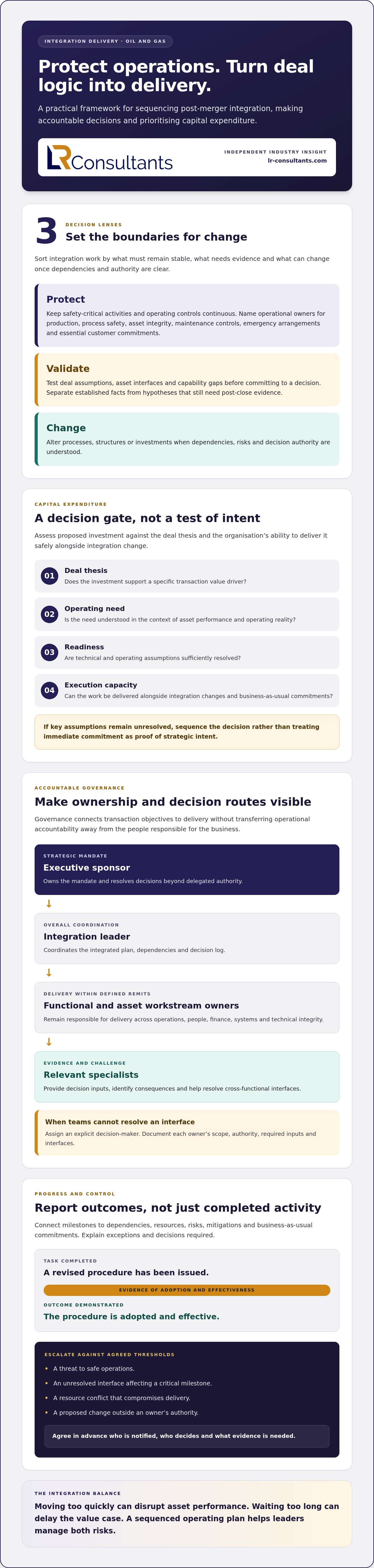
Before consolidating functions or changing procedures, identify what must remain stable and who has authority to approve change. This includes safety-critical activities, maintenance controls, emergency arrangements, customer interfaces and commitments essential to ongoing operations. Changes affecting technical integrity, HSSE or regulatory matters need appropriate specialist input. Combining teams or systems quickly is not progress if it creates unmanaged risk.
A useful starting register groups work into three categories:
- Protect: Activities and controls that must continue without interruption, with named operational owners.
- Validate: Value assumptions, asset interfaces and capability gaps that need evidence before a decision.
- Change: Processes, structures or investments that can be altered once dependencies, risks and decision authority are clear.
This boundary-setting also helps shape CAPEX priorities. Assess proposed investments against the deal thesis, operating need, readiness and capacity to execute alongside integration changes. If technical or operating assumptions remain unresolved, sequence the decision rather than treating immediate commitment as proof of strategic intent.
Build post-merger integration governance around accountable decisions
Integration governance should make clear who decides, who delivers and how unresolved issues reach someone with authority to act. It connects transaction objectives to workstream delivery while keeping business-as-usual responsibilities visible.
Scale the structure to the transaction. An acquisition involving a single asset may need a lean leadership forum and a small number of accountable owners. A combination spanning upstream operations, processing facilities, pipelines or LNG activities may need more formal coordination because decisions can affect shared infrastructure, capital plans, technical standards and operating interfaces. Governance should reflect the operating model and risk profile, not simply the organisation chart.
Assign integration leadership and workstream ownership
Name an executive sponsor to own the strategic mandate and resolve decisions beyond delegated authority. An integration leader coordinates the overall plan, dependencies and decision log; functional and asset workstream owners remain responsible for delivery within their remits. Coordination does not transfer accountability from those responsible for operations, people, finance, systems or technical integrity.
Document each owner’s scope, authority, required inputs and interfaces. A proposed maintenance-process change, for example, may involve asset operations, engineering, procurement and finance. One owner should bring the decision forward, while relevant specialists provide evidence and identify consequences. Assign an explicit decision-maker to unresolved cross-functional issues rather than expecting teams to settle them informally.
Make progress and risk visible to decision-makers
Use an integrated plan to connect milestones with dependencies, resources, risks, mitigations and business-as-usual commitments. Reporting should distinguish completed activity from achieved outcomes: issuing a revised procedure is a task; demonstrating that it is adopted and effective is evidence of progress. Explain exceptions and decisions required rather than relying on status colours without context.
Agree escalation thresholds at mobilisation. These could include a threat to safe operations, an unresolved interface affecting a critical milestone, a resource conflict that compromises delivery, or a proposed change outside an owner’s authority. Specify who is notified, who decides and what evidence is needed, so leaders can intervene before an issue disrupts operations.
A useful governance pack brings together:
- Delivery: Milestones, owners, slippage and recovery actions.
- Value: Benefit measures, validation status and material changes to assumptions.
- Control: Significant risks, mitigations, dependencies and decisions awaiting resolution.
- Operations: Business-as-usual impacts, capacity constraints and issues requiring specialist review.
Keep decision forums purposeful. Workstream owners should handle routine delivery, integration leadership should address cross-functional trade-offs, and the sponsor or executive body should decide material changes to strategic priorities. Set a cadence that reflects active risks and the evidence available. Record decisions, conditions and owners so later reviews can establish what changed and why.
Use an integration management dashboard
A practical dashboard should give the sponsor and workstream owners one view of value, risk, operating performance and decisions. Metrics should be trendable, assigned to named owners and supported by evidence rather than status colour alone.
| Dashboard area | Sample metrics | Accountability and action |
|---|---|---|
| Value delivery | Validated benefits; realised versus forecast value; benefit confidence; integration cost to date; net value versus original deal case | Benefit owner reports variance, evidence and recovery action; finance reconciles the position |
| Critical risks | Open high-severity risks; overdue mitigations; safety-critical or asset-integrity threats; process-safety and HSSE actions; management-of-change items | Risk owner records treatment, due date and escalation threshold; sponsor accepts or directs action |
| Operational performance | Production or throughput continuity; unplanned downtime; maintenance backlog; overdue safety-critical maintenance; reliability; permit, incident and emergency-readiness indicators | Asset and operations leaders explain deterioration and protect safe operating boundaries |
| CAPEX and project milestones | Stage-gate status; scope maturity; forecast cost and schedule; procurement and contract milestones; critical-path slippage; commissioning and handover readiness | Project owner reports recovery plan and interfaces with operations, maintenance and technical integrity |
| Readiness | Workstreams mobilised; procedures approved and adopted; training and competence completion; systems and data readiness; open operational-readiness actions | Integration leader coordinates evidence; receiving operational owner confirms readiness to accept change |
| Unresolved decisions | Decisions overdue; days awaiting decision; decisions affecting critical milestones; decision dependencies; items beyond delegated authority | Named decision-maker, required evidence and escalation date are visible for every item |
| Accountability | Milestones on time; actions overdue; benefits without owners; risks without mitigations; workstreams with incomplete reporting | Workstream owner is accountable for correction; integration leader escalates repeated gaps |
Review the dashboard at the appropriate cadence: operational and safety indicators may require frequent review, while benefits and strategic CAPEX decisions may follow the executive governance cycle. Every red or deteriorating measure should show its owner, decision required, recovery action and target date.
Decide what to integrate, preserve or sequence first
Integration is not a choice between combining everything immediately and leaving the acquired business untouched. Decide separately for each area, considering the deal rationale, operational dependencies, risk, available capability and capacity for change. Standardising a commercial process may support the transaction thesis, while retaining an asset’s operating arrangements during transition may be prudent until technical differences and controls have been assessed.
Record each decision, its owner, dependencies and the evidence or conditions that would trigger a review. This makes clear why an area is changing, remaining distinct or awaiting further assessment.
Integration choices at a glance
Full integration. Apply a common process, system or structure where standardisation supports the deal thesis and can be implemented with adequate controls. The potential benefit is consistency; the trade-off is transition effort and interface risk. Review the decision if readiness, control effectiveness or service continuity is weaker than expected.
Selective integration. Combine components with a clear strategic or operating benefit while retaining distinct arrangements elsewhere. This focuses effort but creates interfaces that need defined ownership. Review if separate processes lead to inconsistent reporting, unclear accountability or gaps in control.
Preservation or sequencing. Retain an arrangement temporarily or defer change until evidence or readiness is sufficient. This can protect continuity, but may delay benefits or sustain duplication. Set a review trigger, such as completing a technical assessment or resolving a material operating dependency.
Choose an integration approach for each business area
Assess commercial functions, people processes, technology and operations separately. Identify differences that could affect reliability, reporting, approvals or control. A maintenance workflow, for example, may remain in place temporarily if accountabilities and asset information stay clear. Record whether the area will integrate, remain distinct or await further evidence, together with the rationale and review conditions.
Align people, organisation and change
Structural integration requires leadership alignment on the target operating model, organisation design and the pace of change. Define clear responsibilities, decision rights and role boundaries, retain critical talent and skills, and communicate what is changing, when and why. Assess cultural differences and reinforce the working practices required for safe, reliable operations. Employee communication, training and local sponsorship should support adoption of new processes, systems and ways of working; completion is demonstrated by sustained use, not simply by issuing a new organisation chart or procedure.
Integrate IT, OT and data with operational control
Systems integration should cover data migration, cybersecurity, access controls, ERP integration, maintenance management systems and operational technology (OT), including the interfaces that support safe and continuous operations. Map data ownership, quality, retention and transfer requirements before migration, and test reporting, permissions and recovery arrangements. Preserve critical operating systems and asset data until migration, access and continuity are confirmed, with controlled transition plans and clear operational owners.
Protect asset integrity, process safety and HSSE
Sequence asset-related changes according to risk to safety-critical elements, operating barriers and asset integrity. Use the facility Safety Case or COMAH Report, where relevant, alongside Technical Integrity Verification (TIV) reports to inform technical due diligence. Assurance should cover engineering design and plant modifications, as well as technical and operating integrity. Review management-of-change records for cumulative risk, including temporary overrides and bypasses.
Assess how controls work in practice, not only whether they are documented. Process safety reviews should consider operating culture and cultural fit alongside procedures, competence and escalation behaviour. If evidence identifies a gap, define the control or further assessment needed before changing the affected system or operating practice.
Manage post-merger integration through a controlled execution roadmap
A roadmap turns priorities into sequenced work, evidence and decisions. It should adapt as assumptions are tested while keeping changes and investment commitments controlled. Assess each CAPEX proposal against the transaction rationale, operating need, delivery readiness and the organisation’s capacity to execute alongside integration. Knowing how to manage post-merger integration means deciding not only what to change, but when a capital commitment is sufficiently mature to advance.
- Mobilise governance. Confirm the sponsor, integration lead, workstream owners, decision rights and escalation routes. Identify who owns integration-related capital proposals and how they connect to asset and project governance.
- Validate assumptions. Test the commercial, technical and operating basis for proposed changes or expansion. Record evidence gaps, dependencies and risks, and escalate material uncertainty before it becomes a commitment.
- Confirm priorities. Rank proposals by strategic value, risk and readiness. Use front-end loading (FEL) to develop project definition before major investment decisions, and stage-gate reviews to decide whether a proposal is ready to proceed, needs further work or should be deferred.
- Execute workstreams. Deliver approved actions against defined scope, schedule and controls. Apply cost and schedule assurance to material projects, and coordinate integration with procurement, contracts, interfaces and operational responsibilities.
- Review outcomes. Compare delivery evidence and realised benefits with the approved case. Reassess risks, costs, schedule and readiness when conditions change, and record whether to continue, correct, defer or stop.
Translate priorities into a workstream plan
Each workstream charter should define scope, accountable owner, deliverables, dependencies, risks and decisions required. Where integration affects active projects, align procurement plans, contract interfaces, project controls and resource assumptions. For CAPEX proposals, specify the evidence required at each gate, including scope maturity, cost and schedule basis, key risks and readiness of the receiving operation. Review points should let leaders change sequence when new evidence or conditions warrant it.
Coordinate the core PMI workstreams
Establish a core set of workstreams, each with one accountable owner and defined interfaces. The integration management office (IMO) coordinates dependencies, sequencing, reporting and escalations without displacing functional or asset accountability.
- Operations and assets: accountable owner: asset or operations director; protect continuity, asset integrity, maintenance and operational readiness.
- People and organisation: accountable owner: HR or organisation-change lead; align leadership, organisation design, critical talent, communications, roles, culture and adoption.
- Finance and reporting: accountable owner: CFO or finance integration lead; align controls, reporting, planning, consolidation and benefit measurement.
- Commercial and procurement: accountable owner: chief commercial or procurement lead; coordinate contracts, suppliers, sourcing, customer interfaces and procurement synergies.
- IT and data: accountable owner: CIO or technology integration lead; manage cybersecurity, access, ERP, maintenance systems, data migration and OT interfaces.
- CAPEX and projects: accountable owner: capital projects director; align portfolio priorities, stage gates, project controls, resources, interfaces and handover.
- HSSE and risk: accountable owner: HSSE or risk director; manage process safety, technical integrity, regulatory commitments, management of change and risk treatment.
- Benefits realisation: accountable owner: benefits or transformation lead; baseline, validate, assign, track and reconcile benefits against integration costs and the deal rationale.
Define workstream and programme exit criteria
A workstream should close only when its agreed deliverables and systems or processes are functional and accepted by the receiving owner; operating responsibilities and decision rights are settled; benefits are verified or formally assigned with a tracking method; critical risks and actions have accepted treatment plans; and residual dependencies have designated owners and review dates. The IMO should record evidence of each criterion and obtain sponsor or governance approval for closure.
The overall integration programme should close when every workstream has met its exit criteria, the combined operating model is functioning, critical systems and controls are operating with confirmed continuity, benefits are verified or assigned for ongoing tracking, critical risks and actions have accepted treatment plans, and all residual dependencies have named owners and review dates. A formal closure decision should approve the transition to business-as-usual ownership and retain the registers, baselines and review cadence needed to manage remaining commitments.
For asset changes, include operational readiness and handover requirements in the delivery plan. If commissioning or start-up is involved, establish how responsibilities, procedures, training, outstanding actions and asset information will transfer to the operating team. Construction or system implementation being complete does not, by itself, demonstrate readiness to operate.
Track value realisation without confusing activity with results
Use a synergy and value-realisation framework
Value realisation should be managed as a controlled evidence process, not as a headline synergy estimate. Begin with the original deal rationale and translate each value driver into a measurable benefit, an operating or financial baseline and the conditions required to achieve it.
- Baseline. Record the pre-close reference point for production, throughput, reliability, maintenance cost, headcount, procurement spend, project cost, schedule, revenue, margin, working capital or other relevant measures. State the period, source, normalisation assumptions and counterfactual used for each baseline.
- Validate. Test the benefit with finance, asset operations, engineering, maintenance, commercial and HSSE specialists. Confirm that the benefit is incremental, attributable to the integration and consistent with safe operating limits, asset-integrity requirements, process-safety controls and the original deal thesis. Mark each item as validated, under assessment, at risk or rejected, with evidence and an approval date.
- Assign ownership. Give every benefit one accountable owner, a supporting workstream, a delivery milestone, a measure, a forecast date and an escalation route. The owner is responsible for the result, not merely for completing an activity such as issuing a new procedure or combining a team.
- Track. Report committed, forecast and realised benefits separately. Pair financial measures with operational indicators such as production continuity, unplanned downtime, maintenance backlog, process-safety actions, HSSE performance, project readiness and asset-integrity findings. Show dependencies, confidence, timing and corrective actions in the same reporting cycle.
- Reconcile. Compare realised benefits with the original deal case and reconcile them against integration costs, transitional operating costs, stranded costs, CAPEX changes and resource consumption. Explain variances by assumption, scope, timing, delivery constraint or dependency, and obtain approval for any re-baseline. Continue tracking benefits through handover to business-as-usual owners.
This approach distinguishes gross opportunity from net value and makes clear whether a benefit is being delayed, displaced by another risk, consumed by integration cost or no longer supported by the transaction rationale.
Use review findings to remove blockers, revise sequencing or reconsider proposals that no longer meet their rationale or readiness criteria. Client leadership remains accountable for decisions and benefits, with evidence and actions visible through integration governance.
Sustain post-merger integration value with independent oversight
Independent oversight is useful when the combined organisation needs additional challenge or coordination, not when leadership wants to transfer accountability. Executives retain authority for decisions, resource allocation, risk acceptance and benefits realisation. An adviser can test whether evidence supports a proposed change, identify gaps between workstreams and make delivery risks visible. The client’s leaders remain responsible for acting on that advice.
Additional support is particularly relevant where operating assets, active projects and organisational changes intersect. A change to a maintenance model may affect project interfaces, workforce capability, procurement arrangements and asset performance at the same time. Competing priorities or limited internal capacity can leave these connections unmanaged. An independent review can identify decisions to resolve before they affect continuity, investment choices or delivery milestones.
Know when additional integration support is useful
Use review points before material decisions, not only after problems emerge. An independent review can test whether assumptions remain valid, governance is working, risk controls are adequate and operational readiness supports the next stage. Findings should identify the evidence considered, unresolved issues and actions required. The review should strengthen the client’s decision process, not create a parallel authority.
Support can also help when workstreams prioritise local deliverables at the expense of shared outcomes. An independent perspective can expose dependencies between project delivery, operating teams and enabling functions, helping leadership focus on decisions that unblock progress. Internal owners remain responsible for delivering actions and reporting against agreed outcomes.
Connect integration advice to the operating lifecycle
Test integration choices against how assets are developed, modified, commissioned and operated. An organisational or process change may influence project governance and controls today, and operational readiness, HSSE or asset integrity at handover. Reviewing these connections helps leaders avoid treating integration as a corporate exercise detached from the asset lifecycle. It also grounds investment decisions in delivery capability and operating requirements.
LR Consultants provides M&A advisory, project management, operational excellence and risk management advice for complex projects and transactions. For PMI, its support can include a structured integration roadmap linked to the deal rationale; a governance charter with decision rights, meeting cadence and reporting arrangements; integrated risk, dependency, interface and decision registers; and a practical dashboard covering value delivery, critical risks, operational performance, CAPEX milestones and readiness.
Match LRC support to the integration trigger
External support is warranted when the scale, capacity or interfaces of the transaction exceed the organisation’s normal integration capability. LRC can provide a defined deliverable for each common trigger:
- Complex multi-asset acquisitions: an integrated first-100-days roadmap, governance charter, workstream plans and interface matrix covering assets, projects, systems and operating responsibilities.
- Constrained internal integration teams: an integration management office service with mobilisation support, decision and dependency registers, meeting cadence, dashboard and executive reporting.
- Resource competition between CAPEX and integration: a prioritised integration and capital portfolio, capacity assessment, stage-gate packs and a plan that sequences resources without compromising operational readiness.
- Uncertain synergy realisation: a benefits-realisation framework with baselines, validation, accountable benefit owners, evidence requirements, tracking and reconciliation against integration costs and the original deal rationale.
- Significant interfaces between projects and operating assets: an operational-readiness, commissioning and handover plan, supported by asset-integrity, HSSE, management-of-change and project-interface assurance.
The firm’s approach is Value-led, Risk-focused, Integrated, Controlled and Independent. Client leadership retains accountability for decisions, risk acceptance, resource allocation and benefits while LR Consultants provides the structure, challenge and delivery support needed to keep integration moving safely and measurably. For a specific integration challenge, discuss the decision, evidence and interfaces that need attention with LR Consultants.
Agree the review question, evidence required, decision owner and route for resolving findings before work begins. Bring the results into existing governance and benefits tracking so advice leads to action rather than another reporting layer.
Turn the next decision into a clear starting point
Identify the decision most likely to influence the combined business’s direction, then establish what evidence leaders need to make it. It may concern an investment priority, an operating-model change or an unresolved interface between assets and projects. Defining the decision, its owner and the consequences of delay gives the integration effort a practical focus.
There is no single template for how to manage post-merger integration. The right approach depends on the transaction thesis, the assets involved and the organisation’s capacity to deliver change. Treating each major decision as a chance to test assumptions, protect operational performance and strengthen the basis for future commitments helps leaders make progress without losing control of the transition.
LR Consultants provides senior-led, independent advisory across project management, M&A, operational excellence and risk management. Start a conversation with LR Consultants about your integration priorities and agree a practical next step.
Frequently Asked Questions
What is post-merger integration?
Post-merger integration is the structured alignment of selected parts of two businesses after a transaction, guided by its rationale. It may cover governance, people, processes, systems, operations and risk controls. An acquirer might standardise financial reporting while retaining distinct operating procedures at an asset until compatibility is assessed. Integration does not require combining everything: leaders decide what to unite, preserve or change, and when.
When should post-merger integration planning begin?
Planning should begin while the transaction is being assessed, so leaders can identify likely workstreams, dependencies and information needs. Before completion, planning must respect applicable approvals, confidentiality arrangements and restrictions; it must not become premature integration. Once implementation can proceed, turn the agreed rationale into accountable owners, decision points and a controlled roadmap.
Who is responsible for managing post-merger integration?
The acquiring organisation’s executive sponsor remains accountable for strategic direction and key decisions. An integration leader coordinates the overall plan, while functional and operational owners deliver their assigned work. An asset manager, for example, retains responsibility for operating decisions even when a central team coordinates the integration schedule. Independent advisers can challenge assumptions or support coordination without taking accountability from client leadership.
What should be integrated first after a merger?
There is no universal first step. Address stabilisation needs and dependencies that could affect safety, continuity, contractual commitments or essential controls. Then assess other changes against expected value, implementation risk and the organisation’s capacity to absorb them. A control weakness may require prompt attention, while replacing an established system could be phased until data, training and operating interfaces are ready.
How do you measure post-merger integration success?
Measure performance against the transaction’s objectives, not the number of completed actions. For each benefit, establish an accountable owner, a suitable baseline, a credible evidence source and a review method. A system migration is a delivery milestone; evidence of accurate reporting and effective use helps show whether it supports the intended outcome. Pair value measures with continuity and risk indicators relevant to the asset and deal thesis.
What are common reasons post-merger integration struggles?
Integration can struggle when decision rights are unclear, deal assumptions go untested, workstream owners lack authority or change is poorly sequenced. In industrial businesses, exposure can also arise when documented procedures do not reflect operating behaviour, including how management of change is applied. Test assumptions against operating evidence, surface cross-workstream dependencies early and assign an owner to each unresolved decision.
Turn Acquisition Strategy into Realised Value
Completing the transaction is only the beginning. The real challenge is integrating the business, protecting operational performance and delivering the value that justified the acquisition.
LR Consultants provides independent, senior-led Post-Merger Integration (PMI) and M&A advisory for energy and industrial businesses, investors and asset owners. We help clients translate acquisition objectives into a controlled integration programme, with clear accountability, measurable benefits and effective risk management.
Our support can include:
- PMI strategy and the first 100 days: Integration roadmaps, Day 1 readiness, stabilisation priorities and workstream mobilisation.
- **Integration governance and delivery: **Integration management office support, decision rights, integrated plans, risk registers and executive dashboards.
- Operational and project integration: Asset integrity, process safety, HSSE, CAPEX prioritisation, project controls and operational readiness.
- **Value realisation: **Synergy validation, benefits tracking, integration cost control and independent progress reviews.
Whether you are preparing for an acquisition, mobilising integration after completion or addressing a programme that is falling behind its value objectives, LRC can help establish the priorities, controls and actions needed to move forward.
Have an acquisition or integration challenge that needs independent attention?
Discuss your PMI requirements with LR Consultants and identify the decisions, risks and value opportunities that should take priority.


