


Article by
Jacobus Nieuwenhuijze
Jacobus Nieuwenhuijze (CEO, and Founder of LR Consultants) is a senior energy executive with over 40 years of international experience across five continents and more than US$23 billion in successfully executed projects. He specialises in project initiation, concept development, front-end loading (FEL), CAPEX optimisation and project financing, transforming complex concepts into bankable business cases and high performing assets. His experience spans major greenfield and brownfield developments, with a proven track record in technical, commercial and strategic leadership across complex energy and industrial projects. Jacobus’s expertise in complex energy infrastructure projects has evolved into applying “Big Oil” execution rigor to the “Energy Transition”, where he currently leads decarbonisation and low carbon fuel developments, ensuring the next generation of energy assets are built on sustainable principles.
Executive Summary
Oil and gas transactions frequently founder post-acquisition when virtual data room (VDR) disclosures obscure historical environmental non-compliance, unquantified ecological liabilities, and fragile community relations. Whilst buy-side transaction teams routinely scrutinise subsurface reserves, reservoir decline curves, and financial models, post-completion equity value is often eroded by unbudgeted capital requirements. Critical value destroyers include legacy groundwater plumes, unrecorded asset retirement obligations (ARO), escalating methane abatement mandates, and social unrest that jeopardises the asset's licence to operate.
LR Consultants provides an independent, senior-led mergers and acquisitions (M&A) advisory practice that bridges environmental, social, and governance (ESG) due diligence directly with commercial valuation and transactional mechanics. Rather than relying on self-reported vendor disclosures or desktop checklists, our advisory methodology audits physical assets against rigorous international frameworks, including the International Finance Corporation (IFC) Performance Standards, World Bank Group Environmental, Health, and Safety (EHS) Guidelines, IOGP, and Ipieca good practice.
Our environmental and social due diligence practice operates across four core pillars:
- Empirical Environmental and Regulatory Baselines: Interrogating operating permits, produced-water handling, naturally occurring radioactive materials (NORM), hazardous drilling waste, and soil contamination plumes against domestic statutes and international standards.
- Measurement-Based Emissions and Decarbonisation Auditing: Moving beyond generic reporting factors to test source-level flaring, venting, and fugitive methane under the OGMP 2.0 framework, whilst stress-testing asset cash flows against carbon pricing exposure and required abatement capital expenditure (CAPEX).
- Social Performance and Licence to Operate: Auditing historical community grievance logs, land acquisition records, security arrangements, and human rights impacts to identify latent operational interruption and blockade risks before ownership transfers.
- Commercial and Contractual Integration: Translating technical and ESG deficits into quantified net present value (NPV) deductions, costed Environmental and Social Action Plans (ESAP), purchase price adjustments, specific indemnities, escrow holdbacks, and conditions precedent in the Sale and Purchase Agreement (SPA).
Introduction
Oil and gas acquisitions can destroy value when historical environmental compliance and sustainability reporting conceal liabilities. Transaction teams often scrutinise reserves, geology and cash flow, yet post-acquisition losses may arise from unquantified contamination, greenhouse gas (GHG) exposure, inadequate decommissioning funding and damaged relations with host communities.
Acquiring an upstream field, midstream pipeline network, LNG facility or downstream refinery means acquiring its environmental footprint and historical social liabilities. Licence suspensions, community blockades, legacy groundwater contamination and unbudgeted capital expenditure (CAPEX) can quickly undermine the projected internal rate of return (IRR). Virtual data room (VDR) reviews may miss these exposures when they rely on selective, self-reported environmental, social and governance (ESG) disclosures.
This article provides a practical framework for environmental and social due diligence in oil and gas acquisitions. It explains how to benchmark assets against the International Finance Corporation (IFC) Performance Standards, World Bank Group Environmental, Health, and Safety (EHS) Guidelines, IOGP and Ipieca good practice; test historical disclosures; quantify remediation and decarbonisation costs; and convert findings into deal protections and post-acquisition action plans.
Key Takeaways
- Find hidden liabilities: Test permits, emissions, contamination and decommissioning reserves against the asset’s actual footprint.
- Use international benchmarks: Apply the IFC Performance Standards, World Bank Group EHS Guidelines, IOGP and Ipieca guidance.
- Verify emissions: Use measurement-based evidence to assess methane, flaring, carbon pricing and abatement exposure.
- Assess social performance: Review community grievances, land rights, human rights, security and contractor practices.
- Protect value: Translate findings into price adjustments, indemnities, escrow, conditions precedent and an Environmental and Social Action Plan (ESAP).
What ESG due diligence must establish in oil and gas acquisitions
Environmental and social due diligence is a structured examination of an asset’s regulatory compliance, environmental liabilities, emissions, decommissioning obligations and social performance. It must establish not only that permits exist, but whether operations meet their physical conditions, whether communities accept the operation and whether hidden liabilities could impair equity value after completion.
Effective diligence converts operational evidence into quantified balance-sheet adjustments, investment provisions and mitigation measures. Environmental or social liabilities can breach lender requirements, damage reputation or threaten an operating licence. Transaction teams should understand how due diligence drives equity valuation in oil and gas project M&A so that material risks are reflected in the transaction model.
Which parties rely on environmental and social due diligence?
The operational complexity of hydrocarbon footprints
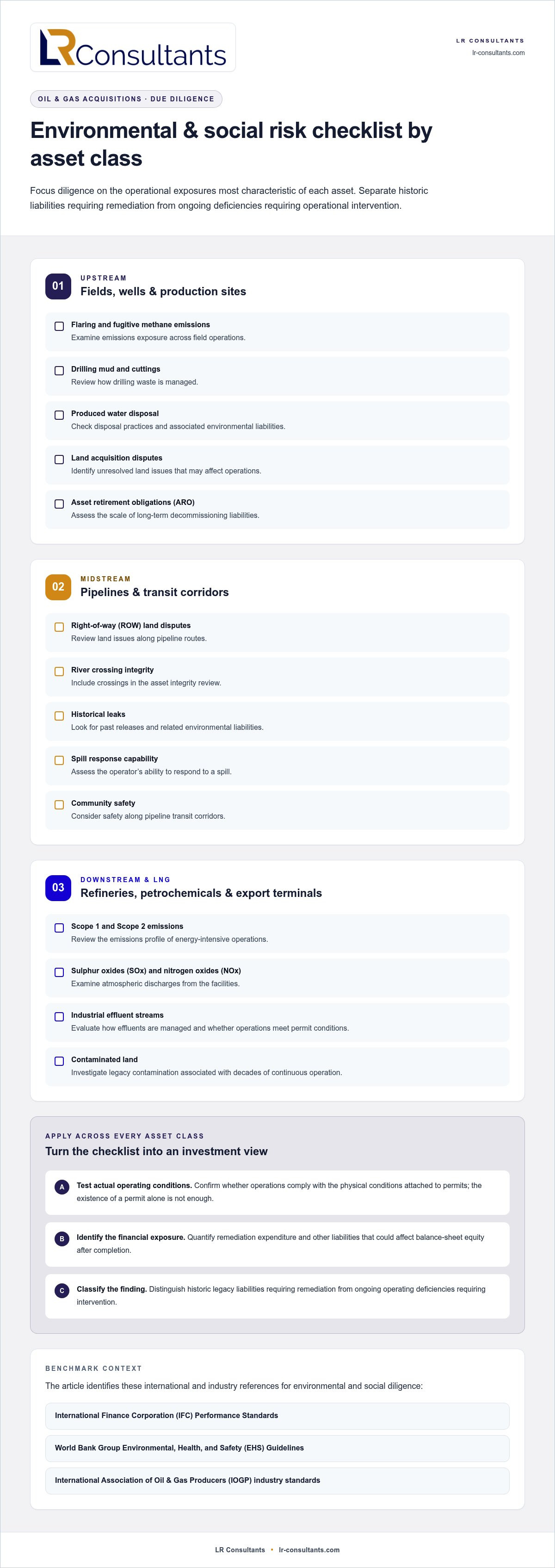
Risk profiles vary by asset. Upstream operations require review of flaring, fugitive methane, drilling waste, produced water, land access and asset retirement obligations (ARO). Midstream assets require attention to right-of-way disputes, leaks, spills, river crossings and community safety. Refineries, petrochemical complexes and LNG terminals add intensive Scope 1 and Scope 2 emissions, SOx and NOx, industrial effluent and contaminated land. Diligence should distinguish legacy liabilities from current deficiencies requiring operational intervention.
Core environmental risk areas and regulatory baselines
Environmental due diligence tests physical, ecological and regulatory performance against domestic law and international benchmarks. For environmental site due diligence, teams can use ISO 14015:2022, ASTM E1527-21: Standard Practice for Environmental Site Assessments: Phase I Environmental Site Assessment Process, ASTM E1903-19: Standard Practice for Environmental Site Assessments: Phase II Environmental Site Assessment Process and ASTM E1528-22: Standard Practice for Limited Environmental Due Diligence: Transaction Screen Process.
A comprehensive review should cover:
- Emissions: Scope 1 and Scope 2, flaring, venting and fugitive methane.
- Water: Produced water, drilling fluids, cooling water, runoff and marine discharges.
- Waste and contamination: Hazardous waste, NORM, drilling sumps, soil and groundwater plumes.
- Biodiversity: Critical habitats, protected areas, invasive species and habitat fragmentation.
- Decommissioning: Well plugging and abandonment, facility removal, remediation and financial security.
Benchmarking against the World Bank Group EHS Guidelines
Host-country compliance is a minimum baseline. International capital providers generally benchmark facilities against the World Bank Group General EHS Guidelines and sector guidance for onshore oil and gas, offshore oil and gas and petroleum refining. The review should identify performance gaps, estimate corrective CAPEX and reflect those costs in the valuation.
Decarbonisation trajectories and methane liabilities
Methane has a global warming potential over 80 times greater than carbon dioxide across a 20-year timescale. Buyers should test whether emissions inventories rely on generic IPCC Tier 1 or Tier 2 factors, or on source-level measurement under the Oil & Gas Methane Partnership 2.0 (OGMP 2.0) framework. Leak detection should cover valves, compressor seals, tanks and flare systems.
Teams should also model carbon taxes, the EU Carbon Border Adjustment Mechanism (CBAM), electrification, flare-gas recovery and power optimisation over the asset’s economic life.
Social performance, human rights, and the social licence to operate
Social risks directly affect operational uptime. Poor community relations can cause access blockades, vandalism, regulatory halts and litigation. A social licence to operate is earned through transparent engagement, human rights due diligence, effective grievance management and equitable economic participation.
Review grievance logs, resolution times, land access and crop-damage compensation, water and dust complaints, noise and local employment commitments. Recurring complaints indicate structural weaknesses rather than isolated incidents.
Applying the IFC Performance Standards to oil and gas M&A
The IFC Performance Standards provide a global benchmark for environmental and social risk. Diligence should assess each standard and connect deficiencies to transaction consequences:
| IFC standard | Principal diligence focus | Potential transaction risk |
|---|---|---|
| PS1 | Environmental and Social Management System, capability and compliance tracking. | Systemic underperformance and shutdown risk. |
| PS2 | Labour conditions, contractors, migrant workers and supply-chain labour rights. | Strikes, disputes and human rights exposure. |
| PS3 | Emissions, energy, water, waste, flaring and spill prevention. | Remediation, carbon and regulatory costs. |
| PS4 | Community health, transport, emergency planning and security. | Blockades, conflict and liability. |
| PS5 | Land acquisition, displacement and compensation. | Litigation and additional compensation. |
| PS6 | Biodiversity, critical habitat and natural resources. | Permit loss and lender exclusion. |
| PS7 | Indigenous Peoples, FPIC, traditional lands and benefit sharing. | Legal challenge and loss of social licence. |
| PS8 | Cultural heritage and chance-find procedures. | Permit revocation and community friction. |
Aligning with IOGP and industry good practice
IOGP and IPIECA publish industry guidance on environmental and social performance. Due diligence should also consider the Equator Principles, UN Guiding Principles on Business and Human Rights, Voluntary Principles on Security and Human Rights, IPCC guidance and OGMP 2.0. Relevant IOGP-IPIECA topics include Environmental and Social Management Systems (Report 510), Indigenous Peoples and FPIC (Report 538), community grievance mechanisms (Report 532) and contractor management (Report 423).
Beyond document review: Uncovering latent liabilities and data gaps
VDRs provide curated views of environmental performance. Sellers may highlight permits, clean audits and sustainability reports while omitting soil plumes, legacy waste or community disputes. Desktop review should therefore be tested through permits, monitoring data, regulatory records, site observations, remote sensing and stakeholder interviews.
Sustainability and ESG reports are useful starting points, but they are self-reported and may be selective. Compare them with Ipieca guidance, the Global Reporting Initiative (GRI) standards and OGMP 2.0. Greenwashing indicators include unsupported net-zero claims, undisclosed boundaries or baselines, reliance on offsets or generic factors, omitted legacy liabilities and a lack of independent assurance.
Verify every material claim against permits, monitoring data, grievance registers and site evidence before relying on it in valuation.
A document review proves that a file was created; it does not prove that an asset is environmentally compliant, socially viable or free from legacy contamination.
Identifying creeping environmental liabilities
Creeping liabilities can bypass routine reporting until they trigger remediation costs or regulatory action. Review produced-water reinjection pressure, NORM in piping and sludges, cumulative minor spills, and informal settlement growth around industrial sites. These issues can create contamination, disposal, safety and land-use liabilities.
Translating diligence findings into transactional mechanisms
Technical and ESG findings must become commercial and legal protections. Quantify confirmed and potential liabilities, then allocate them through the transaction structure rather than accepting them as ordinary operating exposure.
Available mechanisms include:
- Price adjustments: Deduct the estimated net present value (NPV) of remediation, abatement CAPEX or ARO underfunding.
- Specific indemnities: Allocate known contamination or litigation through extended or higher-cap protections.
- Escrow and holdbacks: Retain consideration until agreed actions are independently verified.
- Conditions precedent: Require permit transfers, licence renewals or community settlements before closing.
- Carve-outs: Exclude severely contaminated plots, idle pipelines or non-producing fields.
Planning and executing an ESG diligence review for oil & gas acquisitions
A staged review balances transaction speed with the investigation needed to uncover hidden liabilities. It should focus specialist resources on issues that can change valuation, financing or the ability to operate.
- Scope and materiality: Set boundaries by asset type, geography, regulation and investment strategy.
- VDR investigation: Review EIAs, permits, inspections, emissions, decommissioning plans and grievance records.
- Benchmark gap analysis: Compare performance with IFC, World Bank Group EHS, IOGP and relevant Ipieca guidance.
- Physical verification: Inspect emissions points, containment, waste, site conditions and workforce facilities.
- Financial integration: Convert remediation, decarbonisation and social programmes into modelled cash flows.
- ESAP: Set out prioritised, costed actions for the first 100 days and longer-term CAPEX.
Developing an actionable Environmental and Social Action Plan (ESAP)
The ESAP bridges transaction closing and steady-state ownership. It should define the corrective action, benchmark, accountable role, milestone and CAPEX or OPEX budget. Actions should be categorised as pre-closing, 100-day integration or longer-term programme work.
Using independent advisory to support transaction decisions
Buyers cannot rely on generalist ESG checklists or unverified seller disclosures when material capital is at stake. An independent adviser challenges assumptions, verifies physical conditions and integrates environmental and social liabilities into valuation, financing and negotiations.
LR Consultants provides senior-led M&A advisory and technical due diligence for complex energy, industrial and infrastructure transactions. LRC evaluates environmental liabilities, decarbonisation roadmaps and social risks for sponsors, private equity funds and lenders.
When to engage and what happens next
Engage technical ESG advisers during the non-binding offer stage or when the confirmatory data room opens. Early involvement identifies evidence gaps, determines whether site sampling or remote sensing is needed and informs valuation before terms are finalised.
Align the scope of your environmental, social, and sustainability due diligence with your transaction objectives and lender requirements. Discuss technical due diligence for your oil and gas transaction with LR Consultants.
Securing long-term asset value through rigorous ESG governance
The value of diligence depends on implementation after completion. Assign ownership for every ESAP action before closing, protect remediation budgets and establish monitoring and executive accountability. This turns diligence from a transaction checkpoint into a framework for sustainable, long-term value.
LR Consultants supports investors, operators and financial institutions across the integrated project lifecycle, deploying senior practitioners to deliver independent, actionable technical and ESG due diligence.
Frequently Asked Questions
What is environmental and social due diligence in an oil and gas acquisition?
It is an independent review of an oil and gas asset’s environmental compliance, liabilities, emissions, decommissioning obligations and community relationships. It tests physical performance against local law and international standards such as the IFC Performance Standards and World Bank Group EHS Guidelines, quantifies required CAPEX and informs the investment decision.
The IFC Performance Standards provide a recognised benchmark for environmental and social risk in capital-intensive sectors. Benchmarking an acquisition identifies bankability issues, reputational exposure and the corrective measures required to access international capital.
How does environmental due diligence uncover hidden decommissioning and ARO liabilities?
Technical diligence independently reviews the asset inventory, local remediation requirements, contamination history and well plugging and abandonment costs. This bottom-up assessment identifies unfunded gaps and supports purchase price adjustments or other protections.
How can buy-side teams detect "greenwashing" or selective disclosure in a Virtual Data Room (VDR)?
Virtual data rooms present curated information. Sellers frequently provide high-level corporate sustainability reports, environmental management system (EMS) certificates, and clean domestic audit summaries while omitting underlying empirical data.
To detect selective disclosure:
- Trace Emissions to Empirical Sources: Verify whether greenhouse gas disclosures rely on generic IPCC desktop factors or empirical source-level measurements aligned with frameworks such as OGMP 2.0.
- Audit Primary Records: Cross-reference self-reported compliance against primary agency inspection logs, produced-water reinjection pressure trends, effluent monitoring logs, and waste consignment notes.
- Identify Data Boundaries: Scrutinise reporting perimeters for omitted joint-venture assets, idle flowlines, flare systems, or contract worker camps that harbor unrecorded environmental or labour risks.
Can community relations and social performance genuinely halt operations or impair cash flows?
Social performance is an operational prerequisite. Weak community relations, unresolved land access compensation, disregard for Indigenous rights, or inappropriate third-party security conduct represent direct threats to asset uptime.
Unresolved social friction frequently manifests in:
- Physical blockades of pipelines, well sites, and access roads, halting production and delaying maintenance.
- Civil litigation and regulatory licence challenges from affected communities.
- Sabotage and pipeline tapping, causing severe environmental contamination and safety incidents.
Evaluating historical grievance logs, resolution times, free, prior, and informed consent (FPIC) documentation, and local employment equity provides clear foresight on operational continuity.
How are environmental and social due diligence findings converted into legal and commercial deal protections?
Environmental due diligence must generate enforceable contractual mechanisms rather than purely advisory commentary. Findings are translated into the transaction structure through specific mechanisms:
- Purchase Price Adjustments (PPA): Direct deductions from the purchase price reflecting the estimated NPV of immediate remediation and capital upgrades.
- Specific Indemnities: Seller indemnity coverage with higher liability caps and extended limitation periods for known historical contamination or active disputes.
- Escrow and Consideration Holdbacks: Retention of transaction funds until specified environmental permits, remediation milestones, or regulatory sign-offs are completed.
- Conditions Precedent (CP): Contractual stipulations requiring the vendor to remediate critical hazards, resolve community disputes, or renew operational licences before closing.
- Environmental and Social Action Plan (ESAP): A costed, milestone-driven integration roadmap assigned to operational leadership for execution within the first 100 days post-completion.
What is the difference between domestic regulatory compliance and international EHS standards?
Domestic law sets the host-country minimum. World Bank Group EHS Guidelines and IFC Performance Standards represent international good practice and may be required by lenders, investors or export credit agencies. A gap against these benchmarks can affect financing, reputation and future operating flexibility.
How are environmental and social diligence findings incorporated into the Sale and Purchase Agreement (SPA)?
Findings can be reflected in the Sale and Purchase Agreement through price reductions, specific indemnities, escrow holdbacks and conditions precedent covering remediation, permit renewals or community settlements.
When should an acquiring team start environmental and social due diligence?
Begin when transaction boundaries are defined and preliminary data room access is granted. Early review identifies information gaps, site-investigation needs and cost estimates in time to inform valuation and negotiations.
Convert Due Diligence into Transaction Certainty: Partner with LR Consultants
Acquiring an upstream field, midstream pipeline network, LNG facility, or downstream refinery demands certainty that historical operating liabilities will not impair future investment returns or violate international project finance covenants. LR Consultants acts as an independent strategic adviser, technical expert, and sponsor-side representative, ensuring investment committees and lenders deploy capital on verified operational evidence rather than unhedged vendor narratives.
When evaluating an oil and gas transaction or preparing to enter confirmatory data rooms, investment teams should implement the following steps:
- Commission an Early-Stage Bankability and ESG Gap Analysis: Engage our senior practitioners during the non-binding offer stage or upon initial data room access to identify red flags, determine site sampling requirements, and establish accurate remediation and abatement allowances.
- Integrate Defensible ESG Protections into the Transaction Structure: Retain LR Consultants to reconcile physical site realities with your financial model, converting latent liabilities into robust purchase price adjustments, indemnities, and pre-closing conditions precedent.
Contact the energy advisory practice at LR Consultants to arrange a preliminary transaction review with our senior leadership. Ensure your capital deployment is protected against hidden legacy liabilities, aligned with international lender standards, and structured for sustainable asset performance.


