

Article by
Jacobus Nieuwenhuijze
Jacobus Nieuwenhuijze (CEO, and Founder of LR Consultants) is a senior energy executive with over 40 years of international experience across five continents and more than US$23 billion in successfully executed projects. He specialises in project initiation, concept development, front-end loading (FEL), CAPEX optimisation and project financing, transforming complex concepts into bankable business cases and high performing assets. His experience spans major greenfield and brownfield developments, with a proven track record in technical, commercial and strategic leadership across complex energy and industrial projects. Jacobus’s expertise in complex energy infrastructure projects has evolved into applying “Big Oil” execution rigor to the “Energy Transition”, where he currently leads decarbonisation and low carbon fuel developments, ensuring the next generation of energy assets are built on sustainable principles.
Executive Summary
Oil and gas projects can struggle to secure financing even when the underlying opportunity is commercially attractive. The problem is often not the absence of a compelling vision, but weaknesses in the evidence supporting the investment case: unverified assumptions, inconsistent financial models, underdeveloped cost estimates, unrealistic schedules, uncertain revenues and risks that have not been adequately assessed or allocated.
These weaknesses can undermine lender and investor confidence, trigger repeated due diligence requests, increase development and advisory costs, delay financing decisions and postpone revenue generation. Their consequences can be particularly significant for capital-intensive upstream developments, LNG facilities, refineries and petrochemical projects, where technical scope, construction schedules, operating performance and market conditions are closely interconnected.
Avoiding costly project financing mistakes requires a disciplined approach to financing readiness. Sponsors must ensure that technical, commercial and financial assumptions are traceable to credible evidence, that capital requirements and schedules are realistic, and that the proposed financing structure remains supportable under plausible downside scenarios. Material risks and unresolved dependencies should be clearly identified, with appropriate mitigation measures, accountable owners and prioritised corrective actions.
This article examines the common mistakes that weaken oil and gas project financing proposals, explains how technical, commercial and financial assumptions affect one another, and identifies the red flags that lenders and investors may question. It also provides a practical readiness checklist to help sponsors identify evidence gaps and strengthen their financing case before approaching capital providers.
LR Consultants’ PROJECT FINANCE & CAPITAL ADVISORY supports energy and infrastructure sponsors through Financeability, Capital Strategy, Transaction and Financial Close. Its Financeability Review, including a Bankability Gap Analysis and prioritised action plan, helps sponsors identify weaknesses, establish corrective priorities and prepare for more informed engagement with prospective lenders and investors.
Introduction
Securing financing for an oil and gas project involves considerably more than presenting an attractive opportunity to lenders or investors. Capital providers need confidence that the project is sufficiently defined, its commercial rationale is credible, its costs and schedule are realistic, and its expected cash flows can support the proposed investment and financing structure.
In practice, weaknesses often emerge where technical development, commercial planning and financial modelling have progressed at different speeds. Production forecasts may rely on assumptions that have not been adequately validated; capital estimates may not fully reflect project scope, contingency or escalation; schedules may understate procurement, construction or approval requirements; and revenue projections may depend on market or offtake arrangements that remain uncertain. When these assumptions are not aligned, the financing case becomes difficult to verify and the risks harder to assess.
The consequences can extend beyond additional questions during due diligence. Sponsors may face repeated studies and model revisions, higher advisory costs, delayed financing decisions, additional funding requirements and postponed project revenues. In capital-intensive developments, delays can also increase financing costs and expose the investment case to changing market conditions.
Many of these problems can be identified before formal financing discussions begin. A structured financing-readiness assessment helps sponsors test the consistency of their assumptions, evaluate material risks, clarify outstanding decisions and establish which evidence or actions are needed to progress. The objective is not to eliminate uncertainty, but to demonstrate that it is understood, appropriately managed and reflected in the investment case.
This article explores the most common project financing mistakes in oil and gas developments, how technical, commercial and financial assumptions interact, and the warning signs that may concern lenders and investors. It concludes with a practical checklist for assessing financing readiness and explains how LR Consultants can help sponsors identify bankability gaps and prioritise the actions needed to prepare for capital-provider engagement.
Understanding why these mistakes become costly is the starting point for avoiding them.
Key Takeaways
- Common mistakes in project financing proposals include unsupported assumptions, conflicting project figures and risks without clear ownership. Trace each material claim to evidence or label it explicitly as an assumption.
- Reconcile scope, schedule, CAPEX/OPEX, revenue, offtake and funding rationale so the proposal presents one consistent financial and project case.
- Compare each investment claim with its supporting evidence, associated risk, mitigation and accountable workstream to expose gaps before approaching capital providers.
- Scale the readiness review to the project’s development stage. Identify the next decisions and evidence needed rather than treating every project as if it requires the same documentation.
- For sponsor-side readiness, PROJECT FINANCE & CAPITAL ADVISORY can connect Financeability, Capital Strategy, Transaction and Financial Close in a coordinated financing process.
Why project financing mistakes become costly
Financing readiness affects how quickly and how confidently a project can move towards funding. Gaps in evidence or inconsistent figures can lead to clarification cycles that delay assessment. Delays can add cost through extended development spend, repeated studies or advisory work, and later contractor commitments. Unresolved questions can also create funding uncertainty, because capital providers may need more evidence before they engage, or may reconsider the structure, timing or terms they are prepared to discuss.
These effects are not inevitable, and their scale depends on the project and the gap. The sections below link each major mistake to the financial or commercial consequence it can have.
A financing proposal presents a project, its investment case and the rationale for the funding sought. For an oil and gas development, this may mean explaining the asset or infrastructure scope, the project’s current development stage, its commercial basis and how capital would be applied. It is an initial document for assessment, not a substitute for feasibility work, due diligence or a financing commitment.
A decision-useful proposal makes its material claims traceable to project evidence, distinguishes established facts from assumptions and states what decision or engagement is being requested. This helps expose common mistakes in project financing proposals before they undermine confidence. A general Project Finance Overview can provide background on typical structures and risks, but sponsors still need to show how those considerations apply to their project.
Confusing a persuasive pitch with a financeable project
Clear design and a compelling strategic narrative can help readers understand a project. They cannot establish that its technical concept is sufficiently developed, that its commercial case is supportable or that its financial model reflects the current scope. A proposal may describe an LNG development as scalable, for example, but decision-makers need to understand the basis for that claim: the defined facilities, development assumptions, market or offtake basis, and analysis supporting the expected benefits.
Claims such as “low risk”, “strong returns” or “ready for execution” invite scrutiny when supporting evidence is absent or inconsistent. If engineering maturity is limited, state that clearly alongside the work required to resolve outstanding questions. The proposal is an entry point to assessment, not proof of bankability. Its purpose is to make the case assessable, including where further definition or assurance is needed.
Failing to state the funding purpose and decision sought
A capital provider or strategic stakeholder should be able to identify what the sponsor is asking for. State the project stage, the capital requirement where established, and the intended use of funds, such as advancing front-end engineering, developing facilities or preparing for construction. If these details remain under development, label the assumptions and explain what work will establish them. A funding figure without a defined use and basis is difficult to assess.
Be precise about the requested engagement, too. A sponsor seeking early strategic feedback is making a different request from one seeking transaction engagement. Say whether the immediate objective is to test the investment case, discuss potential capital structures or progress a financing process. These are distinct decision points.
Do not present indicative assumptions as agreed financing terms. Proposed debt proportions, repayment profiles, pricing or security arrangements should be identified as assumptions or discussion points unless formally established. This distinction protects the credibility of the document and helps prevent readers from mistaking a sponsor’s working case for a lender’s commitment.
The major mistakes in oil and gas project financing
- Unsupported assumptions. Inputs that cannot be traced to engineering or market evidence can prompt lender challenge and rework, which may delay assessment.
- Weak project definition. An immature scope can make CAPEX, schedule and production uncertain, and may lead to later changes that add cost.
- Underdeveloped cost estimates. Estimates without a clear basis or contingency can understate funding needs and may create a later gap in the funding plan.
- Unrealistic schedules. Optimistic timelines can defer revenue and increase interest or financing costs if start-up slips.
- Revenue uncertainty. Unclear pricing, volume or offtake assumptions can weaken cash-flow forecasts and reduce confidence in repayment capacity.
- Unsuitable debt assumptions. Debt levels or repayment profiles that do not fit the project's cash flow can lead to renegotiation, a different capital structure or a longer financing process.
- Poorly allocated risks. Risks without a clear owner may be questioned by capital providers and can leave the sponsor with unplanned exposure.
How technical, commercial and financial assumptions connect
A change to one assumption can flow through the whole case. A wider scope can raise CAPEX and extend the schedule; a later start-up can defer revenue; lower production can reduce revenue and cash available for debt service. Together these can lower the debt service coverage ratio and may require a different debt size or repayment profile.
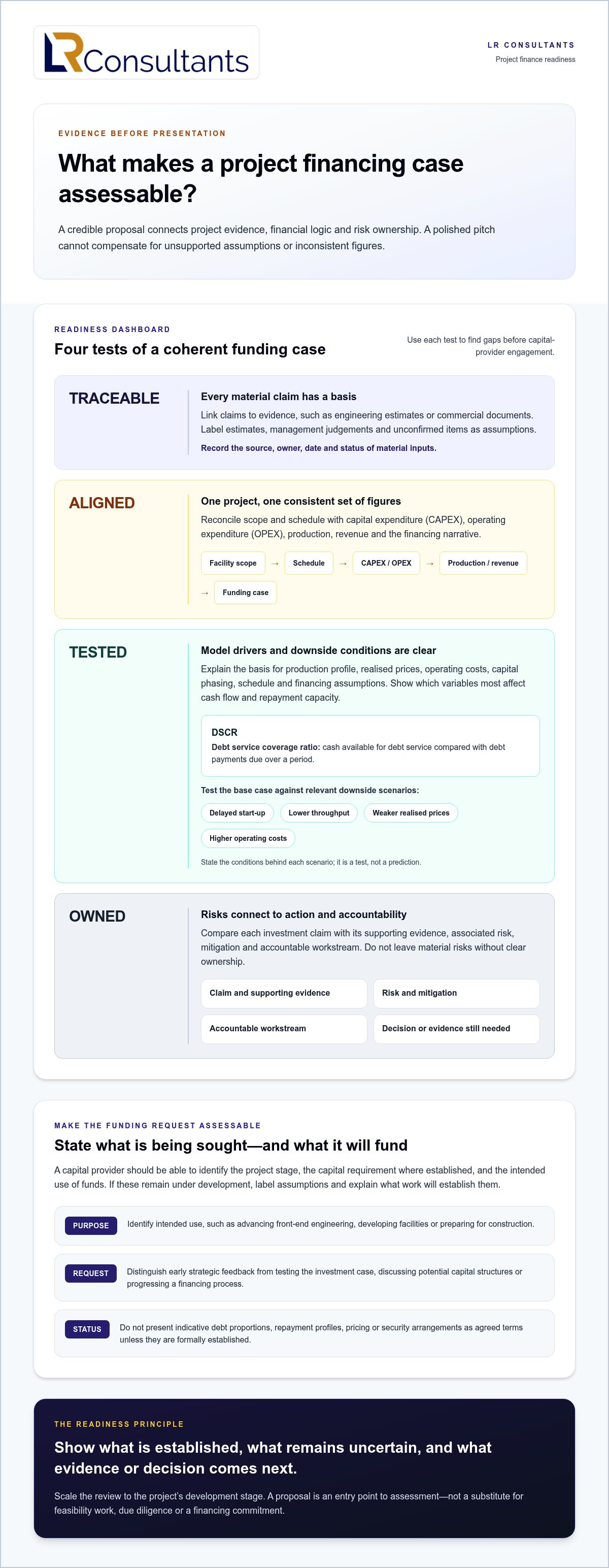
A financing case is only as reliable as the evidence and relationships behind its figures. Each material claim should be traceable to a source, such as an engineering estimate, a commercial document or an explicitly labelled assumption. Review the proposal as a connected system: a change to facility scope can affect schedule, capital expenditure (CAPEX), operating expenditure (OPEX), production, revenue and the financing narrative. If sections use different bases or versions, the model may appear precise while describing no single, coherent project.
Assumptions should be transparent, internally consistent and open to challenge; otherwise, model outputs are difficult to interpret as decision evidence. Record the source, owner, date and status of material inputs. Distinguish established information from estimates, management judgements and items awaiting confirmation. This makes it easier to explain which uncertainties could alter the investment case.
Testing whether the proposed debt structure fits the project
A financing model should test whether the proposed debt amount, repayment profile and financing assumptions remain supportable under realistic downside scenarios. For oil and gas projects, delayed start-up, lower production, weaker realised prices or higher operating costs can reduce cash available for debt service precisely when funding requirements remain elevated. Review debt service coverage, repayment timing and additional funding needs together, and identify which assumptions would require the capital structure or financing plan to be reconsidered. The appropriate structure will depend on project maturity, cash-flow characteristics, risk allocation and the requirements of prospective capital providers.
A model should show more than a headline return. Explain the key inputs and their basis, including production profile, realised prices, operating costs, capital phasing, schedule and financing assumptions. For a debt-funded case, define the debt service coverage ratio (DSCR), which compares cash available for debt service with the debt payments due over a period, and show what drives it. Identify the variables with the greatest effect on cash flow and repayment capacity.
Test a base case against relevant downside scenarios, such as delayed start-up, lower throughput, weaker realised prices or higher operating costs. State the conditions behind each case rather than presenting it as a prediction. A model review can assess structure, formulas and consistency of inputs; it cannot make uncertain assumptions certain or assure future performance. IR Global’s discussion of Challenges and Criticisms in Project Finance also highlights why transparency matters in complex project structures.
Omitting commercial, technical and execution dependencies
Revenue assumptions need a clear commercial basis. If the case depends on an offtake arrangement, explain its status and the assumptions used for volume, timing and pricing. Do not present discussions or intended terms as contracted commitments. Production forecasts should align with the technical basis, and the delivery schedule should reflect the project’s current definition and execution plan.
Make dependencies visible in the main proposal, not only in appendices. Identify unresolved workstreams, their accountable owners and the evidence or decision required to close each gap. A technology choice, procurement strategy or delayed approval can affect schedule and cash flow, so reflect these interfaces in the financial case. A financeability review can help organise model, CAPEX/OPEX, risk and due-diligence inputs into a prioritised readiness assessment.
Project finance red flags lenders and investors may question
- Unsupported claims: statements such as "low risk" or "ready for execution" without evidence can invite scrutiny and slow assessment.
- Inconsistent model versions: figures that differ between the model and the proposal may reduce confidence and require rework.
- Unconfirmed offtake: revenue that relies on discussions rather than agreements can leave cash-flow forecasts open to challenge.
- Unclear funding uses: a funding figure without a defined use can make the request hard to assess.
- Unresolved approvals: outstanding approvals can affect schedule and cash flow, and may delay financial close.
A financing proposal is stronger when its claims and risk treatment can be assessed together. A statement that an LNG facility is ready for execution, for example, should be considered alongside design maturity, contracting status, schedule basis and unresolved approvals. Risks should be classified accurately: some may be mitigated, some allocated through contracts or other arrangements, some retained by the sponsor, and others still require assessment. Allocation does not make a risk disappear; it identifies who bears its consequences.
Use a consistent comparison framework for each material claim. These examples show the level of connection to make, rather than a complete risk register.
Claim: Production can meet the forecast. Evidence: Reservoir or feedstock basis and production assumptions. Risk: Lower deliverability or operating availability. Mitigation and owner: Define the technical work and monitoring plan; subsurface and operations teams.
Claim: The project can be delivered to the proposed schedule. Evidence: Schedule basis, scope maturity and contracting strategy. Risk: Design development, long-lead equipment or interface delays. Mitigation and owner: Cost and schedule assurance, with actions assigned to project controls and delivery leads.
Claim: Revenue supports the investment case. Evidence: Market analysis and the status of offtake discussions or agreements. Risk: Price, volume, counterparty or market changes. Mitigation and owner: Test downside cases and document commercial actions; commercial team.
Claim: Environmental and social impacts are manageable. Evidence: Project assessments, commitments and stakeholder engagement records. Risk: Unresolved impacts or gaps in health, safety, security and environment (HSSE) controls. Mitigation and owner: Track actions and evidence; HSSE and sustainability teams.
Include technical, market, regulatory, country, counterparty and Environmental, Social and Governance (ESG) exposures where relevant to the project’s location, development plan and operating context. A risk register should show assessment status and accountable owners; do not describe it as complete if material dependencies remain untested. Broad statements can conceal where exposure sits and what decision is needed next, making this a common source of weakness in project financing proposals.
Make risk treatment specific and credible
Replace labels such as “construction risk” with the actual exposure, its current status and the party responsible for action or consequence. Development uncertainty may require further studies; technology risk may require evidence of suitability; construction exposure may depend on scope maturity and contract strategy. Offtake and market risks call for commercial analysis. Mitigations should be evidenced and assigned, not presented as assurances without an implementation basis.
Match capital strategy to project requirements
Debt, equity and strategic capital involve different assessment priorities and risk tolerances. A preferred funding source is not, by itself, a capital strategy. Link proposed sources to project stage, risk profile, cash-flow characteristics and the sponsor’s funding requirements. State what is being evaluated and why, while recognising that suitability and terms depend on assessment and negotiation. Do not imply that a structure or provider is assured.
Project financing readiness checklist
A readiness review should test whether the proposal is clear, internally coherent and appropriate to the project’s current development stage. An upstream appraisal, an LNG development approaching a major investment decision and a refinery expansion will not have identical evidence available. Completeness means providing the information needed for the decision being sought, while being explicit about what remains under development.
Review the proposal as a decision-maker would
Read the document in sequence. Can a decision-maker understand the project’s rationale, scope, commercial case and funding request without reconstructing the story from appendices? Then compare headline statements with supporting analysis and source documents. Any mismatch, undefined assumption or missing dependency may prompt questions that delay assessment or complicate due-diligence preparation.
- Clarify purpose and decision sought. State the project stage, the engagement requested and the intended use of funds where established. Distinguish a request for strategic feedback from a request to progress transaction discussions.
- Test the investment case. Check that the project rationale, defined scope and commercial basis are explained, with material claims supported by evidence or clearly identified as assumptions.
- Check the evidence set. Confirm that referenced technical, commercial, schedule and cost information is current and relates to the same project scope and basis. Identify important documents that are incomplete, outdated or still in preparation.
- Reconcile the financial case. Verify that the model’s key inputs and outputs align with the proposal’s scope, schedule, operating assumptions, revenue basis and funding narrative. Make sensitivities and downside cases visible where they affect the decision.
- Assess material risks and dependencies. Check that significant technical, execution, market, counterparty, regulatory, country and ESG/HSSE matters are visible, with mitigation status and accountability recorded.
- Set next actions. Record the evidence, decisions or analysis needed to address material gaps, assign owners and agree how readiness will be reviewed before engagement.
Turn findings into an owned readiness plan
Prioritise gaps by their effect on the decision, the evidence needed to resolve them, whether that evidence is available and who is accountable. A missing study that affects scope or production assumptions may warrant earlier attention than a presentational improvement. Keep unresolved items visible and distinguish actions that must be completed before engagement from those that can progress during a later project phase.
Use a simple sequence: define gaps → assign actions → review evidence → prepare engagement. Record progress against each action and revisit priorities when project decisions or evidence change. This keeps the readiness plan proportionate to project maturity and gives the sponsor a clear basis for deciding when the proposal is ready for the next stage.
Frequently Asked Questions
When should an oil and gas project undergo a financing-readiness assessment?
A financing-readiness assessment is most useful before approaching lenders or investors formally, although it can also help when a project encounters difficulties during financing discussions. The appropriate timing depends on project maturity, the intended capital structure and the decisions approaching. An early review can identify gaps in feasibility studies, cost estimates, commercial arrangements, risk allocation and financial modelling before further expenditure is committed. The assessment should be proportionate to the project stage and updated as the technical and commercial definition develops.
What documents do lenders and investors typically require to assess an oil and gas project?
Requirements vary by project type, financing structure, development stage and capital provider. Commonly requested information includes feasibility and engineering studies, project scope and development schedules, CAPEX and OPEX estimates, production or throughput forecasts, financial models, market assumptions, offtake or sales arrangements, permits and regulatory approvals, material contracts, risk registers and environmental, social, health and safety documentation. Lenders may also require information on sponsor capability, equity commitments, security arrangements and repayment sources. Sponsors should maintain a controlled, consistent evidence set and confirm specific requirements with prospective capital providers.
How can inaccurate CAPEX estimates affect project financing?
Underestimated capital expenditure can create a funding shortfall, weaken projected returns and require additional sponsor equity or financing. It may also undermine confidence in the wider financial model if the estimate does not adequately reflect project scope, contingency, escalation, foreign-exchange exposure, long-lead equipment and construction risks. Sponsors should ensure that the estimate is consistent with the project’s maturity, supported by documented assumptions and updated as engineering and procurement information improves. Potential cost overruns should also be reflected in downside scenarios and funding plans.
How do lenders assess whether an oil and gas project can repay its debt?
Lenders typically examine the reliability and timing of projected cash flows, the proposed debt amount and repayment profile, and the project’s ability to meet debt service obligations under expected and downside conditions. Depending on the financing structure, their analysis may include the debt service coverage ratio (DSCR), production or throughput assumptions, realised prices, operating costs, capital requirements and the impact of delays. A credible assessment should demonstrate not only that the base-case model works, but also how the project would respond if material assumptions deteriorated.
What is the difference between project bankability and project financing readiness?
Project financing readiness concerns whether the sponsor has developed a sufficiently consistent and credible body of evidence to engage constructively with potential capital providers. It includes identifying gaps in project definition, commercial arrangements, financial assumptions, risk management and supporting documentation. Bankability is the broader question of whether a project’s risk-return profile, contractual arrangements, cash flows and other characteristics are acceptable to the relevant lenders or investors. Improving readiness can help address bankability gaps, but it does not guarantee that a project will be considered financeable or that funding will be offered.
How should project sponsors manage risks that cannot be eliminated before financing?
Sponsors should identify material risks, assess their potential financial and schedule consequences, and determine how each risk will be managed, allocated or monitored. Depending on the circumstances, responses may include design changes, contingency allowances, insurance, contractual protections, hedging, additional equity, phased investment or revised financing terms. Each material risk should have an accountable owner, an appropriate mitigation plan and a clear explanation of any residual exposure. The objective is to demonstrate that uncertainty has been recognised and incorporated into the investment and financing case rather than ignored.
How important are offtake agreements and commercial contracts to oil and gas project financing?
Their importance depends on the project’s revenue model and financing structure. Long-term offtake agreements, sales contracts, feedstock supply arrangements, transportation agreements and other material contracts can help establish revenue visibility, cost certainty and the allocation of commercial risks. However, their value depends on the terms, counterparties, enforceability and remaining conditions. Sponsors should distinguish executed agreements from heads of terms, letters of intent and uncontracted market assumptions, and explain how any remaining uncertainty affects projected cash flows and financing requirements.
What should an oil and gas project sponsor do if a lender identifies material gaps during due diligence?
The sponsor should establish a clear, prioritised response plan rather than addressing each request in isolation. This means confirming the issue, identifying its effect on project economics or financing terms, assigning responsibility, setting a realistic completion date and ensuring that the resulting evidence is reflected consistently across the financial model, project documentation and risk register. Where a gap cannot be closed immediately, the sponsor should explain the interim position, the remaining uncertainty and the proposed route to resolution. A controlled process helps reduce duplicated work and supports more effective engagement with capital providers.
What should a project financing proposal include?
Alongside the core investment case, include enough context for a reviewer to understand who is sponsoring the project and how it will be governed. A concise ownership and decision-making overview can clarify who approves scope changes, manages interfaces and provides sponsor support. Include a document index showing which studies, approvals and commercial records are available, in preparation or not applicable at the current stage. This helps reviewers navigate the evidence efficiently.
How do I make a project financing proposal more credible?
Apply disciplined document control before circulation. Give each document an owner, date, revision status and clear reference in the proposal, and ensure the underlying data room uses consistent naming and version conventions. Check that units, currencies, time periods and definitions are consistent across schedules and model inputs. These controls reduce avoidable clarification questions and help reviewers identify the basis of a figure without relying on informal explanations.
What is the difference between a financing proposal and a bankability assessment?
A proposal is the sponsor’s case for consideration; a bankability assessment is a structured diagnostic of how the project may be viewed by capital providers. The assessment can test whether the proposed risk allocation, revenue structure and development plan are coherent for the financing approach under consideration. It may also identify questions requiring specialist input. Its findings inform sponsor decisions but do not replace a capital provider’s own credit, investment or due-diligence process.
Should a financing proposal include downside scenarios?
Yes. Scenarios should consider how pressures might combine, not only how each variable behaves in isolation. For example, a delay could coincide with increased financing needs and a later start to revenue. Explain which management responses are assumed, whether they are within the sponsor’s control and what indicators would prompt action. This gives reviewers a more realistic view of resilience than sensitivities that assume every risk can be addressed independently.
When should sponsors seek feedback on a financing proposal?
Seek structured feedback when there is a coherent draft to review, but before relying on it for a broad capital-provider approach. A useful point is when the sponsor can share the current investment case and a controlled set of supporting materials, while still having time to resolve material questions. For a major stage-gate decision, schedule the review early enough for findings to inform the decision pack, rather than treating feedback as a final editorial check.
How LR Consultants helps sponsors prepare for financing
Financing readiness is an ongoing process. As a project advances, changes to scope, schedule, commercial arrangements, risk allocation or evidence can affect the investment case, so sponsors should review priorities and actions at each material stage.
Prepare Your Oil and Gas Project for Financing
A credible financing case requires more than a persuasive proposal. It requires consistent technical, commercial and financial evidence, a realistic view of project risks, and a clear plan for resolving the gaps that could affect financing readiness.
LR Consultants’ PROJECT FINANCE & CAPITAL ADVISORY supports energy and infrastructure sponsors across Financeability, Capital Strategy, Transaction and Financial Close. A Financeability Review includes a Bankability Gap Analysis and prioritised action plan, helping sponsors identify material weaknesses, assign corrective actions and coordinate the evidence needed for capital provider engagement.
Whether you are preparing for an initial investor approach, progressing towards a major investment decision or addressing gaps in an existing financing case, LRC can help establish the priorities and actions required for the next stage.
Preparing an oil and gas project for financing? Contact LR Consultants to discuss your project’s financing-readiness requirements and potential scope of support.


