


Article by
Jacobus Nieuwenhuijze
Jacobus Nieuwenhuijze (CEO, and Founder of LR Consultants) is a senior energy executive with over 40 years of international experience across five continents and more than US$23 billion in successfully executed projects. He specialises in project initiation, concept development, front-end loading (FEL), CAPEX optimisation and project financing, transforming complex concepts into bankable business cases and high performing assets. His experience spans major greenfield and brownfield developments, with a proven track record in technical, commercial and strategic leadership across complex energy and industrial projects. Jacobus’s expertise in complex energy infrastructure projects has evolved into applying “Big Oil” execution rigor to the “Energy Transition”, where he currently leads decarbonisation and low carbon fuel developments, ensuring the next generation of energy assets are built on sustainable principles.
Executive Summary
Capital allocation decisions in major industrial developments frequently fail when technical speed is conflated with commercial viability. An existing offshore platform often appears to offer an expedited route to first production, just as a new onshore facility promises clean-sheet engineering flexibility. However, neither inherent characteristic settles the commercial, operational, or safety case. Industrial project sponsors and investment committees require a disciplined strategic review to evaluate competing development pathways against identical business objectives, operational constraints, and verified evidence before sanctioning capital.
To ensure capital is committed on a defensible basis, the strategic review subjects each pathway to a structured comparison across five interdependent pillars, preventing technical optimism or isolated throughput targets from concealing operational fragility:
- Strategic Fit and Portfolio Alignment: Testing whether the asset supports long-term corporate objectives, corporate decarbonisation mandates, and intended operating life cycles.
- Technical and Operational Feasibility: Verifying plant integrity, duty limitations, process safety barriers, and the operational impact of modifications against empirical inspection records rather than unverified assumptions.
- HSSE and Process Safety Exposure: Quantifying major accident hazards, environmental emissions profiles, regulatory compliance requirements, and the operational controls needed to maintain barrier integrity during both construction and long-term operations.
- Commercial Logic and Market Robustness: Stress-testing throughput profiles, offtake commitments, fiscal regimes, and economic sensitivity against market volatility and tariff adjustments.
- Execution Readiness and Governance: Establishing constructability sequencing, simultaneous operations controls, turnaround windows, and the explicit evidence thresholds required to pass each investment stage gate.
Ultimately, this framework bridges the divide between conceptual engineering and disciplined capital governance. By systematically separating verified facts from working assumptions and assigning accountability for unresolved risks, the review ensures that the preferred development pathway advances into a controlled, predictable delivery programme rather than remaining an attractive but unviable technical concept.
Introduction
The technically fastest route may be the least viable investment. An existing offshore platform can appear to offer a shortcut, just as a new onshore site can promise a cleaner design. Neither advantage settles the commercial and operational case. A strategic review for industrial companies must test each pathway against the same objectives, constraints and evidence.
That comparison is difficult because brownfield options involve interfaces, ageing assets, tie-in windows and uncertainty about existing conditions. Greenfield developments bring their own land, infrastructure, permitting and schedule requirements. Offshore and onshore settings shift the balance again. Decision-makers need more than a technical preference: they need a defensible basis for committing capital and resources.
This article sets out a practical framework for comparing onshore and offshore brownfield and greenfield oil and gas developments. It examines value, deliverability, HSSE and process safety exposure, environmental and commercial risk, and the assumptions to test before selecting a pathway. It also explains how to make decision gates explicit, so the preferred option can progress into a controlled execution plan rather than remain an attractive concept.
Key Takeaways
- Agree evaluation criteria before comparing options so each pathway is judged against consistent evidence, not shifting assumptions.
- A strategic review for industrial companies should distinguish strategic fit, technical and operational feasibility, HSSE and process safety exposure, commercial logic and execution readiness.
- Assess brownfield options for asset condition, safety-critical elements, modifications, operating interfaces and shutdown requirements, as well as the potential value of existing infrastructure.
- Use a repeatable decision sequence to document assumptions, expose material risks and define the evidence required at each decision gate.
- Independent project oversight can connect the selected pathway to governance, project controls, procurement interfaces and handover planning.
Why strategic review matters for industrial companies making capital decisions
A capital decision is not simply a choice between a technically possible project and one that is not. An onshore processing expansion, an offshore tie-in, a new development or a modification to an operating asset may each support the business objective, but differ in value, risk, schedule exposure and operational impact. A strategic review for industrial companies provides a structured comparison of these pathways before the owner commits to one.
Definition: A strategic review is an evidence-based assessment of project options against agreed owner objectives, constraints and decision criteria. It produces a recommendation and records the assumptions, uncertainties and conditions that affect the decision.
The review is not detailed engineering design, a procurement exercise or contractor execution. It determines which pathway merits further development and what must be resolved before the next investment gate. Design teams can then develop the selected concept, procurement can establish commercial arrangements, and contractors can execute the work within the project’s governance framework.
This distinction matters. A concept may appear attractive on a high-level cost or production case while depending on an unverified tie-in, an operating shutdown, limited offshore access or infrastructure that cannot meet the required duty. A review makes these dependencies visible alongside the strategic case, rather than treating technical promise as proof of decision readiness.
What does a strategic review assess?
The review tests each option against the same owner-approved objectives and project constraints. It should distinguish established evidence from assumptions, identify information gaps and state the boundaries of the decision. A brownfield option may use existing facilities, for example, but the assessment still needs to address asset condition, integration requirements and operating constraints. The term Brownfield land describes previously developed land, though an oil and gas review must also examine the condition and interfaces of the relevant facilities.
Strategic choice is made at a different level from design maturity. The review can identify a preferred pathway without suggesting that its technical definition, cost estimate or delivery plan is complete. Its conclusions are only as robust as the evidence and scope on which they rest.
When should industrial leaders commission a review?
Commission a review when a decision could materially change the project’s value, risk or route to delivery. Typical triggers include concept selection, a major asset upgrade, brownfield integration, a change in development assumptions or investment reappraisal. Early assessment can expose unresolved interfaces before they become embedded in a selected concept, tender basis or approved commitment.
Timing should follow the decision, not an assumed project calendar. If leadership must choose between reusing an offshore facility and developing new capacity, the review should address the evidence needed to make that choice. If the question is whether to proceed after new asset or market information emerges, reassess the affected assumptions and decision criteria rather than reopening the whole project without cause.
A sound review leaves decision-makers with a traceable basis for action: the options considered, the criteria applied, the material uncertainties and the conditions for advancing the preferred pathway. That record supports disciplined stage-gate decisions and gives subsequent design and delivery teams a defined strategic starting point.
Which dimensions should a strategic review compare across industrial projects?
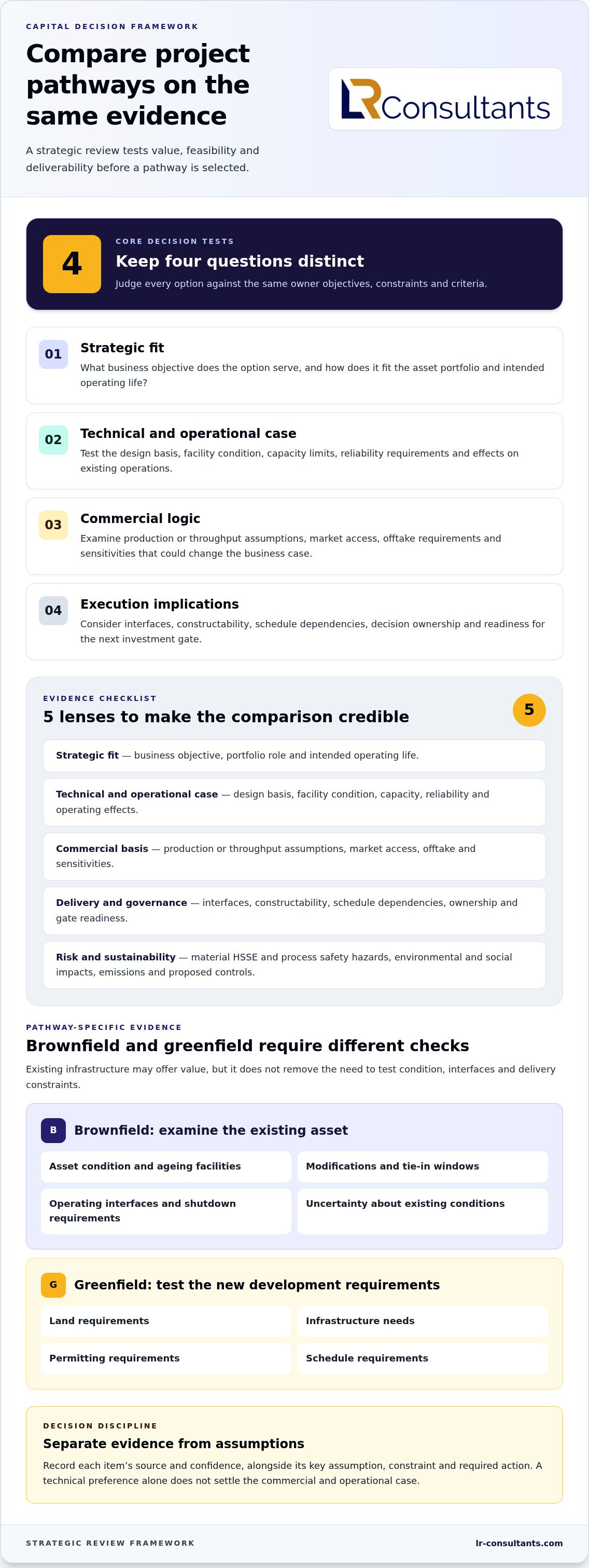
A robust comparison keeps five tests distinct: strategic fit, technical and operational feasibility, HSSE and process safety exposure, commercial logic and execution readiness. Assess each option against the same owner objectives, operating case and decision criteria. This prevents strength in one area, such as production potential, from obscuring a weakness elsewhere, such as asset integrity exposure, process safety barriers or an unworkable delivery sequence.
For a strategic review for industrial companies, also record how confidently each test is supported. Separate verified evidence from assumptions, identify constraints and make unresolved questions visible. A concise decision record might capture:
- Strategic fit: the business objective served, expected role in the asset portfolio and fit with the intended operating life.
- Technical and operational case: design basis, facility condition, capacity limits, reliability requirements and effects on existing operations.
- Commercial basis: production or throughput assumptions, market access, offtake requirements and sensitivities that could change the business case.
- Execution readiness and governance: interfaces, constructability, simultaneous operations, schedule dependencies, decision ownership and readiness for the next investment gate.
- HSSE and process safety exposure: major accident hazards, barrier integrity, environmental and social impacts, emissions considerations, regulatory compliance and proposed controls.
For each item, state its source, confidence, key assumption, constraint and the action needed to close any gap. This makes unlike options easier to compare without presenting uncertain information as established fact.
How should technical and commercial viability be considered together?
Test whether the technical configuration can deliver the operating case that underpins its commercial rationale. An offshore modification, for example, may depend on production availability, tie-in timing and access to existing utilities. Each dependency can affect the value case. A greenfield development may allow a purpose-designed layout but still rely on assumptions about market access, product quality or offtake. Identify which assumptions need evidence, then test how the conclusion changes if they do not hold.
How do execution and operating constraints change the comparison?
Execution is part of option viability, not a later detail. Assess access for people and equipment, construction sequencing, tie-ins, shutdown windows, contractor interfaces and the effect of work on live operations. For offshore work, marine logistics and weather exposure may be relevant. Onshore, plot availability and connections to existing infrastructure may govern the sequence. Treat these as project-specific constraints, not generic penalties.
Compare cost and schedule on a consistent basis, making the maturity of estimates clear rather than presenting them as certain. Include commissioning, start-up, operator capability, procedures, maintenance access and handover requirements. An option that reaches mechanical completion but lacks operational readiness has not demonstrated a complete delivery pathway.
Finally, examine how the criteria interact. A delivery constraint may affect the operating case, while a proposed risk control may introduce cost, schedule or maintenance implications. Making these connections explicit helps decision-makers assess an option’s combined consequences instead of treating each criterion as an isolated score.
Brownfield vs greenfield: how industrial companies should compare project pathways
Brownfield and greenfield describe different development contexts, not guaranteed levels of value, cost or risk. A brownfield pathway integrates with an existing asset; a greenfield pathway develops a new site or facility. Either may be onshore or offshore. A disciplined comparison tests both against identical decision criteria and records project-specific dependencies instead of favouring a pathway by label.
The matrix below can be used in a strategic review for industrial companies. For each option, document the evidence available, assumptions made, constraints identified and questions still to be resolved.
| Decision criterion | Brownfield considerations | Greenfield considerations |
|---|---|---|
| Asset and site basis | Condition and capacity of existing facilities; compatibility with the proposed duty; known and uncertain asset data. | Site suitability, plot requirements, ground or marine conditions, and the facilities needed to support the development. |
| Integration and change | Connections to live systems, plant modifications, management of change, control of temporary overrides and bypasses, and effects on ongoing operations. | Design interfaces between new process units, utilities, export routes and supporting infrastructure. |
| Delivery and access | Work sequencing around operations, tie-in and shutdown windows, construction access, and coordination with asset teams. | Site access, enabling works, infrastructure availability, construction logistics and delivery of new facilities. |
| Operations and handover | Fit with established operating practices, maintenance access and the implications of introducing modified equipment into an operating asset. | Requirements to establish operating arrangements, maintenance capability, procedures and handover for a new facility. |
What changes between brownfield and greenfield developments?
Brownfield integration can make use of existing infrastructure, but it also creates interfaces that need verification. Examine design information, asset condition and modification history, then identify how construction and commissioning could affect operating continuity. Greenfield development avoids some existing-asset interfaces, but requires a complete site and infrastructure basis to be defined. Neither option should be treated as settled until its dependencies and uncertainties are visible.
How should onshore and offshore context influence the review?
Location changes the execution and operating questions, not the fundamental test of value. Onshore reviews may need to examine land access, connections and movement of construction materials. Offshore assessments may need to consider marine access, platform constraints, logistics and work sequencing in a remote operating environment. These are prompts for project-specific analysis, not universal assumptions about cost or risk.
For each pathway, trace constraints through construction, commissioning, start-up and ongoing operations. A feasible concept may still be difficult to execute if access, interfaces or operating resources are unresolved. Record the planned mitigation, responsible decision owner and evidence needed before the next gate, keeping estimates and assumptions distinct from verified facts.
A practical framework for comparing industrial project options
A repeatable method makes an options appraisal traceable from the initial business question to the next investment gate. For a strategic review for industrial companies, keep the scope stable, use agreed criteria and show where evidence is incomplete. Scores can support discussion, but they cannot replace judgement about material risks, dependencies or conditions that could change the preferred pathway.
- Define the decision. State what leadership must decide, why it matters now and what falls outside the review. Clarify whether the decision concerns concept selection, investment reappraisal or permission to progress into further definition.
- Establish the options. Describe each pathway at a comparable level of maturity. Where relevant, include a credible baseline, such as maintaining the current operating arrangement or deferring investment.
- Test the evidence. For every option, identify the evidence source, its maturity and any gaps. Distinguish verified facts from assumptions, dependencies and questions requiring further investigation.
- Compare implications and recommend action. Assess each option against the agreed criteria, test sensitivities and explain the trade-offs. State the preferred pathway, decision conditions and work needed before the next gate.
How can decision criteria make options genuinely comparable?
Agree owner objectives and non-negotiable constraints before examining option scores. Criteria should cover strategic fit, technical and operational feasibility, HSSE and process safety exposure, commercial logic and execution readiness. Define what each criterion means and what evidence would demonstrate it. If criteria carry different weight, document why, who approved the weighting and how a reasonable change in weighting affects the ranking.
Use scores as a structured prompt, not a declaration of certainty. A high score based on an unverified assumption should not be treated as equivalent to one supported by asset data or a mature execution basis. Record both the rating and its confidence, then test whether the preferred option changes when key assumptions are varied.
What should a decision-ready review communicate?
Decision-makers need a concise account of the alternatives, comparison basis, evidence quality and principal trade-offs. The review should distinguish findings from judgement, identify material uncertainties and make clear which issues could change the recommendation. It should also set out decision gates, required assurance and information needed to progress, with ownership assigned for closing each gap.
Transparent assumptions strengthen investment decisions because they show which conclusions are evidence-based and what could change them. A recommendation should explain not only which pathway is preferred, but also the conditions under which that preference remains valid.
Before approval, the accountable sponsor should confirm that the recommendation, its conditions and outstanding actions are accurately captured in the project’s decision record. This gives subsequent governance reviews a clear reference if evidence changes or delivery teams need to revisit the original basis for the option.
When independent project advisory can strengthen a strategic review
Independent oversight is particularly useful when a capital decision carries material uncertainty, relies on inputs from several parties or needs objective challenge before a board or sponsor commits to a pathway. In oil and gas projects, technical, commercial and delivery evidence may sit across asset teams, operators, contractors and consultants. An independent perspective can help owners assess whether those inputs align with the decision criteria and intended operating case.
This role supports the owner’s control; it does not replace contractors or take responsibility for their contracted scopes. Advisory can help clarify what the owner needs to decide, which interfaces need active oversight and what assurance evidence should inform governance. It is relevant where an owner needs an external view of project readiness or a clear account of how technical-commercial issues affect delivery decisions.
What role can senior-led, independent advice play?
Direct involvement from senior practitioners brings experienced judgement to the review, rather than leaving key conclusions to be escalated through layers of delivery. Where partners are directly involved, decision-makers can engage with the people applying that judgement to the project’s evidence, constraints and trade-offs. Sector-specific technical judgement helps place issues in their asset and operating context, so a finding about an interface, modification or delivery assumption is considered for its practical implications rather than in isolation.
Advice should remain independent and aligned with the owner’s interests. LR Consultants’ approach is Value-led, Risk-focused, Integrated, Controlled and Independent. Assurance reporting can give project boards and sponsors a disciplined view of scope, cost, schedule and risk, distinguishing emerging exposure from matters already addressed through project controls. This supports focused questions at governance reviews and clarifies where further evidence or owner direction is needed.
How can a review move into controlled project delivery?
The chosen pathway needs a clear transition into execution. Convert the recommendation and its conditions into an execution strategy, governance responsibilities, integrated project controls and an assurance plan. Procurement and contract interfaces should reflect the selected scope and sequencing. Responsibilities across the owner, contractors and consultants should be explicit, especially where work packages connect or modifications affect operating facilities.
Preserve the decision rationale as the project advances. Carry assumptions and material risks into the project basis and controls, assign responsibility for outstanding actions, and specify what must be resolved at each stage gate. This gives subsequent teams a reference for managing changes without blurring accountability. It also links the strategic choice to commissioning, start-up and handover planning, keeping delivery preparations aligned with operating requirements.
Owners seeking experienced, independent input on a complex pathway or its transition into controlled delivery can discuss an independent project review.
Turn the preferred pathway into a controlled next step
The next decision is how to convert an option into a mandate that can be governed and delivered. A strategic review for industrial companies is most useful when its recommendation carries forward into clear accountabilities, assurance requirements and project controls, rather than ending with pathway selection. This creates continuity between investment intent and delivery decisions as the project develops.
LR Consultants brings senior-led involvement and independent, owner-aligned advice to this transition, supported by integrated project controls and assurance capabilities. The aim is to strengthen the owner’s visibility and decision-making while contractors retain responsibility for their scopes and execution.
If your organisation is weighing development alternatives or needs a clearer basis for the next investment gate, take the next step with Discuss an independent project review with LR Consultants. A well-governed decision gives the project team a stronger foundation for progressing with discipline and confidence.
Frequently Asked Questions
Is a strategic review the same as a feasibility study?
No. A strategic review helps decision-makers compare possible pathways and determine which merits further development. A feasibility study examines a defined project option in greater depth, assessing areas such as technical, commercial, financial, environmental and delivery feasibility. The work can be staged: a review may identify the preferred pathway, then a feasibility study can test whether it is developed enough to support an investment decision.
Can a strategic review compare brownfield and greenfield options together?
Yes. It can compare a modification or tie-in to existing facilities with a new-site development, provided both options are described clearly enough to assess against common objectives. The comparison might weigh the brownfield option’s integration requirements against the greenfield option’s site-enabling and infrastructure needs. If one option has less-developed evidence, record that difference rather than treating a gap in detail as proof of lower value.
What happens if the project evidence is incomplete or based on assumptions?
The review should identify the evidence gap, state the assumption being used and explain how it affects the recommendation. If asset records do not establish whether an existing utility can support additional demand, for example, treat capacity as unresolved and define the investigation needed to verify it. The decision can then be conditional, deferred pending evidence or progressed with a specific action assigned to an accountable owner.
How long does a strategic review for an industrial company take?
There is no reliable standard duration. The time required depends on the number and maturity of options, the quality and accessibility of project information, the decision scope and the availability of people who can validate key assumptions. A focused review of a defined choice will differ from a multi-discipline assessment with unresolved asset or commercial inputs. Set the timetable after agreeing the scope, evidence requirements and decision date.
Can a strategic review support a board or investment committee decision?
Yes. It can provide a concise decision paper setting out the options, their principal implications, outstanding uncertainties and the basis for the recommendation. For a board considering an offshore upgrade, for example, the paper can distinguish the investment decision from approvals still needed for detailed definition. It should specify what the committee is being asked to approve, any conditions and the evidence required at the next gate.
Does independent project advisory replace the project’s contractors?
No. Independent advisory supports the owner’s oversight and decision-making; it does not take the place of contractors or assume their contracted delivery responsibilities. The adviser can help the owner examine reporting, project controls, commercial interfaces and assurance findings, while delivery parties remain accountable for their agreed scopes. Clear role definitions are particularly useful where several contractors or consultants contribute to connected facilities or work packages.
When should an industrial company revisit its strategic review?
Revisit the conclusions when a material change could affect the preferred pathway or its conditions. Triggers may include new information about asset integrity, a revised production or offtake basis, a change in project scope or a delivery constraint that alters the execution plan. The review need not restart from the beginning: identify which assumptions have changed, reassess the affected criteria and record whether the decision remains valid.
How does a strategic review integrate HSSE and process safety risks into option comparison?
It evaluates major accident hazards, environmental emissions, and regulatory compliance requirements as non-negotiable constraints rather than secondary operational considerations. For brownfield options, the review examines the integrity of safety-critical elements, management of change risks, temporary overrides, and the hazards of simultaneous operations during live tie-ins. For greenfield developments, the focus shifts to inherently safer design opportunities, spatial separation, environmental baseline surveys, emissions profiles, and community impact. In both cases, the assessment identifies the operational controls necessary to maintain barrier integrity throughout construction and ongoing operations.
Can numerical scoring matrices replace professional judgement in pathway selection?
No. Multi-criteria scoring models and decision matrices provide a helpful structure for evaluating alternatives, but they cannot substitute for experienced operational and commercial judgement. A high mathematical score based on unverified assumptions should never be treated as equivalent to one supported by validated asset data or mature engineering definition. The review uses scoring mechanisms to highlight trade-offs, challenge internal bias, and test sensitivity, while ensuring that final recommendations remain anchored in verifiable evidence and documented rationale.
Who should participate in a strategic review within the owner organisation?
A successful review requires structured participation across corporate strategy, operations, engineering, commercial, and HSSE functions to prevent any single discipline from dominating the outcome. Essential contributors typically include asset and operations leaders who understand existing plant constraints, project delivery specialists, commercial managers responsible for product offtake, and the executive investment sponsor. Maintaining independent facilitation allows these internal stakeholders to voice competing priorities while keeping the assessment focused on the agreed corporate objectives.
How does the review evaluate shutdown windows and operational interface penalties?
The review treats turnaround constraints, production deferral, and operating interfaces as critical commercial determinants rather than routine scheduling details. It examines the real cost of production outages required to execute tie-ins, the availability of utility systems during modifications, and the physical constraints of working within an active facility. If a brownfield option requires an extended shutdown that exceeds commercial tolerances or demands scarce offshore accommodation, the review highlights that exposure early so decision-makers can weigh it directly against the capital cost of a greenfield alternative.
What specific documentation should a strategic review produce to support the next project phase?
The primary output is a defensible decision record and executive recommendation paper for the project board or investment committee. This deliverable sets out the pathways considered, the comparative analysis against agreed criteria, the principal trade-offs, and the evidence base supporting the preferred option. Crucially, it includes an assumption and dependency register, assigned ownership for closing identified information gaps, and defined assurance requirements for the upcoming stage gate, ensuring the transition into preliminary engineering proceeds with clear governance boundaries.
Commission an Independent Strategic Review with LR Consultants
LR Consultants provides senior-led, owner-aligned project advisory to help asset directors, investment sponsors, and corporate boards rigorously stress-test capital options before sanction. Operating across our five core principles—Value-led, Risk-focused, Integrated, Controlled, and Independent—our practitioners bring decades of process safety, capital governance, and asset management experience to challenge internal consensus and protect capital allocation.
To ensure your preferred pathway transitions into a predictable, tightly governed delivery mandate rather than remaining an unverified concept, our strategic review delivers four critical interventions:
- **Independent Baseline and Asset Verification: **We audit historical inspection records, metallurgical conditions, equipment operating envelopes, and utility capacities to establish genuine technical parity between brownfield modifications and greenfield builds.
- HSSE and Major Accident Hazard Assurance: We quantify the real-world safety exposure of simultaneous operations (SIMOPS), live-plant modifications, temporary overrides, emissions liabilities, and safety-critical element integrity, ensuring life safety and statutory compliance are never sacrificed for schedule expedience.
- **Execution and Interface Stress-Testing: **We evaluate the operational and commercial impact of turnaround windows, production deferrals, marine logistics, and contractor interfaces, transforming high-level cost and schedule estimates into a defensible delivery plan.
- **Defensible Stage-Gate Governance: **We structure transparent decision criteria, assign clear accountability for closing identified information gaps, and define the explicit assurance evidence required to justify each investment gate.
Do not allow unverified engineering concepts or arbitrary schedule targets to dictate your capital programme. A structured, independent review provides your leadership team with the objective evidence required to commit resources with confidence, protect operational integrity, and safeguard project returns.
Contact the advisory practice at LR Consultants today to schedule an executive consultation and discover how an independent strategic review can de-risk your upcoming investment decision.


