

Article by
Jacobus Nieuwenhuijze
Jacobus Nieuwenhuijze (CEO, and Founder of LR Consultants) is a senior energy executive with over 40 years of international experience across five continents and more than US$23 billion in successfully executed projects. He specialises in project initiation, concept development, front-end loading (FEL), CAPEX optimisation and project financing, transforming complex concepts into bankable business cases and high performing assets. His experience spans major greenfield and brownfield developments, with a proven track record in technical, commercial and strategic leadership across complex energy and industrial projects. Jacobus’s expertise in complex energy infrastructure projects has evolved into applying “Big Oil” execution rigor to the “Energy Transition”, where he currently leads decarbonisation and low carbon fuel developments, ensuring the next generation of energy assets are built on sustainable principles.
Executive Summary
A refinery or petrochemical facilities commercial resilience depends on translating market opportunities into realised Net Refining Margin (NRM) rather than targeting production volumes in isolation. Delivering this conversion consistently requires genuine operational excellence—defined as the repeatable alignment of people, processes, and assets to sustain safe, reliable, and commercially effective performance over time.
Too often, substantial margin leaks across the interface between economic planning, off-take commitments, and plant-floor routines. Embedding operational excellence in refineries and petrochemical complexes connects these domains across three operational imperatives:
- Commercial Risk and Off-Take Alignment: Contract terms dictate plant operating discipline. Take-or-Pay structures demand that operational excellence prioritises asset integrity and run-length reliability over aggressive yield tuning to avoid severe supply penalties. In contrast, tolling models isolate the site from crack spreads to focus risk on conversion efficiency, whilst formula-priced contracts require rigorous giveaway control.
- Preventing Process-Unit Margin Leakage: Operational excellence requires eliminating root causes of unit-level value erosion. These losses concentrate in product specification giveaway (excess octane or depressed RVP), catalyst deactivation in FCC and hydrocracker units, hydrogen network imbalances, and crude preheat train fouling that degrades Energy Intensity Index (EII) ratings and limits distillation throughput.
- The Four-Step Operational Margin Bridge: A disciplined operational excellence framework replaces assumptions with an auditable margin bridge. By reconciling the planned Linear Programming (LP) target to realised NRM across four sequential steps—adjusting for external commodity swings, isolating controllable operational variances (yield drift, giveaway, unplanned downtime), and incorporating energy, catalyst, and carbon balances—teams isolate what operations genuinely control.
Ultimately, operational excellence is not a one-off campaign or cost-cutting exercise, but an active operating system. Aligning console setpoints with LP targets, evaluating maintenance deferrals against contractual commitments, and reinforcing accountability through shift handovers ensures commercial strategy and daily operating practices move together.
Introduction
What determines whether a refinery converts favourable market conditions into a resilient, profitable operating margin? Crude differentials, product pricing, conversion yields, unit utilisation and the commercial terms governing product sales all play a decisive role. Yet too often, plants manage these elements in silos, assessing unit performance independently of commercial realities. Sustaining margin capture requires genuine operational excellence: the repeatable, disciplined alignment of people, processes and assets to protect commercial value across daily operating routines.
Off-take arrangements directly shape how market forces impact the producer. Contractual structures influence price volatility exposure, minimum volume commitments, product quality specifications and delivery schedules. These terms dictate operational planning choices, while physical plant constraints and operating discipline determine whether the facility can execute the plan. When maintenance windows, console targets and commercial obligations fall out of step, realised margin erodes.
This article examines how operational excellence bridges the gap between commercial strategy and plant execution. It explores how crude dynamics and market cracks translate into Gross and Net Refining Margins, how off-take agreements influence operating flexibility, and where process units either protect or surrender value. Key themes include crack spreads, Linear Programming optimisation, Nelson Complexity and crude grade differentials, alongside the operational management of Take-or-Pay, tolling and formula-priced contracts.
How refinery and petrochemical margins are built and where they leak
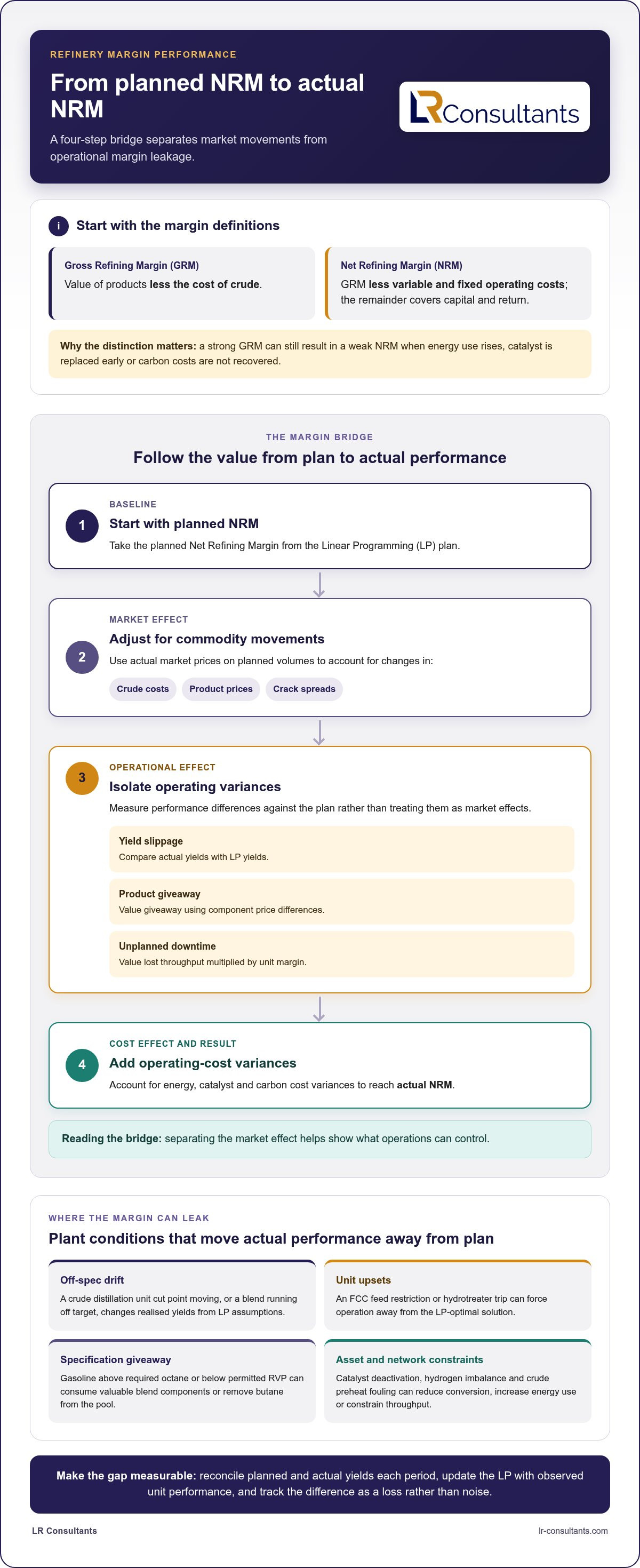
Gross Refining Margin (GRM) is the value of products less the cost of crude. Net Refining Margin (NRM) deducts variable and fixed operating costs from GRM, showing what remains to cover capital and return. The variable deductions that move NRM most are imported energy (power, natural gas and purchased fuel), catalyst and chemical spend, and carbon pricing on direct and indirect emissions. A refinery with a strong GRM can still deliver a weak NRM if furnace fuel use rises, catalyst is replaced early or carbon costs are not recovered, so operating teams need to see these costs alongside yield and price.
Crack spreads give a market proxy for GRM. The 3:2:1 spread takes three barrels of crude as two of gasoline and one of distillate. The 2:1:1 spread takes two barrels of crude as one of gasoline and one of distillate. Both are benchmarks, because a refinery's realised margin depends on its own yields and crude slate.
Crude grade differentials set the value of processing cheaper, heavier or more sour grades. Nelson Complexity measures a refinery's conversion capability and indicates how far it can capture those differentials. Linear Programming (LP) optimisation uses crude and product prices, unit constraints and specifications to select the crude slate, unit severities and product blend that maximise margin.
The LP plan is only as good as its match with the plant. Off-spec drift, such as a CDU cut point moving or a blend running off target, changes real yields away from the LP assumptions. Unit upsets, such as an FCC feed restriction or a hydrotreater trip, force the refinery out of the LP-optimal solution and into a lower-value operating point. Planners should reconcile planned and actual yields each period, update the LP with the observed unit performance, and treat the gap as a measurable loss rather than noise.
Process units and margin leakage in refinery and petrochemical operations
The crude distillation unit (CDU) sets the basic cut of products. The fluid catalytic cracker (FCC) and hydrocracker convert heavier streams into gasoline and distillate, and the reformer produces high-octane gasoline blendstock and hydrogen.
- Product specification giveaway: blending gasoline above the required octane or below the permitted RVP wastes valuable components. Lower RVP removes low-cost butane from the pool, so butane is sold at a lower value instead of being absorbed into gasoline. Each octane number given away consumes reformate or alkylate that could have been sold at a premium.
- Catalyst deactivation: loss of activity in the FCC, hydrocracker and reformer reduces conversion and yield, or forces higher severity and energy use. Operating at higher temperature to hold conversion shortens catalyst life and brings forward replacement spend.
- Hydrogen network imbalances: higher reformer severity raises octane and hydrogen make, but a shortage elsewhere limits hydrotreater and hydrocracker throughput. When surplus hydrogen is vented to fuel gas, the refinery pays the cost of producing it and recovers only fuel value.
- Crude preheat train fouling: fouled exchangers reduce heat recovery, raise furnace fuel use, degrade the Energy Intensity Index (EII) and can hit fired heater duty limits that cap CDU throughput.
These leakages sit between the market margin and the margin the refinery actually banks. A practical operational margin bridge separates them in four steps:
- Start with the planned NRM from the LP.
- Adjust for external commodity movements, namely crude costs, product prices and crack spreads, using actual market prices on planned volumes.
- Isolate operational variances: yield slippage against LP yields, giveaway valued at component price differences, and unplanned downtime valued at lost throughput times unit margin.
- Add energy, catalyst and carbon cost variances to reach the actual NRM.
What remains after the market effect is what operations can control.
Key Takeaways
- Assess refinery and petrochemical performance in the context of margins, feedstock economics and off-take commitments, not production volume alone.
- Operational excellence in refineries and petrochemical plants depends on coordinated operating standards, clear roles and performance information that links LP planning, production and maintenance.
- Use operating trends, maintenance history and frontline observations to distinguish recurring symptoms from underlying process or organisational causes.
- Rank improvement options by operational relevance, risk, feasibility and accountable ownership, rather than novelty or visibility.
- Make improvements part of leadership routines and team learning so operating practices can adapt as evidence emerges.
Operational excellence in refineries and petrochemical plants in practice
Operational excellence in refineries and petrochemical complexes is the sustained ability to operate safely, reliably and effectively while adapting routines to maintain performance. It is not simply a campaign to raise output, a one-off cost reduction exercise or an isolated improvement project. Such initiatives can contribute, but their value depends on whether better practices endure in everyday work.
Operational excellence is the repeatable alignment of people, processes and assets to deliver safe, reliable and effective performance over time. The focus is on how work is planned, executed and reviewed, not just on launching an initiative. The broader Principles of Operational Excellence include approaches such as Lean Management and Six Sigma. In a process plant, these methods are useful when they strengthen the operating system and address a defined performance need.
Why refineries and petrochemical complexes need a joined-up operating approach
Refinery and petrochemical units are linked by material flows, shared utilities and production plans. A disruption in one area can constrain upstream or downstream operations, change intermediate inventories or require teams to adjust conditions elsewhere. The commercial and operational effect may therefore extend well beyond the unit where the issue began.
Production priorities also affect maintenance access and timing, while equipment condition shapes the production plan. Clear operating standards, coordinated schedules and disciplined shift handovers help teams manage these dependencies. Without them, a local decision may solve an immediate problem but create a constraint for another unit or the next shift.
Operational excellence is more than reducing operating costs
Cost efficiency matters, but it must be considered alongside safe operation, reliability, product quality and organisational effectiveness. A cost-only view can favour short-term reductions while overlooking repeat interruptions, avoidable rework or maintenance practices that leave recurring causes unresolved. Spending less in one area does not necessarily make overall plant performance more dependable.
Improvement aims should reflect the plant’s operating context: production priorities, asset condition, product requirements and the constraints teams manage each day. A useful objective links a measurable operating issue to an outcome the organisation values, then assigns responsibility for changing the relevant work practice.
Commercial analysis helps teams identify which operational losses deserve attention. A margin bridge can separate the influence of market prices and contractual terms from factors the plant can affect, such as yield, energy use, product quality, throughput and reliability. In simplified terms, product realisations less feedstock and variable conversion costs indicate contribution before fixed costs and other business expenses. Refinery and petrochemical economics can also depend on product mix, co-products, utilities and quality adjustments, so a single headline price or production-volume measure is rarely enough to explain performance.
Operating teams should therefore distinguish external drivers from controllable ones. A change in feedstock or product prices may move margins even when the plant runs consistently. Conversely, reduced yield, off-spec production or unplanned interruption may weaken realised value even when market conditions are favourable. Production, maintenance and frontline teams need shared priorities and a common view of how work is progressing. Leaders reinforce that alignment by reviewing whether routines are followed and whether they deliver the intended result.
How the operating system connects people, processes and assets
A plant’s operating system is the framework through which work is planned, authorised, carried out and reviewed. It brings together standards, role definitions, shift routines and performance information. A sound procedure alone cannot ensure consistent execution: teams also need clear decision rights, relevant information and reliable handovers between shifts and functions.
The system connects decisions made at different levels. Production planning sets priorities from the LP plan; process control translates them into day-to-day operation, for example by holding console targets to LP cut points; maintenance planning determines how equipment needs are addressed alongside production requirements. If one part changes without communication to the others, work can be delayed, priorities can conflict and the operating plan can become less reliable.
Operational excellence depends on connected operating practices because asset reliability, production performance and workforce decisions influence one another across the plant.
Aligning production routines with maintenance and reliability
Equipment availability depends not only on maintenance execution, but also on how work is identified, prioritised and coordinated with operations. A task may require access, isolation or an operating window. Production teams need timely notice to plan around it, while maintenance teams need an accurate view of operating priorities and equipment condition.
Shared priorities help teams resolve trade-offs transparently. They can review planned work against the production schedule, consider the consequences of deferral and agree who owns the decision. Under Take-or-Pay obligations, deferring a maintenance task that later causes unplanned downtime can leave the refinery unable to supply committed volumes and exposed to penalties, so deferral decisions should be tested against delivery commitments. This connects asset integrity with reliability: sound equipment condition supports stable operation, while operational feedback helps direct maintenance attention to issues affecting performance.
Turning operating information into decisions
Operating information is useful when it helps a team decide what to do next. A recurring interruption, changing equipment behaviour or repeated delay in completing work can prompt a focused review. Teams can compare operating trends with maintenance history and shift observations to determine whether events share a pattern, rather than treating each occurrence as unrelated.
Reports that circulate figures without an owner, interpretation or follow-up offer limited decision value. A practical review asks what has changed, which operating area is affected, what evidence supports the likely explanation and who will act. It also records whether the action changed the observed condition, so the next review builds on evidence rather than assumption.
Organisational effectiveness makes these connections workable. Clear accountability defines who sets priorities, approves changes and confirms completion. Decision rights should be understood across production, maintenance and supervisory roles, particularly when plans change between shifts. Effective handovers preserve the context behind outstanding work, emerging constraints and agreed actions. Without that context, teams may repeat diagnosis or make decisions using incomplete information.
Where interfaces are unclear or recurring losses cross functional boundaries, structured operational excellence advice can help align workflows, maintenance strategies and accountability around measurable operating priorities.
How to diagnose operational performance gaps without chasing symptoms
A recurring interruption, delayed work order or missed production plan signals a performance gap, but not necessarily its cause. The event may reflect equipment condition, planning quality, operating practice, unclear ownership or several factors together. Effective diagnosis separates what happened from why it happened, then tests explanations against more than one source of evidence.
For operational excellence in refineries and petrochemical complexes, pair lagging outcomes, such as downtime or lost production, with leading indicators that show whether work is being prepared and controlled. Work-plan readiness, for example, can show whether required resources and information are in place before scheduled work begins. Measures are useful when they connect to an operating priority and an owner able to act.
Selecting indicators that support operational decisions
Begin with the plant priority that needs managing, then select measures that show either the condition of the work or its eventual outcome. A diagnostic indicator helps explain performance and prompts a decision; a retrospective measure records what has already happened. Both can be valuable, but a report that is not reviewed, interpreted or linked to action has little diagnostic value.
Commercial context matters too. The relevance of an operating loss depends on the product, feedstock economics and off-take commitments, and the margin bridge above shows which losses are worth chasing first.
Off-take arrangements are primary commercial drivers of operating behaviour. They fall into three main structures, and each allocates price, volume, specification and delivery risk differently.
- Take-or-Pay obligations: the buyer pays for a minimum volume whether or not it lifts it. This gives the refinery revenue certainty, but it commits the refinery to supply, so unplanned downtime can mean missed volumes and penalties, and it can restrict run-rate and turnaround decisions.
- Tolling agreements: the customer supplies crude and takes the products, and the refinery earns a processing fee. Commodity exposure to crack spreads passes to the customer, while the refinery carries conversion-efficiency, throughput and reliability risk.
- Formula-priced term contracts: prices are linked to published benchmarks plus a premium or discount, so they follow the market while giving volume security. Margin then depends on yields and costs rather than price timing.
These terms shape operating trade-offs, such as whether to maximise gasoline or distillate against committed grades. They also drive tankage constraints, because limited storage forces production to follow lifting schedules. Late or missed cargoes create demurrage risk, and off-specification product can breach contract terms. Schedules and maintenance windows should be tested against these obligations.
Take-or-Pay liabilities for failing to supply committed volumes shift operating priorities towards asset integrity and run-length reliability rather than aggressive yield optimisation. A stable run that delivers committed cargoes is worth more than a marginal yield gain that risks an unplanned outage.
Tankage and logistics buffers set the physical limits. Minimum operating inventory, including the tank heels needed to protect pump suction, and maximum safe fill limits define usable storage. If marine off-take liftings stall, tanks can reach safe fill limits and force crude distillation unit turndowns, which reduces margins regardless of crack spreads.
Finding recurring losses and their underlying causes
Review repeat events alongside maintenance work history, backlog changes and handover records. Look for patterns in timing, equipment, operating conditions, work preparation or unresolved actions. Treat each pattern as a hypothesis to investigate, not proof of a single cause. Root-cause analysis should draw on records and frontline knowledge, then test whether the proposed explanation fits the evidence across instances.
These diagnostic prompts help teams move from observation to investigation:
- Recurring interruption: Examine operating trends, event records and related maintenance history. Does it recur under similar conditions, or are different causes being grouped together?
- Work repeatedly deferred: Review backlog movement, planning information and priority decisions. Is work delayed by access, resources, changing production needs or incomplete preparation?
- Issue raised across handovers: Compare shift records with actions taken and outstanding decisions. Is relevant context carried forward, and is an owner clear?
Close the diagnosis by recording the evidence, the cause or causes still under review, the next action and the accountable person. If evidence does not support the initial explanation, revise the hypothesis rather than forcing the event to fit it. This helps distinguish isolated variation from a recurring weakness in the operating system.
A practical improvement cycle for refinery and petrochemical teams
A disciplined improvement cycle turns an identified performance gap into controlled action and a lasting operating practice. For operational excellence in refineries and petrochemical complexes, the sequence matters: establish what is happening, understand the causes, select a feasible response, implement it with appropriate oversight and review the result. This prevents teams from treating an attractive idea as a priority before confirming that it addresses a material operating need.
Evidence and baseline → diagnose causes → prioritise action → implement and monitor → review results → standardise or adapt
- Establish a baseline. Define the operating issue in measurable downstream parameters, such as Reid Vapour Pressure giveaway offset (psi), atmospheric tower cut-point drift (°C) or the decline in preheat train furnace inlet temperature. Record the effect on plant priorities, so later reviews compare like with like.
- Diagnose causes. Test explanations against operating records, maintenance history and frontline experience, including refinery-specific interactions such as sulfur spikes in the crude slate overwhelming hydrotreater amine wash systems, or wet gas compressor limits forcing flaring on the fluid catalytic cracker.
- Prioritise. Rank actions by LP opportunity costs. When evaluating maintenance deferrals, such as exchanger bundle cleaning or compressor valve maintenance, balance the expenditure against the daily margin penalty of rate-clipping the crude unit or missing product lifting windows.
- Implement with oversight. Assign an accountable owner, define the change and its intended effect, and agree how it will be monitored. Where appropriate, trial the change under suitable operational oversight before extending it more widely.
- Review and standardise. Compare the observed result with the baseline and consider frontline feedback. If evidence supports the change, incorporate it into relevant routines and work practices. If the result differs from expectations, adapt the action or revisit the diagnosis.
Prioritising improvements for practical implementation
Novelty is not a sound priority on its own. A proposal should address a problem supported by evidence, fit the plant’s operating context and account for dependencies such as equipment access, production schedules and maintenance resources. Confirm who has authority to decide, who will deliver the action and who will assess its effect. This makes constraints explicit before implementation and avoids assuming unvalidated savings or performance gains.
Some actions may be worthwhile but not immediately feasible. Record the reason for deferral, the conditions needed to proceed and the person responsible for revisiting the decision. This preserves a clear rationale instead of allowing lower-priority initiatives to displace urgent operational work without review.
Embedding improvements into daily management
Routine team reviews keep implementation connected to operating conditions. The owner can report progress, raise obstacles and compare results with the agreed measure; frontline feedback can show whether the revised practice works during actual shifts. Leaders should confirm whether the change is being used consistently, not just whether an action has been marked complete. Where evidence is mixed, adjust the method and continue assessing its effect.
Close each review by documenting the decision, its rationale and any conditions that would trigger reassessment. This gives teams a clear record to use if operating conditions change, responsibilities transfer or the issue returns. It also helps distinguish a deliberate adjustment from an informal departure from the agreed approach.
Sustaining operational excellence through leadership and organisational learning
Operational excellence is not a fixed end-state. Plant conditions, production demands and equipment needs change, so operating practices must be reviewed and adjusted as evidence accumulates. Leadership enables this by setting clear priorities, following up agreed actions and responding constructively when results differ from expectations. When teams can report obstacles and challenge assumptions, learning can inform decisions instead of being lost between reviews.
In operational excellence in refineries and petrochemical complexes, accountability should connect decisions with outcomes. Managers establish priorities and remove barriers; supervisors clarify expectations in day-to-day work; frontline teams contribute practical knowledge about how routines work on shift. The aim is not to add layers of oversight. It is to make ownership visible and ensure that people affected by a change can explain what changed, why it matters and how its effect will be assessed.
Building ownership without creating change fatigue
Improvement is more manageable when teams focus on a defined set of priorities and assign responsibilities to people who can influence the result. Involve those who perform and support the work early enough to identify practical constraints, clarify handovers and surface unintended consequences. Leaders can then check progress through existing management routines rather than treating every initiative as a separate campaign. The right approach depends on the plant and the issue.
Learning from results, not just launching initiatives
A completed action does not prove that an improvement has lasted. Teams need to review whether the change was used as intended, what operating evidence followed and what frontline feedback revealed. If the outcome is weaker or different than expected, investigate why and adapt the approach. If it is working, incorporate the revised practice into relevant standards, training or review routines so learning is retained beyond the original project team.
Leaders reinforce this cycle through consistent behaviour. They ask whether agreed actions changed the underlying condition, make trade-offs explicit when priorities compete and treat early reporting of problems as useful operational information. This helps teams distinguish a change that has been implemented from one that has become part of normal work.
External support may be useful when improvement efforts remain disconnected, recurring losses persist despite repeated interventions, or production, maintenance and organisational practices are misaligned.
Turn operational priorities into lasting capability
Start by identifying where commercial priorities are not translating into dependable day-to-day performance. Select an operating gap with clear evidence, establish who can influence it and decide how the organisation will judge whether action has made a difference. This gives leaders a practical basis for directing attention and adapting decisions as operating conditions change.
Operational excellence in refineries and petrochemical complexes is built through ongoing discipline, not declared as a completed state. LR Consultants’ Operational Excellence advisory connects Linear Programming targets, off-take risk profiles and console routines into a unified operating standard, so commercial and operating priorities move together. To align yours, start a conversation with LR Consultants.
Frequently Asked Questions
How do Take-or-Pay, tolling and formula-priced contracts affect refinery operations?
Take-or-Pay commits the refinery to supply minimum volumes, so unplanned downtime and deferred turnarounds carry penalty risk. Tolling moves commodity exposure to the customer and leaves the refinery with conversion-efficiency and reliability risk. Formula-priced contracts follow benchmarks, so margin depends on yields, giveaway and costs. Schedules and maintenance windows should be tested against each structure.
How should a refinery manage and measure its margin?
Track GRM and NRM, including energy, catalyst, chemical and carbon costs, and use an operational margin bridge to separate crack spread and crude price movements from yield slippage, giveaway and unplanned downtime. Consistent definitions make periods comparable, and the remaining variance shows what operations can control.
How does a refinery keep its operations aligned with the LP plan?
Reconcile planned and actual yields each period, and review off-spec drift and unit upsets that move the plant away from LP-optimal operation. Update the LP with observed unit performance, and link console targets to LP cut points. Any change to safe operating limits must go through the site's established safety and management of change processes.
What is the difference between operational excellence and continuous improvement?
Continuous improvement is a method of making work better through repeated review and adjustment. Operational excellence is the wider organisational capability that sets the direction for that work and connects it to plant performance. A team might use a continuous-improvement method to reduce a recurring quality loss; operational excellence also concerns how that effort aligns with production objectives, management decisions and other operating priorities.
How can operations and maintenance teams work together to improve plant performance?
They can maintain a shared view of planned work, production constraints and the conditions required to return equipment to service. A practical handover should clarify what work is complete, what remains outstanding and whether operating restrictions continue. Maintenance completion is not the only endpoint: operations needs the information required to resume or adjust the unit’s plan in a controlled way.
What are common barriers to sustaining operational improvements in refineries and petrochemical complexes?
Conflicting incentives can undermine progress. A production measure that rewards volume without accounting for quality or feedstock use, for example, may encourage decisions that weaken overall economics. Inconsistent definitions of losses between departments also make results difficult to interpret. Agreeing how performance is measured and how commercial, production and maintenance priorities are reconciled helps prevent local targets from obscuring wider plant objectives.
When should a refinery or petrochemical operator undertake an operational excellence review?
Consider a review when a change in feedstock, product mix or off-take terms alters the plant’s operating choices, or when commercial expectations no longer align with operating plans. These shifts can change which constraints matter most, even if equipment and procedures have not changed. A review can test whether current priorities, accountabilities and performance measures still support the asset’s commercial and operating context.
Embed Operational Excellence to Safeguard Realised Margins
A refinery or petrochemical facility's profitability is rarely lost in the market; it erodes silently across the gaps between commercial planning, off-take commitments and plant-floor control. Sustained margin resilience is never a one-off improvement drive or a blunt cost-reduction exercise. It demands genuine operational excellence: the disciplined, repeatable alignment of people, processes and assets to protect commercial value every shift.
LR Consultants partners with downstream operators and petrochemical complexes to institutionalise operational excellence across the entire asset lifecycle. By linking Linear Programming economic targets, off-take contractual risks and console-level operating routines into a unified, auditable operating standard, we ensure commercial strategy and plant execution move in total lockstep.
Start a conversation with LR Consultants today to diagnose your operational margin bridge, eliminate recurring unit leakage and turn operational excellence into enduring margin capture.


